



Keep reading
Rather we just did it for you?
Let's get your business seen.
Social media, websites, SEO and ads from a team you can actually meet.
If you have a budget for paid social, the big question is where to spend it: TikTok or Meta (Facebook and Instagram)? Both can bring customers, both reward good video, and both can burn money fast if you get the set up wrong. This guide compares TikTok ads vs Meta ads for UK small businesses: audiences, costs, targeting, creative, measurement and which suits different types of business, so you can decide with confidence.
The quick answer
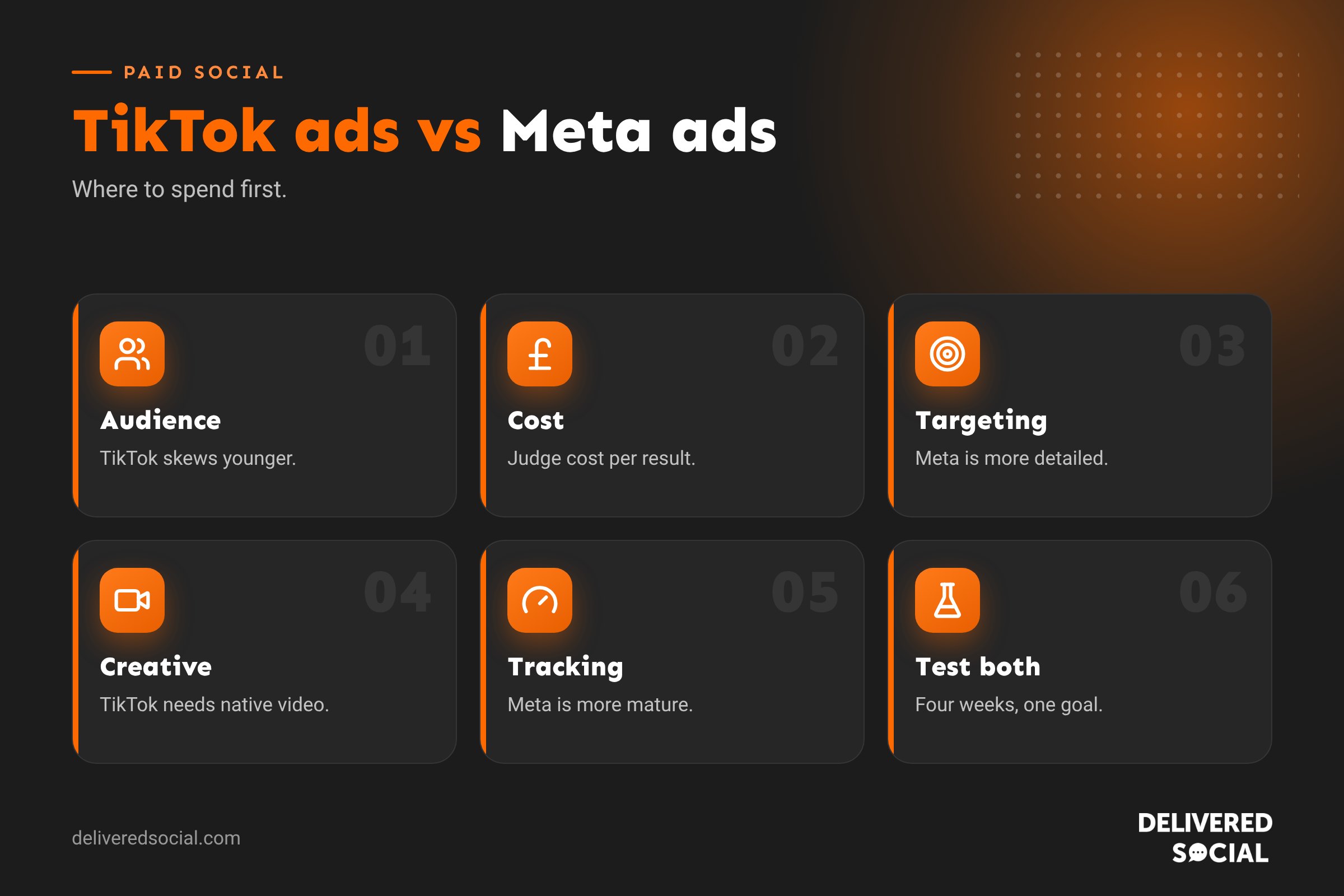
Meta is the safer starting point for most small businesses because of its mature targeting, broad audience across age groups and reliable conversion tracking. TikTok can deliver cheaper reach and stronger results for consumer brands with engaging video, particularly those targeting under 40s. Many businesses get the best results by testing both, with clear goals and budgets.
Audience
- Meta reaches a huge UK audience across Facebook, Instagram, Messenger and Threads, from teenagers to retirees. Facebook skews older, Instagram younger.
- TikTok has grown well beyond teenagers, with large numbers of UK users in their 20s, 30s and 40s, but it still skews younger than Facebook.
If your customers are mostly over 50, Meta is likely to work better. If they are Gen Z or millennials, TikTok deserves a serious test.
Cost
Costs vary by industry, season, audience and creative quality. In general, TikTok often has lower cost per thousand impressions, so you can reach more people for the same money. Meta often converts more reliably, so the cost per lead or sale can be better even if the reach is more expensive. See our guides to TikTok ads costs in the UK and Facebook ads costs in the UK for typical figures.
Judge platforms on cost per result, not cost per view.
TikTok ads vs Meta ads at a glance
| TikTok ads | Meta ads | |
|---|---|---|
| Audience age | Skews younger | All ages |
| Reach cost | Often lower | Often higher |
| Targeting | Good, more reliant on the algorithm | Very mature, detailed options |
| Ad formats | Vertical video, Spark Ads | Video, images, carousels, collections, lead forms |
| Creative demands | High: native, entertaining video | Flexible: images can still work |
| Lead generation | Instant forms available | Strong instant forms |
| Tracking | Pixel and Events API | Pixel and Conversions API, very mature |
| Best for | Consumer brands, ecommerce, awareness | Most businesses, leads, ecommerce, local |
Targeting
Meta offers detailed targeting by location, age, interests, behaviours, custom audiences from your customer list or website visitors, and lookalike audiences. Increasingly, its Advantage+ campaigns let the algorithm find buyers for you.
TikTok offers interest, behaviour, location and custom audiences too, but it leans heavily on its algorithm and your creative to find the right people. Broad targeting with great video often beats narrow targeting on TikTok.
Creative
This is the biggest difference. On TikTok, ads that look like ads get skipped. Successful TikTok ads look like native TikToks: filmed on a phone, a person talking to camera, a strong hook in the first two seconds, captions, trending sounds and a natural call to action. Spark Ads let you promote your own organic posts or creators’ posts, keeping the likes and comments.
Meta is more forgiving. Short video performs best, but good images, carousels and product catalogues still work, which helps if you do not have video resources.
Measurement and tracking
Meta’s Pixel and Conversions API are mature, and most website platforms, including WordPress and Shopify, connect easily. TikTok’s Pixel and Events API have improved a lot but can be less straightforward to set up. Whichever you choose, install tracking properly before spending, and check results in Google Analytics as well as in the ad platform.
Which businesses suit which platform
| Business type | Start with |
|---|---|
| Local trades and services | Meta |
| Fashion, beauty and lifestyle brands | TikTok and Meta |
| Restaurants, bars and attractions | Both, with strong video |
| B2B services | Meta or LinkedIn |
| Ecommerce with products that demo well | TikTok, then Meta |
| Recruitment of young staff | TikTok |
| Charities and events | Meta, testing TikTok |
How to test both properly
- Set one clear goal, such as leads, sales or bookings.
- Install tracking on both platforms and test it.
- Give each platform a fair budget for at least four weeks.
- Create native creative for each platform rather than reusing the same advert.
- Compare cost per result, quality of leads and actual sales.
- Move budget towards whichever performs better, and keep testing new creative.
Common mistakes
- Running polished TV style adverts on TikTok.
- Judging success on views or clicks rather than leads and sales.
- Testing with too little budget to learn anything.
- Not installing tracking before launching.
- Changing campaigns every day before the algorithm has learned.
- Forgetting the landing page: a slow, confusing page wastes good ads.
Organic first, paid second
Before spending on either platform, it helps to post organically for a few weeks. Organic posts show you which topics, hooks and formats your audience responds to, and the winners make excellent adverts. On TikTok, Spark Ads let you boost an organic post that is already performing, keeping its likes and comments as social proof. On Meta, you can promote existing posts from Ads Manager rather than using the simpler boost button, which gives you far more control over targeting and goals. Our guide to boosting Facebook posts explains the difference.
Budgets for a first test
There is no magic number, but a meaningful test usually needs enough budget for each platform to deliver dozens of conversions, not a handful. For a local service business, that might mean a few hundred pounds per platform over a month. For ecommerce, base it on your target cost per sale. If the budget is very tight, pick one platform, prove it works, then expand.
Ad formats compared
TikTok centres on full screen vertical video in the For You feed. Key formats include In Feed ads, Spark Ads that boost organic posts, TopView and branded effects for bigger budgets, and Shopping ads for TikTok Shop sellers. Almost everything is video.
Meta offers a wider choice: single image, video, carousel, collection and instant experience ads, across Facebook and Instagram feeds, Stories, Reels, Marketplace, Messenger and more. Lead ads with instant forms are a strong option for service businesses, and catalogue ads work well for ecommerce.
Policies and approval
Both platforms review ads before they run and have strict policies on topics such as health claims, finance, alcohol, weight loss and before and after images. TikTok can be stricter on some product categories, and both restrict targeting for housing, employment and credit. Read each platform’s policies before creating content, as a rejected ad can delay a campaign launch.
Our approach for clients
For most local and service businesses we start with Meta, because it delivers leads reliably and is easier to track. Once a campaign is profitable, we test TikTok with creative made specifically for the platform, often filmed on a phone by the business owner or team. For consumer brands with a younger audience and products that demo well, we often run both from the start.
Reporting and attribution
Each platform tends to credit itself generously for sales. Compare what TikTok and Meta report with Google Analytics and your own sales data, and look at total business results when you add or remove a platform. That gives a truer picture than relying on either dashboard alone.
Key takeaways
- Meta is the safer starting point for most small businesses.
- TikTok can deliver cheaper reach for brands with engaging, native video.
- Judge on cost per lead or sale, not cost per view.
- Creative matters even more on TikTok than on Meta.
- Test both properly with tracking and a clear goal.
Frequently asked questions
Are TikTok ads cheaper than Facebook ads?
Reach is often cheaper on TikTok, but cost per sale or lead depends on your business and creative.
Which is better for small businesses, TikTok or Meta ads?
Meta suits most small businesses first; TikTok suits consumer brands with strong video.
Can I use the same video on both?
You can, but adapting it to each platform’s style usually performs better.
Do TikTok ads work for B2B?
Sometimes for awareness and recruitment, but LinkedIn and Meta are usually stronger for B2B leads.
What are Spark Ads?
TikTok ads that promote existing organic posts, keeping their engagement.
How much should I spend to test?
Enough to get meaningful results over at least four weeks per platform.
Do I need a pixel?
Yes. Without tracking you cannot measure or optimise results properly.
Which platform has better targeting?
Meta has more detailed targeting; TikTok relies more on its algorithm.
Can I run lead forms on TikTok?
Yes, TikTok offers instant forms, like Meta.
Should I stop Meta ads to try TikTok?
No. Test TikTok alongside your proven campaigns.
Can I run TikTok ads without a TikTok account?
You can run ads through TikTok Ads Manager, but an active organic account helps a lot.
Which platform is better for ecommerce?
Both work. Meta has mature catalogue ads; TikTok suits products that demo well on video.
Want help with paid social?
We plan, create and manage Meta and TikTok ads for businesses across Surrey, Hampshire and the UK. Call us on 01483 608 303.
































