




Keep reading
Rather we just did it for you?
Let's get your business seen.
Social media, websites, SEO and ads from a team you can actually meet.
If you are planning a new website, you will probably hear the phrase “brochure website” early on. It is one of the most common types of website for small businesses, and for good reason: it is affordable, quick to build and does the job most service businesses need. But what exactly is a brochure website, how is it different from an ecommerce site or a web app, and is it the right choice for you? This guide explains what a brochure website is, what pages it usually includes, what it costs, how to make it bring in enquiries and when you might need something more.
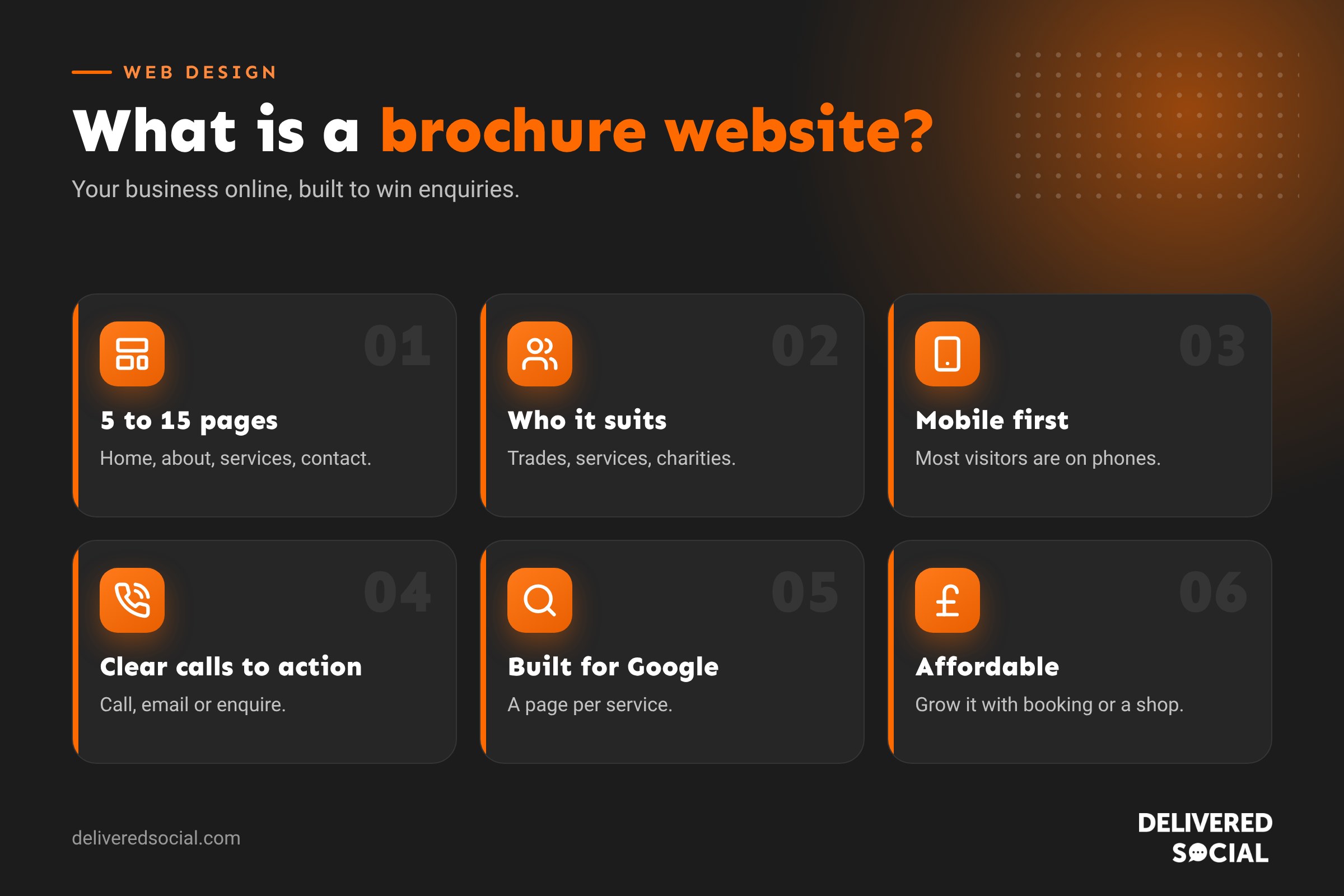
What is a brochure website?
A brochure website is a small, informational website that presents your business online, in the same way a printed brochure would. It tells visitors who you are, what you offer, why they should choose you and how to get in touch. It does not usually sell products directly, take bookings through complex systems or let users log in. Its main job is to build trust and turn visitors into phone calls, emails and enquiry forms.
Most brochure websites have between five and fifteen pages, although there is no fixed rule. The name comes from the early days of the web, when businesses essentially put their printed brochure online. Today, a good brochure website is far more than a digital leaflet: it is mobile friendly, fast, found on Google and designed to persuade.
Typical pages on a brochure website
- Home: a clear summary of what you do, who you help and where, with a strong call to action.
- About: your story, team, values and experience.
- Services: an overview page plus a separate page for each main service, which also helps with search.
- Portfolio or case studies: examples of your work and results.
- Testimonials or reviews: proof from happy customers.
- Blog or news: helpful articles that bring in search traffic.
- Contact: phone number, email, enquiry form, map and opening hours.
- Legal pages: privacy policy, cookie policy and terms.
Who is a brochure website for?
Brochure websites suit businesses where the sale happens through a conversation rather than an online checkout. Examples include:
- Trades such as builders, electricians, plumbers and roofers.
- Professional services such as accountants, solicitors, consultants and architects.
- Health and wellbeing businesses such as physios, dentists and personal trainers.
- Local services such as cleaners, gardeners and dog groomers.
- Charities and community organisations.
- B2B companies where buyers research before getting in touch.
Our guide to web design for small businesses explains what most small firms need from a site.
Brochure website vs ecommerce website
An ecommerce website lets customers browse products, add them to a basket and pay online. It needs product pages, stock management, payment processing, delivery options and more security, so it costs more to build and maintain. A brochure website focuses on information and enquiries. If you sell physical or digital products online, you probably need ecommerce. If you sell services, a brochure website is often enough, and you can add simple features such as online booking or payment links later. Our guide to the benefits of ecommerce covers the other side.
Brochure website vs web application
Web applications, such as customer portals, booking platforms and membership systems, let users log in and do things. They are custom built and much more expensive. Most small businesses do not need one, and those that do often start with a brochure website and add specific tools as they grow.
Features a modern brochure website should have
- Mobile friendly design: most visitors arrive on phones, so every page must work perfectly on small screens.
- Fast loading: slow sites lose visitors and rank lower in Google.
- Clear calls to action: call, email, book a consultation or request a quote, visible on every page.
- Click to call: phone numbers that dial when tapped on mobile.
- Enquiry forms: short, simple forms that send straight to your inbox.
- Trust signals: reviews, accreditations, awards, logos of clients and photos of real people.
- Easy editing: a content management system such as WordPress, so you can update text and photos yourself.
- Security: an SSL certificate (the padlock), regular updates and backups.
- Analytics: Google Analytics and Search Console to track visitors and enquiries.
- Accessibility: readable fonts, good contrast and alt text for images, so everyone can use it.
How much does a brochure website cost in the UK?
Prices vary widely depending on who builds it and what is included. As a rough guide:
- DIY website builders: a monthly subscription, but you do all the work and design yourself.
- Freelancers: often from several hundred to a couple of thousand pounds for a small site.
- Agencies: usually from around a thousand pounds to several thousand, depending on the number of pages, design work, copywriting and SEO included.
Ongoing costs include your domain name, hosting, security updates, backups and support. Some agencies offer monthly plans that combine the build and ongoing care. When comparing quotes, check what is included: copywriting, photography, SEO set up, training and aftercare make a big difference to results.
How long does it take to build?
A straightforward brochure website typically takes between two and eight weeks, depending on the number of pages and how quickly content and feedback are ready. The biggest delays are usually waiting for text and photos, so gather these early.
Content that turns visitors into enquiries
Design gets attention, but words win the work. Good brochure website content:
- Speaks to the customer’s problem, not just your history.
- Explains clearly what you do, for whom and where.
- Shows proof with reviews, case studies and numbers.
- Answers common questions about price, process and timescales.
- Uses real photos of your team, premises and work rather than stock images.
- Ends every page with a clear next step.
SEO for brochure websites
A brochure website only works if people find it. Basic SEO steps include:
- A separate page for each main service and, where relevant, each location you serve.
- Page titles and meta descriptions that include what you do and where.
- Helpful, original content on every page.
- Fast loading and mobile friendly design.
- A Google Business Profile linked to your website, with consistent name, address and phone number.
- Reviews from happy customers.
- A blog answering the questions your customers search for.
Our guide to how Google ranks websites explains the basics.
Should your brochure website have a blog?
A blog is one of the best ways to grow a brochure website’s traffic over time. Each helpful article targets a question your customers ask, brings visitors who would never search for your company name and gives you something to share on social media and in emails. Even one good article a month adds up. If you do not have time to write, consider outsourcing, but keep the content genuinely useful and specific to your industry.
Common brochure website mistakes
- Too much about the business and not enough about the customer.
- No clear call to action or hidden contact details.
- Stock photos instead of real ones.
- One page listing every service, instead of a page for each.
- Never updating the site after launch.
- Slow, heavy pages that are hard to use on phones.
- No analytics, so you cannot tell what works.
When you might need more than a brochure website
As your business grows, you might add online booking, payments, a client portal, a shop or a members area. Many of these can be added to a WordPress brochure website with plugins or integrations, so you do not always need to start again. If online sales become a major part of your business, a dedicated ecommerce platform may be the better long term choice.
Keeping your brochure website working
A website is not a one off job. Keep plugins and themes updated, check that forms still send, refresh testimonials and photos, and add new case studies as you complete projects. Review your analytics every month to see which pages bring visitors and enquiries. Small, regular improvements keep the site fresh for both visitors and Google, and stop it slowly drifting out of date.
Key takeaways
- A brochure website is a small, informational site that presents your business and generates enquiries.
- It suits service businesses, trades, professionals, charities and local firms.
- Typical pages are home, about, services, case studies, reviews, blog and contact.
- Mobile friendly design, fast loading, clear calls to action and SEO are essential.
- Most can grow later with booking, payments or a shop.
Frequently asked questions
What is a brochure website?
A small informational website that tells visitors who you are, what you offer and how to contact you.
How many pages does a brochure website have?
Usually between five and fifteen, though there is no strict limit.
How much does a brochure website cost?
From a few hundred pounds with a freelancer to several thousand with an agency, plus hosting and maintenance.
Can I sell products on a brochure website?
A few, with simple payment links, but a full shop needs ecommerce.
Can I update a brochure website myself?
Yes, if it is built on a content management system such as WordPress.
Is a brochure website good for SEO?
Yes, if it has separate service pages, good content and a blog.
Need a brochure website that wins work?
We design and build websites for businesses across Surrey, Hampshire and the UK. Find out more about our small business web design. Call us on 01483 608 303.
































