



Keep reading
Rather we just did it for you?
Let's get your business seen.
Social media, websites, SEO and ads from a team you can actually meet.
Sending a proposal shouldn’t feel like the hardest part of winning a client. But for most marketing agencies, it is, copy-pasting old decks, chasing e-signatures across email threads, watching deals stall because the follow-up process is scattered. The best proposal software for marketing agencies in 2026 closes that gap, turning a slow manual step into a repeatable, trackable system.
Why Marketing Agencies Need Proposal Software That Actually Works
Generic proposal tools aren’t built around how agencies sell. Retainer structures, mixed billing models, and scope-of-work nuance don’t fit neatly into a one-size template. What agencies actually need is a tool where proposals connect directly to projects, budgets, and invoicing, not a pretty PDF sitting in isolation. That tight loop between selling and delivering is what separates purpose-built agency software from the broader market.
Beyond the proposal itself, agencies need version control, e-signature, and visibility into which prospects have opened the document and when. Speed matters. A deal that sits unsigned for a week is a deal at risk.
1. Verbial
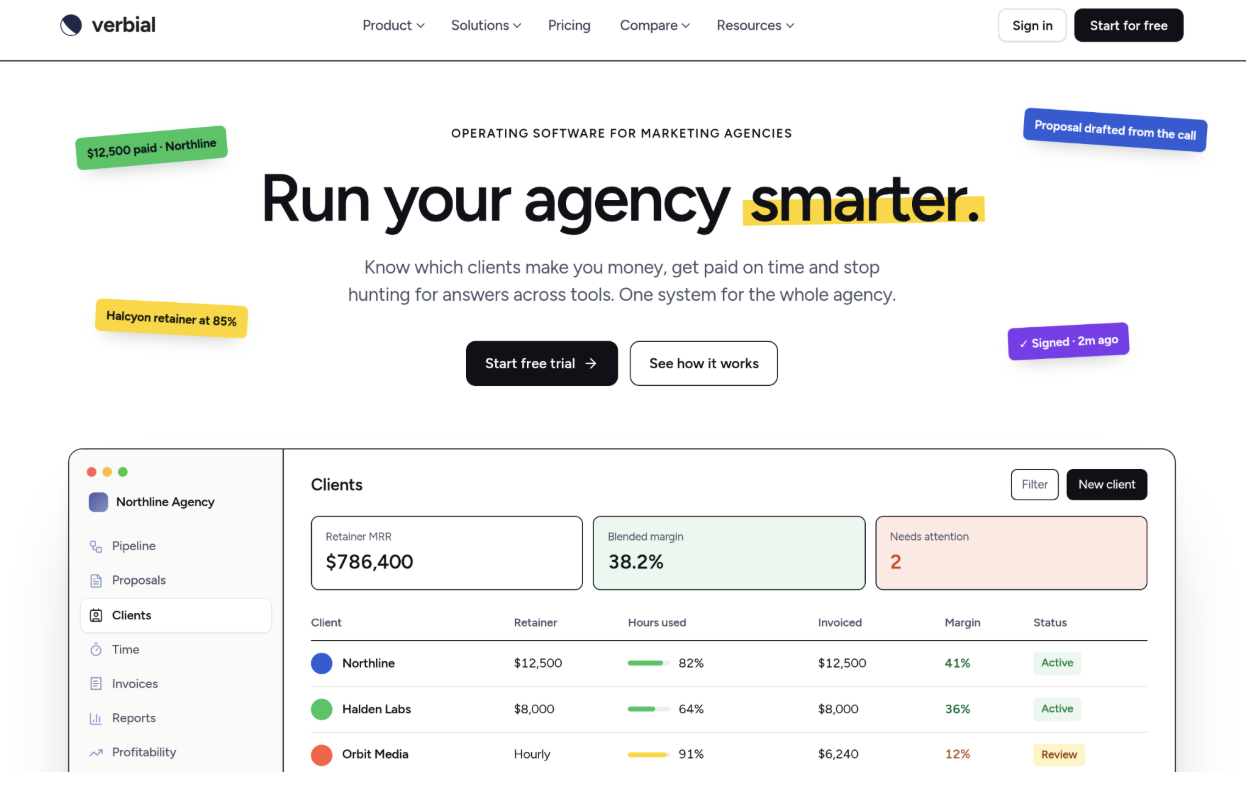
Verbial is agency management software built around the full agency revenue cycle, from first contact through final invoice. Its proposal module handles the structural headaches agencies deal with daily: mixed retainer and hourly arrangements, team time allocations embedded in the scope, and a first invoice raised the moment the client signs. The proposal builder at https://verbial.io/product/proposals builds each proposal from the agency’s own packages, scope tables, and retainer terms, so the proposal, contract, and invoice always match.
The platform consolidates CRM, proposal creation, project delivery, time tracking, and invoicing in a single workspace. AI-assisted proposal drafting pulls from discovery call notes to speed up the first draft; e-signature (currently in beta) is built in, so a signed proposal automatically creates the client, project, and first invoice. Profitability by client and team is visible from the start, not reconstructed at month-end.
Verbial also includes white-label client reporting and retainer pacing tools, which matter for agencies managing recurring revenue. Discipline-specific setups cover PR, SEO, paid media, content, web development, and full-service operations. Free resources – utilization calculators, retainer pricing calculators, an agency valuation tool – are available to trial users before any commitment. A 14-day free trial of the Starter plan is available with no credit card required, and proposals are part of the Growth plan (coming soon) and Enterprise.
2. Productive
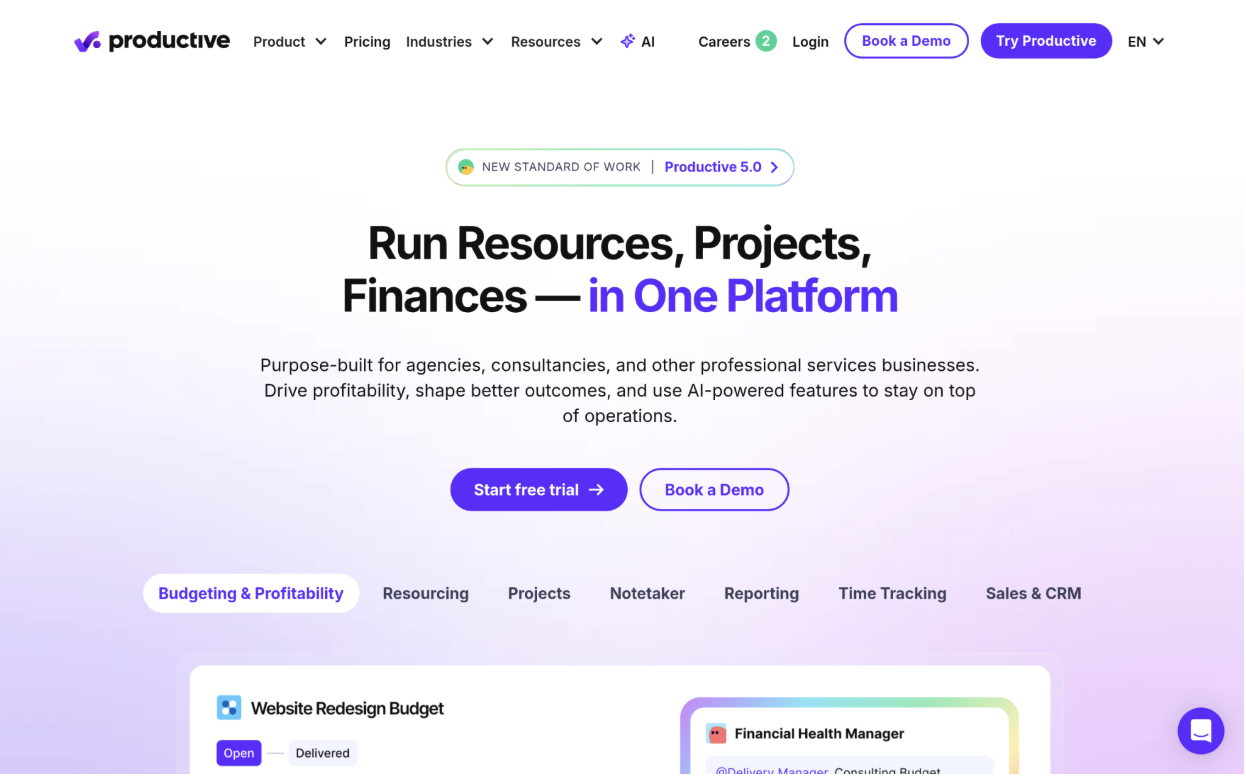
Productive is a professional services automation platform founded in 2014, built initially by the founders of a 350-person design and development firm. That origin shows in the product; it reflects how large, multi-discipline service businesses actually operate. The company is headquartered in Claymont, Delaware, and employs around 130 people as of 2026.
Budgeting, profitability tracking, invoicing, and expense management are all native; no third-party connections are required for the main workflow. The platform brings together project management, resource planning, time tracking, financial forecasting, and CRM in one place. A sales CRM with an AI notetaker is included. Scenario planning and revenue recognition tools make Productive a strong fit for agencies that need serious financial visibility.
Productive serves roughly 200 customers and focuses on agencies, consultancies, IT services, and architecture and engineering firms. It’s self-funded and profitable, which gives it a stable, long-term product plan. Smaller agencies may find the platform’s depth more than they need early on.
3. Teamwork
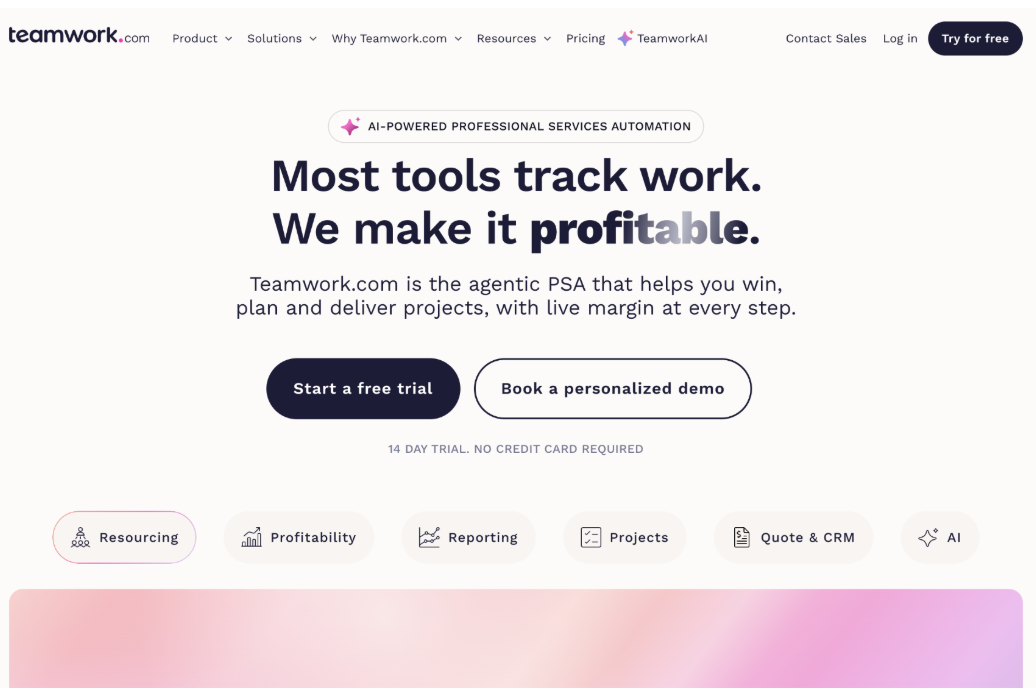
Teamwork was founded in Cork, Ireland in 2007 and has grown to over 350 employees across five countries. The platform serves more than 20,000 customers, including organizations like Disney and Spotify, a scale that signals enterprise readiness but also shapes where the product’s priorities sit.
Its PSA offering covers project management, resource planning, profitability tracking, time tracking, and client collaboration tools. Teamwork Desk adds helpdesk functionality, and native chat and CRM tools round out the suite. The AI positioning centers on profitability, identifying where hours are running over and where margin is thin.
Teamwork is a reasonable fit for mid-size agencies that want strong task management paired with financial oversight. Teams that live in Gantt charts and task boards will feel at home quickly. But agencies with more complex billing structures may need to work around some of the financial tooling’s limitations compared to platforms built specifically around service firm economics.
4. Kantata
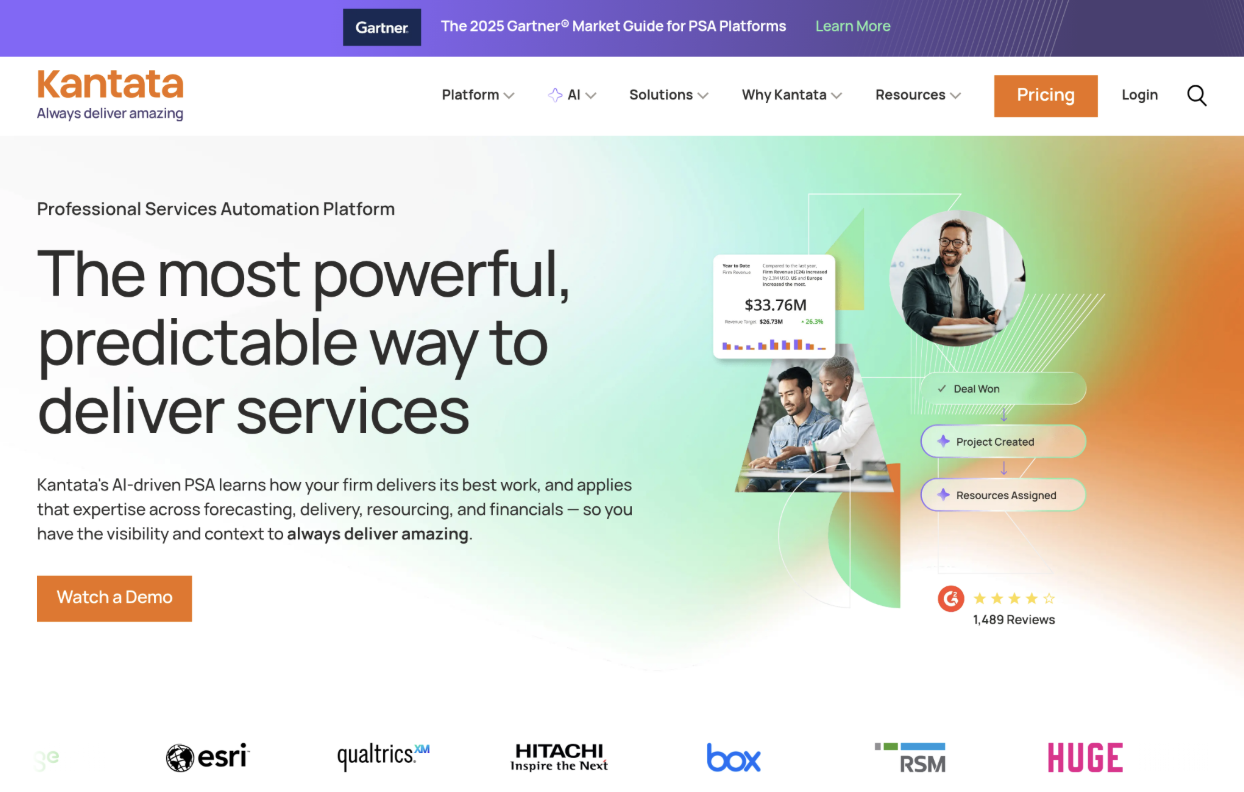
Kantata was formed in 2021 through the merger of Mavenlink and Kimble Applications, two established names in professional services automation. The company is headquartered in Irvine, California and London, with roughly 521 employees worldwide; it serves more than 2,500 professional services organizations across 100-plus countries.
The platform comes in two architectures: OX, a standalone platform, and SX, which runs natively on Salesforce. Organizations already deep in the Salesforce ecosystem will find SX a natural fit. Both versions offer resource planning, project management, financial management, business intelligence, and collaboration tools.
Kantata’s AI Expertise Engine learns from past project data to improve resource matching, delivery forecasting, and margin predictions over time. Clients like Deloitte, Sage, and Hitachi are on the roster. And that customer profile matters: Kantata is oriented toward large professional services firms rather than independent or boutique agencies, so smaller teams may find the platform over-engineered for their needs.
5. Scoro
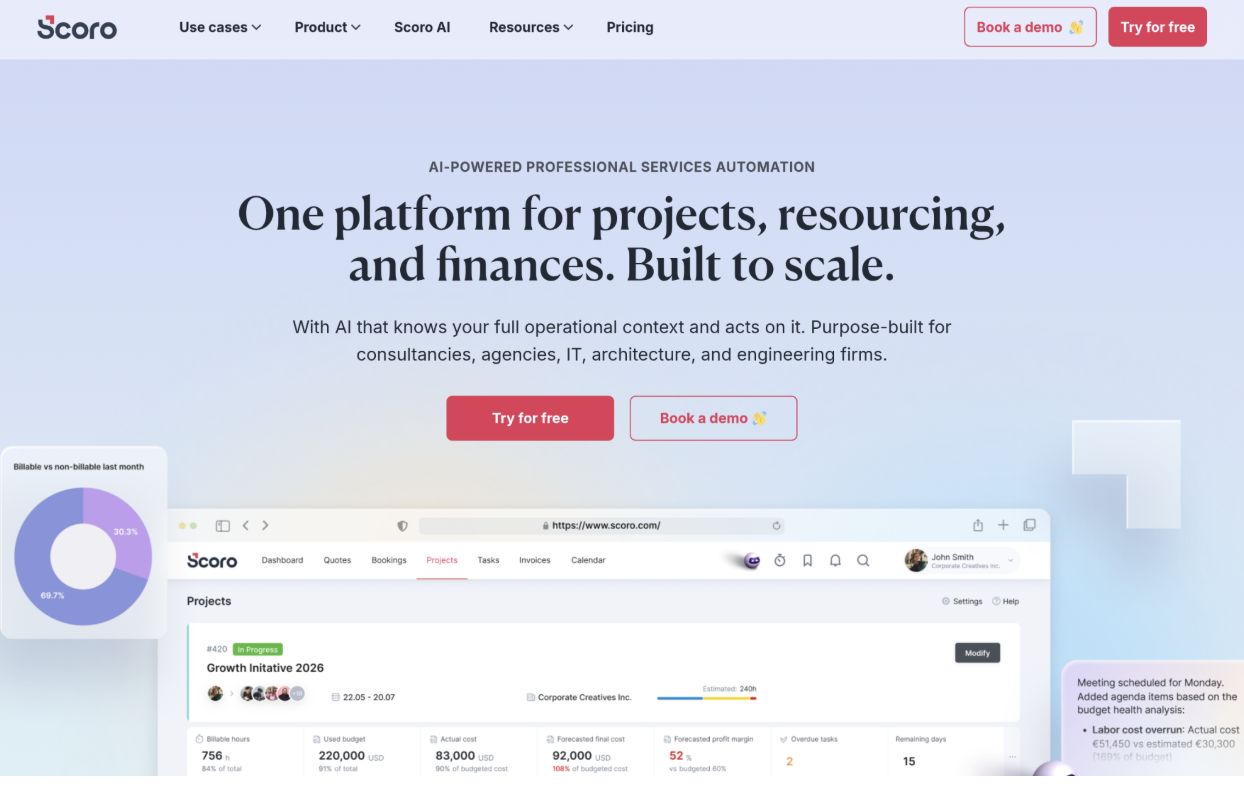
Scoro was founded in 2013 in Tallinn, Estonia, and is now headquartered in London with offices in New York, Riga, and Vilnius. The platform has 151 employees and serves thousands of businesses across more than 60 countries.
The modular approach is Scoro’s defining characteristic. Agencies pick from eight applications – project management, resource planning, time tracking, billing, financial reporting, CRM pipeline management, estimating and budgeting, and expense management – and pay only for what they use. Honestly, that structure works well for agencies that want to start lean and add capability as they grow. Case studies from DGA Group and Global Production Partners appear on the site.
Scoro combines sales, delivery, and financial data into a single view, giving leadership real-time project and performance visibility. The platform’s interlinked data architecture means a change in one area – a revised budget, a time entry – flows through to reporting automatically. Teams that’ve outgrown simple tools but aren’t ready for enterprise PSA costs tend to find Scoro’s pricing and flexibility a reasonable middle ground.
What to Look for in Proposal Software for Agencies
Choosing among these platforms comes down to a few practical questions. Does the tool connect proposals directly to project delivery and billing, or does it create another handoff? Can it handle mixed billing models – retainer, hourly, fixed-fee – within the same engagement? And does it give leadership margin visibility before a project starts, not just after?
E-signature, version control, and open tracking are table stakes at this point. The trick is what happens after the client signs. Software that treats the proposal as an isolated document forces the account team to re-enter scope, budget, and team allocation into a separate system, duplication that creates errors and costs real time. Agencies running more than a handful of active clients can’t afford it.
So the connection with time tracking and invoicing matters more than template aesthetics. A proposal that automatically generates a billing schedule and feeds into utilization reporting is worth more than one that just looks polished.
Bottom Line
The right choice depends on agency size and workflow needs. Agencies that want proposal-to-delivery continuity in a tighter, more focused package will find it among the tools built specifically around service firm economics. Teams that’ve grown past simple project management and need depth in resource planning and financial forecasting should look at platforms with stronger PSA capabilities. Large professional services organizations with enterprise-grade requirements have options built to match that scale. Matching the platform to your actual workflow – not just grabbing the most feature-rich option available – is what makes the best proposal software for marketing agencies worth the investment.































