

Keep reading
Rather we just did it for you?
Let's get your business seen.
Social media, websites, SEO and ads from a team you can actually meet.
Few things look more impressive on a profile than a big network, which is why so many people end up searching for a way to buy linkedin connections. A number like 5,000 or 500+ looks like proof that you are well known. The trouble is that LinkedIn is a place where people do business with people they trust, and a crowd of strangers who will never reply does not build trust. It tends to do the opposite.
In this guide we will explain what you are actually buying, what LinkedIn says about fake and automated activity, and the real risks to your account and your reputation. Then we will walk through how to grow a relevant network the honest way, how to write connection requests people say yes to, and a simple weekly routine you can keep up in about 20 minutes a day.
Everything here is general information from public sources, written on the date shown. LinkedIn does not allow automated tools to read some of its help pages, so where we could not confirm a detail from LinkedIn directly, we say so. Please check LinkedIn’s current rules before acting.
What you actually get when you buy connections
Sellers of connections tend to use one of three methods. We have not tested any of them and we are not naming services, but the pattern is consistent across this market.
- Fake or empty profiles. Accounts with stock photos, thin work histories and no activity. They accept your request, then do nothing.
- Hijacked or dormant real accounts. Genuine people whose accounts have been taken over or abandoned, which raises serious questions about how the account was obtained.
- Automated “growth” tools. Software that sends requests on your behalf, from your own account, in bulk. That is a different problem: you are the one breaking the rules.
Whichever route you pick when you buy linkedin connections, you end up with a number rather than a network. None of those profiles will read your posts, answer a message, refer you to a client or hire you. If you have read our guide on how to spot fake followers, you already know what that looks like from the outside, and anyone who checks your connections can do the same.
Why you should not buy linkedin connections
There are three clear reasons, and the first is the one that matters most to anyone using LinkedIn for work.
It breaks LinkedIn’s rules
LinkedIn’s own transparency reporting says the platform prohibits fake profiles and requires members to be real people who represent themselves accurately. It also says spam and scams are not permitted, and describes repetitive messages or invitations as part of the most common type of inappropriate content it acts on. You can read this on the LinkedIn community report. That report also says that the large majority of fake accounts are stopped by automated defences before anyone reports them.
We tried to read LinkedIn’s User Agreement and Professional Community Policies directly, but the pages could not be fetched by our tools. From general knowledge, we understand that they restrict fake identities, misleading activity and the use of bots or other automated methods to add connections or send messages. We could not confirm the exact wording for this article, so please read those pages yourself on LinkedIn before relying on that summary.
It rarely leads to sales
Think about what a connection is for. It lets you appear in someone’s feed, send them a message and be seen as a credible professional. A connection who does not exist, or does not care, delivers none of that. Worse, your posts are shown to a first group of your network, and if that group ignores them, the platform has little reason to show them to anyone else. We cannot see LinkedIn’s algorithm, so we will not claim to know exactly how it ranks content. But it is widely understood across the industry that early engagement matters, and a network full of silent accounts gives you none.
It damages how you look
Buyers tend to be wary of this. A person with 4,000 connections and posts that get two likes looks odd to a buyer, a recruiter or a prospect. Many people check a profile before replying to a message. A tidy profile with 600 relevant, active connections tells a better story than an inflated one.
The real risks to your account
We would put the risks in this order, from most likely to least likely but most serious.
- Wasted money. You pay and receive little or nothing, with no one to complain to.
- Weak reach. Your content lands in front of people who do not engage.
- Warnings or restrictions. If you use automation to send large volumes of requests, or if you are seen to be using fake accounts, LinkedIn can limit what your account can do. We could not confirm the exact thresholds or penalties, because LinkedIn does not publish them in full.
- Losing your account. In serious cases, LinkedIn can close an account. If your profile is where clients find you, that is a heavy loss.
- Legal and advertising risk. In the United States, the Federal Trade Commission’s rule on fake reviews and testimonials also covers buying or selling fake social media indicators, such as bot-generated followers, to misrepresent influence for commercial purposes. It is a US rule, so we cannot say how it applies to a UK business, and this is not legal advice. It does show regulators are paying attention. See the FTC announcement.
If you are tempted by automation rather than purchased profiles, our article on Instagram bots and what is safe to automate explains the same logic for another platform: tools that act on your behalf are where most accounts get into trouble. And if you are weighing up a paid growth service of any kind, our follower growth service legit checklist applies just as well on LinkedIn.
How to grow a relevant network the honest way
A good network is not the biggest one. It is the one full of people who might actually buy from you, refer you, work with you or teach you something. Here is how to build it.
Start with the people you already know
Current and past clients, colleagues, suppliers, local business owners, people you have met at events, and the people on your email list are all natural connections. Most people have a few hundred of these before they have written a single post.
Connect with a reason
Decide who your ideal contact is: a job title, an industry and a place. For a Surrey accountant, that might be owner-managed businesses in Guildford. Search for those people, read what they post and engage before you send a request.
Be useful in public
Comment thoughtfully on other people’s posts. A short, specific comment (“Great point about cash flow, we see this with a lot of clients”) gets you noticed far more than a generic one. Post once or twice a week about problems your customers have. People tend to send you requests when they like what they read.
Join conversations that already exist
Local business groups, industry events and webinars all give you a natural reason to say hello. After an event, a quick note to the people you met is one of the warmest ways to connect.
Connection request etiquette
When people talk about linkedin connection requests, they often mean the blank “Connect” button. It is quick, but a short note usually does better, because it answers the question every recipient has: why are you contacting me?
- Be specific. Mention where you met, a post they wrote, or something you have in common.
- Keep it short. Two or three sentences is enough. We could not confirm LinkedIn’s current character limit for notes, and it can vary by account type, so write something brief and check what your own box allows.
- Do not pitch. A request is not the place for a sales message. Save that for after they accept, and only if it is relevant.
- Make it easy to say no. No pressure and no guilt. Some people simply never accept requests from people they do not know.
- Do not follow up too hard. If someone ignores your request, leave it alone.
Here is an example you can adapt: “Hi Priya, I enjoyed your post on hiring your first employee. I work with owner-managed businesses in Surrey and would be glad to follow your posts. No pitch, just good to connect.”
What about weekly limits?
LinkedIn does limit how many invitations you can send, and it also limits how many unanswered invitations you can have waiting. We could not confirm the current numbers from LinkedIn’s own help pages, and third-party sites quote different figures, so we are not going to give you one. As a safe working rule, send a small number of well-chosen requests a day, spread out through the week, rather than a burst. If LinkedIn tells you that you have reached a limit, stop and wait, and do not look for ways around it.
Profile tips that make people accept
People judge your profile in seconds before they click “Accept”. These changes make the biggest difference.
- A clear photo. A friendly, well-lit headshot where you are easy to recognise.
- A headline that says who you help. “Helping Surrey tradespeople get more local enquiries” beats a job title alone.
- A short About section. Write in plain language about who you help, how, and how to get in touch.
- Featured content. Pin a case study, guide or video that shows your work.
- Recent activity. A profile with some recent posts and comments looks alive.
- Consistent details. Make sure your job, location and company page are up to date.
A safe weekly outreach routine
This routine takes around 20 minutes a day and keeps you inside the spirit of LinkedIn’s rules, because every action is done by you, as a real person, with a real reason.
- Monday: choose your targets. List ten people you would like to know this week, such as new contacts from events or people who engaged with your posts.
- Tuesday: warm them up. Leave a thoughtful comment on a post by three or four of them.
- Wednesday: send requests. Send a few personalised connection requests, each with a short note.
- Thursday: say thank you. Message the people who accepted. Thank them and ask a simple question about their work. No pitch.
- Friday: post and review. Share one useful post, then look at who viewed your profile and who engaged.
Once a month, tidy up. Withdraw old unanswered requests, and note which messages led to real conversations. Keep a simple list of the conversations you have had, so you can follow up in a friendly, helpful way later.
Frequently asked questions
Can I really buy LinkedIn connections?
You can find sellers offering to let you buy linkedin connections, but we do not recommend it. What you receive is usually fake or inactive accounts, and doing so goes against the spirit of what LinkedIn says it wants on the platform.
Will LinkedIn ban me for fake connections?
We cannot say for certain, because LinkedIn does not publish exactly how it enforces its rules. Restrictions and account closure are possible for activity it considers fake or automated, so the risk is real.
How many LinkedIn connection requests can I send a week?
LinkedIn applies limits, but we could not confirm current figures from its official pages. Stick to a modest, steady number and stop if LinkedIn warns you.
Is it better to add a note to a request?
For people who do not know you, usually yes. A short, specific note explains why you are getting in touch. Check what your own account allows.
Are LinkedIn automation tools safe?
We would be cautious. Tools that send requests or messages for you are the kind of automated activity LinkedIn is understood to restrict. We could not confirm its exact current wording, so read its policies first.
Get the free LinkedIn Connection Request Templates
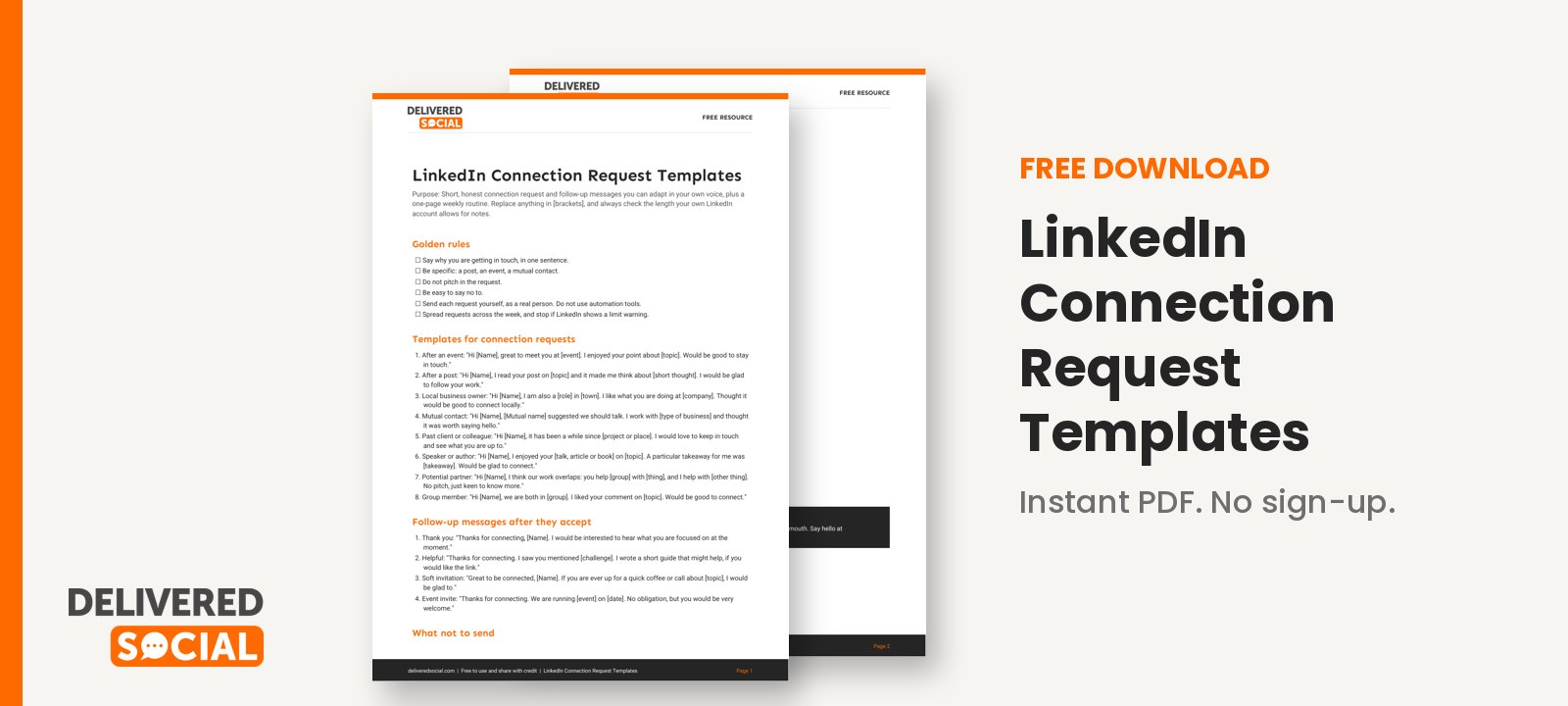
To save you writing from scratch, we have put together a set of ready-to-use message formats for events, clients, referrals and cold introductions. Download the free LinkedIn Connection Request Templates and adapt them in your own voice.
To sum up: you do not need to buy linkedin connections to look credible. A smaller network of real people who know why you contacted them will beat a bigger one every time. If you would like help with your LinkedIn strategy or your wider marketing, the team at Delivered Social would be happy to help, so please contact us.