



Keep reading
Rather we just did it for you?
Let's get your business seen.
Social media, websites, SEO and ads from a team you can actually meet.
High traffic and lengthy session durations often mask a deeper revenue problem. You can spend thousands of dollars driving perfectly targeted clicks to your website, with many mid-sized businesses pumping around $20,000 a month into digital marketing for this purpose, but clean analytics dashboards do not pay the bills.
The real friction lies between clicking a button and entering credit card details, the ultimate goal of any good digital campaign. When a consumer leaves a high-intent page, basic clickstream trackers only tell you where they dropped off, leaving the actual psychological blocker completely anonymous.
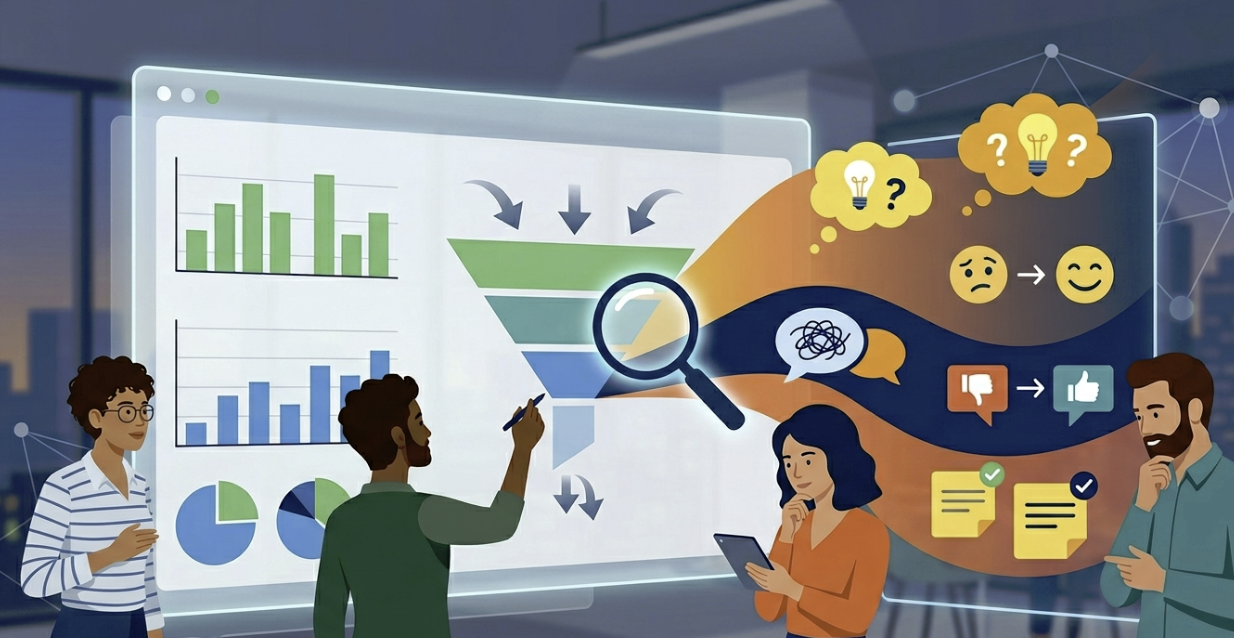
Image Source: Google Gemini
Why The ‘What’ Leaves You Stranded
Relying entirely on numbers like bounce rates or heatmaps forces your marketing team to make uneducated guesses. If forty percent of your web traffic abandons your checkout process at the payment step, the data shows you exactly what happened, but it cannot explain why.
Fixing a drop-off point by changing button colors or shortening copy is just guesswork. Real conversion growth happens when you stop obsessing over quantitative metrics and start looking into user intent through a qualitative insights platform that uncovers real human objections, of which there are many examples available, enhanced with AI for added effectiveness. Reviewing your options and seeing what’s possible with modern software will ease your worries.
Taking action is also necessary. There are millions of abandoned digital shopping carts every day, with average abandonment rates exceeding 75%. To prevent your business from joining that statistic, you must understand the explicit friction points your buyers experience.
- The exact hidden objection stopping the final form submission
- The confusing pricing tier language that causes analysis paralysis
- The missing trust markers needed to close enterprise deals
Moving Beyond Best Practices
McKinsey research shows that 70% of changes based on industry best practices fail to deliver a statistically significant revenue lift. Copying what a competitor does assumes that their audience shares the same motivations and fears as yours.
True conversion rate optimization is an exercise in consumer psychology, not layout design. When you uncover the underlying motivations of your web traffic, you can engineer an experience that handles objections before they turn into a bounced session. When integrated as part of a wider digital marketing strategy, the results should impress.
Unlocking Human Context At Scale
Legacy optimization frameworks require teams to spend months manually sorting through individual user session recordings. Today, modern marketing leaders leverage artificial intelligence to instantly analyze thousands of open-ended customer responses.
This deep thematic analysis allows brands to build behavioral hypotheses backed by authentic customer statements rather than internal corporate assumptions. Closing the gap between visitor engagement and revenue requires hearing the voice behind the click.
If you’re still in need of more guidance and insights on the modern digital marketing arena, don’t go anywhere. Exploring our other posts is the best way to expand your knowledge and see how the tips and tricks you’ve heard about already can actually be applied to real-world operations.































