




Keep reading
Rather we just did it for you?
Let's get your business seen.
Social media, websites, SEO and ads from a team you can actually meet.
More than 13,000 trade shows take place each year, and outdoor events are increasingly common in commercial contexts, bringing with them the same need for seamless digital coordination to remain profitable as their indoor equivalents. When you are operating a mobile retail stall or a festival activation, the distance between you and a wall socket can feel like an ocean. Staying relevant online while staying functional on the ground is the ultimate balancing act for modern event directors.
Digital fatigue is real, but for a remote business, physical power fatigue is the silent killer of growth. You cannot post a viral reel if your laptop is dead or your camera batteries are charging in a locked van three miles away.
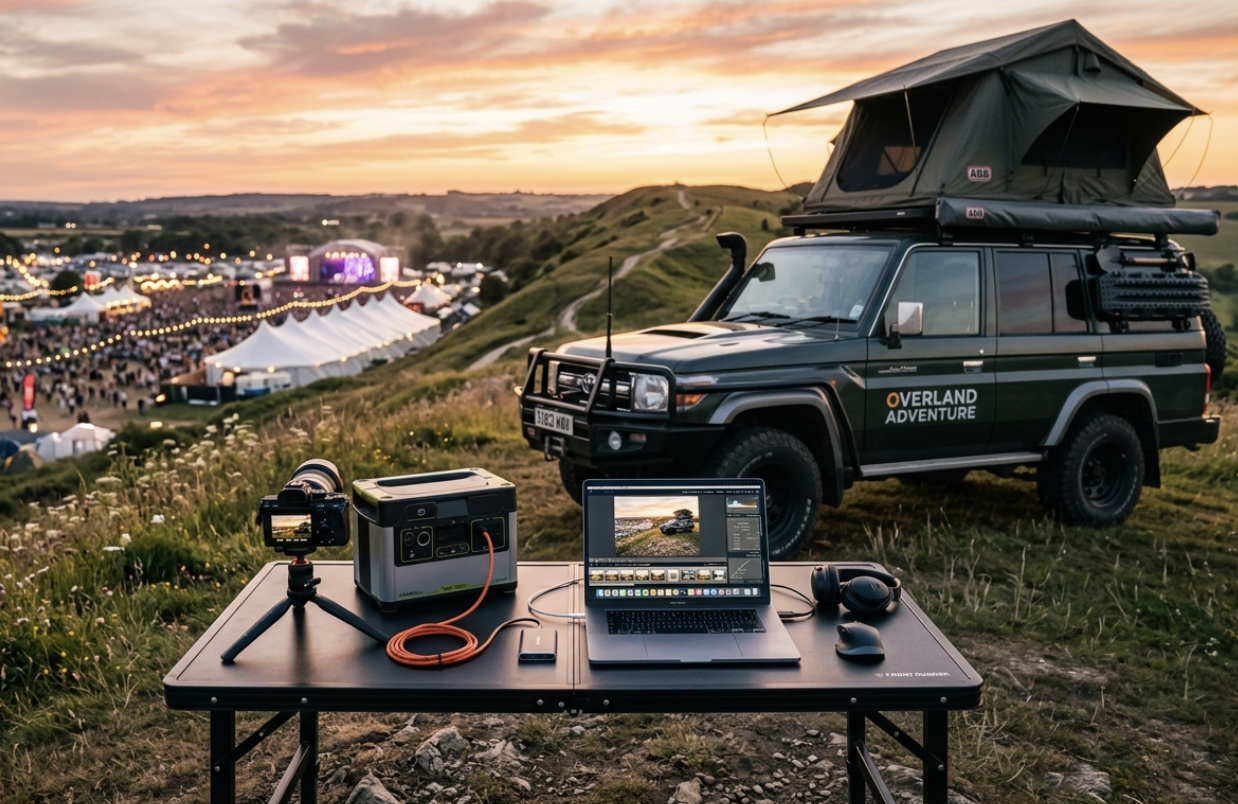
Image Source: Google Gemini
Digital Automation and Low Bandwidth Strategies
Running a business from the field means you cannot afford to be tethered to a live feed. Smart operators rely on time-saving tactics like batching content and using tools like Agorapulse to handle the heavy lifting while they are interacting with customers. Such an approach ensures your brand remains active even when cellular signals are dropping or you are busy managing a queue.
Efficiency is the primary goal for anyone working under the open sky. You need a setup that allows for quick communication without draining your internal battery or your data plan.
- Use text-heavy platforms like Threads for quick updates when 5G is spotty
- Set up automated email responders to manage expectations regarding your response times
- Pre-produce high-resolution video content so you only need to hit publish
Marketing while off-grid is a logistical hurdle that requires specialized equipment to overcome. For businesses that rely on their vehicles as a mobile office, installing smart DC DC charging solutions ensures that your auxiliary batteries stay topped up while you travel between sites. This keeps your tablets and payment terminals ready for the next rush of customers without risking a flat starter battery.
Maintaining Hardware Resilience
The environment is often the biggest enemy of a successful marketing campaign. Dust, heat, and unpredictable rain can wreck a standard laptop in minutes, making ruggedized gear a necessity rather than a luxury. Modern portable power stations have evolved to provide 10 minutes of uninterruptible power supply (UPS) capability, protecting sensitive electronics from sudden surges common in temporary setups.
Reliable energy allows you to run high-wattage displays and digital signage that grab attention from across a crowded field. Since solar installations surged 64% last year, more vendors are following suit and integrating foldable panels into their booths to harvest free energy throughout the day. This reduces the reliance on loud generators that can ruin the atmosphere of a boutique event or a quiet outdoor market.
A mobile business is only as strong as its weakest link in the supply chain. If your power fails, your marketing fails, and eventually your sales follow that same downward trajectory.
Mastering The Remote Marketing Workflow
Success in the outdoor industry requires a mindset shift from reactive to proactive management. By the time you reach the event site, your social media calendar should already be locked and loaded for the duration of the stay. This frees you up to capture the raw, authentic moments that your audience craves without the stress of formatting posts on the fly.
Maintaining a presence while off the grid is no longer a matter of luck but a result of choosing the right hardware and software. When your energy needs are met by a robust vehicle system, the “off-grid” label becomes a competitive advantage rather than a limitation. You can find more tips on optimizing your marketing operations, whatever form they take, by checking out our previous posts.































