

Keep reading
Rather we just did it for you?
Let's get your business seen.
Social media, websites, SEO and ads from a team you can actually meet.
Winning a new guest costs time and money: ads, offers, social posts, a great first visit. Getting them back for a second, third and tenth visit is where a restaurant, café or pub actually makes its money. A good loyalty scheme gives regulars a reason to choose you again instead of the place next door.
I look after marketing for hospitality businesses across Surrey and Hampshire, and this guide is written for independents, not just the big chains. It covers the main types of restaurant loyalty scheme, what the big names do, what a scheme really costs you, the UK data rules, and how to set one up in a week.
Why loyalty schemes work for restaurants
- They give people a reason to come back. When two places are equally good, the one where you’re two stamps from a free lunch wins.
- They build a list you own. Every sign-up is a name, an email or a phone number you can contact without paying for ads.
- They show you who your regulars are. You learn how often people visit, what they order and when they drift away.
- They fill quiet times. Double stamps on a Tuesday or a members-only midweek offer moves visits to when you need them.
- They’re better than blanket discounts. You reward the people already spending with you, rather than giving money off to everyone.
A loyalty scheme won’t fix a poor experience, though. People only join and stay in schemes run by places they already like. Get the food, service and welcome right first.
The five main types of restaurant loyalty scheme
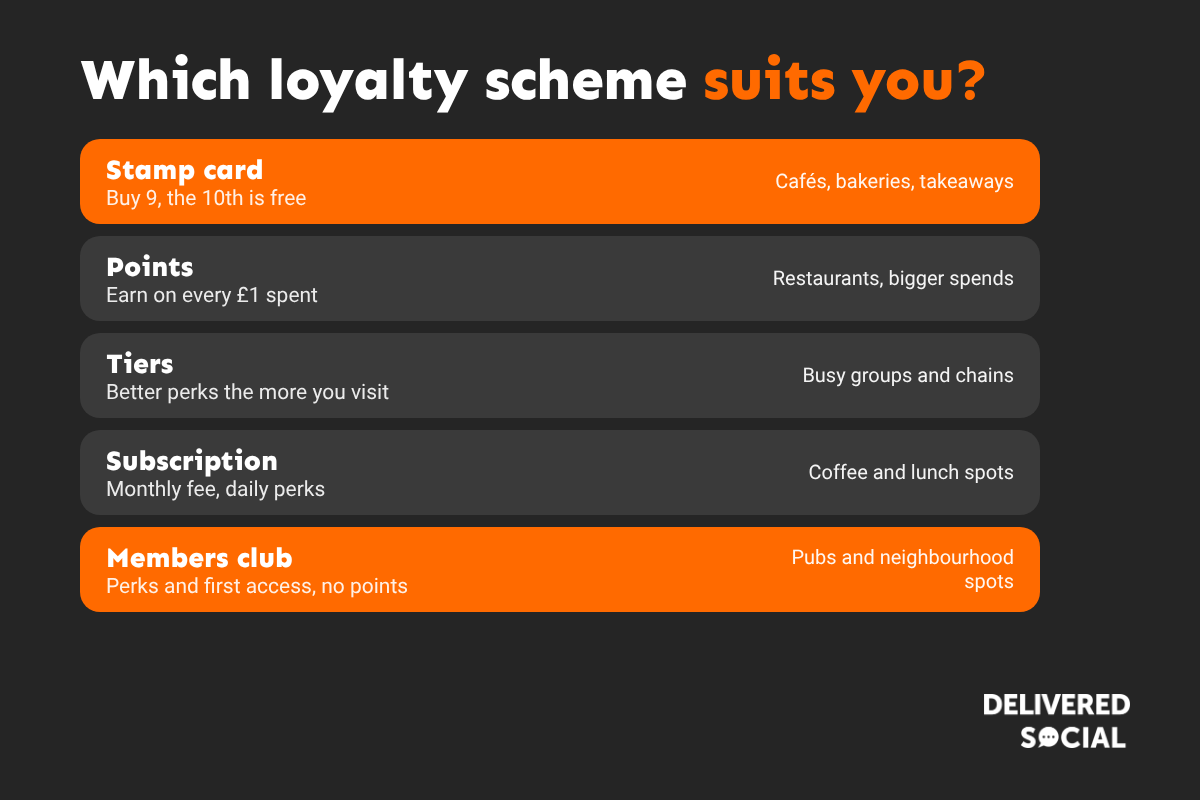
1. Stamp cards (visit-based)
Buy nine coffees, get the tenth free. Simple, easy to explain at the till and loved by customers. Stamp cards can be paper or digital, and digital versions stop people losing the card and let you collect contact details.
Best for: cafés, bakeries, takeaways, lunch spots and anywhere people visit often with a similar spend.
2. Points (spend-based)
Guests earn points for every pound they spend and swap them for rewards, such as £5 off or a free dessert. Points reward bigger spenders more fairly than stamps do, which suits restaurants where one visit might be £15 and the next £120.
Best for: restaurants with a wide range of spend per visit.
3. Tiers
The more you visit, the better your perks: bronze, silver and gold, for example. Tiers give regulars something to aim for and make your best guests feel special. They take more managing, so they suit groups and busier venues more than a single small café.
Best for: busy restaurants and multi-site groups.
4. Subscriptions
Guests pay a monthly fee for a regular perk, such as discounted coffee every day. You get guaranteed income and very frequent visits. The maths needs care, though, because your heaviest users get the most out of it.
Best for: coffee shops and lunch spots with lots of daily regulars.
5. Members clubs (perks, not points)
No counting at all. Members get things like first access to Christmas and Valentine’s bookings, a members-only night, a birthday treat and the odd surprise. This suits pubs and neighbourhood restaurants, where people value feeling like part of the place more than collecting points.
Best for: pubs, neighbourhood restaurants and premium venues that don’t want to discount.
What the big chains do (and what independents can borrow)
Many of the best-known UK schemes are run through apps by large chains. Their details change often, so check each brand’s current terms, but the ideas behind them are useful for anyone:
- Tiered app clubs, like PizzaExpress Club, give better perks as you visit more often. Borrow: a simple “regulars” level after, say, five visits.
- Points with surprise rewards, like Zizzi’s scheme, mix earning with the odd unexpected treat. Borrow: a free dessert or drink, out of the blue, for a regular.
- Coffee subscriptions, like Club Pret, swap a monthly fee for discounted drinks. Borrow: a small café “coffee club” with a capped number of drinks a day.
- Digital stamp apps, used by fast-casual chains such as Island Poké and Barburrito, reward each visit with a stamp and add sign-up and birthday bonuses. Borrow: a stamp on joining, so people feel they’ve already started.
- No scheme at all. Some premium groups, such as Caprice Holdings (The Ivy, Scott’s), focus on gift cards and service rather than points. Borrow: if discounting doesn’t suit your brand, a members club or gift vouchers may fit better.
You don’t need a branded app to do any of this. Most independents get the same benefits from a digital stamp card or their till system’s loyalty feature.
Paper, digital or app: which should you use?
| Option | Typical cost | Pros | Cons |
|---|---|---|---|
| Paper stamp card | Printing only | Cheap, instant, no tech | Easy to lose or fake, no customer data |
| Till or card machine loyalty add-on | Often a monthly fee on top of your system | Works at the till, tracks every visit, can collect phone numbers or emails | Tied to your till provider |
| Digital stamp card or wallet pass | Usually a small monthly fee | Lives on the phone, QR sign-up, push or text reminders | Guests need to sign up |
| Your own branded app | Usually thousands to build, plus running costs | Ordering, payments and loyalty in one place | Expensive, and guests must download it |
Many till and card machine systems, such as Square, offer a loyalty add-on, so check what yours includes before paying for something separate. For a single-site independent, a till add-on or a digital stamp card is usually the sweet spot.
What does a loyalty scheme really cost you?
This is the part most guides skip. The cost of a reward is what it costs you to make, not its menu price. Here are two simple examples, using round numbers for illustration:
- Café stamp card: a coffee sells for £3.50 and costs you, say, £0.70 in ingredients and cup. “Buy nine, get the tenth free” means one free coffee for every £31.50 of coffees sold. That reward costs you about £0.70, or roughly 2% of what that guest has spent.
- Restaurant points: guests earn 1 point per £1 and 100 points gets £5 off. At menu price that’s 5% back. If your food cost is around 30%, the real cost to you is closer to 1.5% of spend.
Not everyone claims their reward, either. Some cards are lost or forgotten, so the true cost is usually lower again. Compare that with a 20% off voucher handed to everyone, and loyalty schemes look very good value.
Work out your own numbers before you launch, and set the reward so it feels generous to guests but stays a small share of what they spend.
How to design a scheme people actually use
- Keep it simple. If staff can’t explain it in one sentence at the till, it’s too complicated.
- Give them a head start. A stamp on joining, or two for the first visit, makes people far more likely to finish the card.
- Make the first reward reachable. A free coffee after ten is fine. A free meal after fifty visits feels impossible.
- Reward what you want more of. Double stamps on quiet days, or bonus points for weekday lunches.
- Add a birthday treat. It brings people back, usually with friends.
- Surprise people. A free pudding for a regular, with no card needed, is often remembered longer than any points.
- Make sign-up fast. A QR code on the table, the bill or the counter that takes under a minute.
- Train your team. Every member of staff should mention it, every time.
Loyalty ideas for cafés, pubs and independents
Cafés and bakeries
- A digital coffee stamp card with a bonus stamp on sign-up.
- A “first bake of the day” text to members when the cinnamon buns come out.
- A small coffee club subscription for your daily regulars, with a cap on drinks per day.
Pubs
- A members club with first access to Christmas and New Year bookings, quiz night table reservations and live sport.
- A “local’s pint” price or a free bar snack for members on quieter nights.
- A Sunday roast card: buy five, the sixth is on us.
Restaurants
- Points on spend, with rewards that suit your menu: a free starter, a bottle of wine, a dessert for the table.
- Members-first booking for tasting menus, chef’s table nights and special events.
- A “regulars” level after a set number of visits, with a welcome drink on arrival.
For more ways to bring regulars back and fill quiet nights, see our list of 25 restaurant marketing ideas.
UK data rules for loyalty schemes
A loyalty scheme collects personal data, so it has to follow UK GDPR and the rules on marketing emails and texts (PECR). In plain words:
- Tell people what you’ll do with their details when they sign up, with a short privacy notice.
- Get clear permission for marketing. Joining the scheme isn’t the same as agreeing to marketing emails or texts, so use a separate, unticked opt-in box.
- Make it easy to opt out in every email and text.
- Only collect what you need. A name, email or phone number and a birthday month are usually plenty.
- Keep it secure, and choose a loyalty provider that stores data safely.
The Information Commissioner’s Office has guidance for small businesses if you want to check the detail.
How to launch a loyalty scheme in a week
- Day 1: choose your type of scheme and set the reward using your own costs.
- Day 2: check whether your till has a loyalty add-on. If not, pick a simple digital stamp card.
- Day 3: write your sign-up wording and privacy notice, with a separate marketing opt-in.
- Day 4: print QR codes for tables, the counter and the bill.
- Day 5: brief the team: what it is, how to explain it, and a target for sign-ups.
- Day 6: announce it on social media and your Google Business Profile, with a launch bonus.
- Day 7: open, and start counting sign-ups.
How to promote your loyalty scheme
- Ask every guest at the till or with the bill. This is where most sign-ups come from.
- Put the QR code on menus, table cards, receipts and takeaway bags.
- Post about it on Instagram and Facebook, and pin the post. Our guide to social media for restaurants shows how to make posts that bring people in.
- Add a Google Business Profile post. See our guide to local SEO for restaurants.
- Mention it on your website’s booking page and in your email newsletter.
How to tell if it’s working
- Sign-ups per week, and which member of staff signs up the most.
- Visit frequency: are members coming back more often than before?
- Reward redemptions: if nobody is claiming rewards, the scheme is too hard. If everyone is, check your costs.
- Spend per visit for members compared with non-members.
- Lapsed members: people who haven’t visited in six to eight weeks. Send them a “we’ve missed you” offer.
Review it after three months and adjust the reward, the earn rate or the way your team promotes it.
Common loyalty scheme mistakes
- Rewards that take too long to reach.
- Rules that are hard to explain.
- Staff who forget to mention it.
- Collecting details and never using them.
- Sending too many offers, so people unsubscribe.
- Pre-ticked marketing boxes, which break UK data rules.
- Launching an expensive app when a digital stamp card would do.
Frequently asked questions
What is the best loyalty scheme for a small restaurant?
For most small restaurants and cafés, a simple digital stamp card or your till system’s loyalty feature works best. It’s cheap, easy to explain and collects contact details so you can invite people back.
Do restaurant loyalty schemes really work?
Yes, when the reward is easy to reach, the team promotes it every day, and you use the contact details to invite members back. They work best for places people can visit often.
How much does a restaurant loyalty scheme cost?
A paper card costs only printing. Digital stamp cards and till add-ons usually have a small monthly fee. A branded app costs much more. The rewards themselves usually cost a small percentage of what members spend.
Should I choose points or stamps?
Stamps suit places where spend per visit is similar, such as coffee shops. Points suit restaurants where spend varies, so bigger spenders are rewarded fairly.
Do I need an app for a loyalty scheme?
No. Digital stamp cards, phone wallet passes and till-based schemes do the job for most independents without the cost of building an app.
Can I use loyalty members’ details for marketing?
Only if they’ve given clear permission, usually with a separate opt-in box when they sign up, and you must make it easy to opt out in every message.
Want help bringing regulars back?
We help restaurants, cafés and pubs across Surrey, Hampshire and the UK with social media, Google and email marketing that fills tables and brings guests back. See how we work as a restaurant marketing agency, or call us on 01483 608 303 for a friendly chat.