



Keep reading
Rather we just did it for you?
Let's get your business seen.
Social media, websites, SEO and ads from a team you can actually meet.
If you run online adverts, ROAS is one of the most important numbers you will see. It tells you how much revenue your ads bring back for every pound you spend, which makes it the quickest way to judge whether a campaign is paying its way. But ROAS is easy to misread, and a “good” number for one business can mean a loss for another. This guide explains what ROAS means, how to calculate it, what counts as a good ROAS, how it differs from ROI and how to improve it on Google Ads, Meta and other platforms.
What does ROAS stand for?
ROAS stands for return on ad spend. It measures the revenue generated by advertising compared with the amount spent on that advertising.
How to calculate ROAS
The formula is simple:
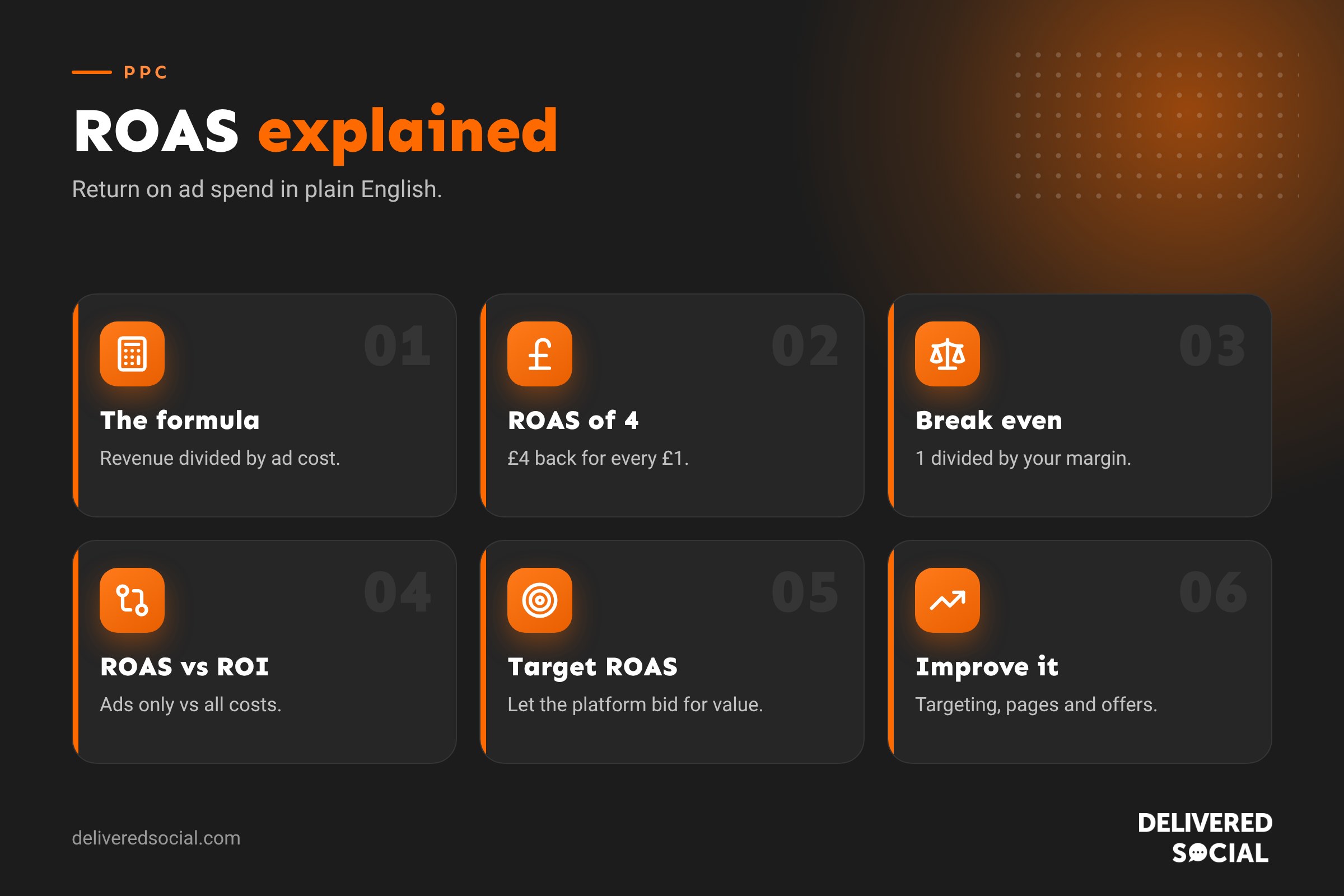
ROAS = revenue from ads ÷ cost of ads
For example, if you spend £1,000 on Google Ads and those ads generate £5,000 in sales, your ROAS is 5. This is often written as 5:1, 5x or 500%. All three mean the same thing: you made £5 in revenue for every £1 spent.
More examples
- Spend £500, revenue £1,000: ROAS of 2 (200%).
- Spend £2,000, revenue £3,000: ROAS of 1.5 (150%).
- Spend £800, revenue £600: ROAS of 0.75 (75%), meaning you got back less than you spent in revenue.
What is a good ROAS?
There is no single answer. A good ROAS depends on your profit margins, your other costs and your goals. A business with 70% margins can be very profitable at a ROAS of 2, while a business with 20% margins might lose money at a ROAS of 4. As a very rough rule of thumb, many ecommerce businesses aim for somewhere around 3 to 5, but you should always work out your own target.
Break even ROAS
Your break even ROAS is the point where ad revenue covers both the ad spend and the cost of the products sold. The formula is:
Break even ROAS = 1 ÷ profit margin
If your profit margin before ad costs is 40% (0.4), your break even ROAS is 1 ÷ 0.4 = 2.5. Below 2.5 you lose money on each sale from ads; above it you make a profit. If your margin is 25%, break even is 4. Knowing this number stops you celebrating campaigns that are actually losing money.
ROAS vs ROI
ROAS and ROI (return on investment) are often confused.
- ROAS looks only at revenue and ad spend. It tells you how efficient your adverts are.
- ROI looks at profit compared with all the costs involved, including product costs, staff time, agency fees, software and delivery. It tells you whether the activity is truly profitable.
A campaign can have a healthy looking ROAS but a poor ROI once all costs are included. Use ROAS to optimise campaigns day to day, and ROI to judge your overall marketing investment.
ROAS vs CPA
CPA, or cost per acquisition, measures how much you pay for each sale or lead. It is often more useful than ROAS for businesses that generate leads rather than online sales, such as service businesses, where the revenue happens later. If you know your average customer value and conversion rate from lead to sale, you can work out a target CPA instead.
Where to find ROAS in ad platforms
- Google Ads: add the “Conv. value / cost” column, which is ROAS. You need conversion tracking with values set up.
- Meta Ads Manager: look for “Purchase ROAS” in your columns, which requires the Meta Pixel or Conversions API sending purchase values.
- TikTok, Pinterest and Microsoft Ads: all report ROAS when purchase values are tracked.
- Google Analytics 4: compare revenue by source with your ad costs, especially if you import cost data.
Accurate ROAS depends on accurate tracking. If your conversions are not set up correctly, the number is meaningless.
Target ROAS bidding
Google Ads and Meta both offer bidding strategies that aim for a specific ROAS. In Google Ads, Target ROAS tells the system to try to achieve a set return, raising bids for searches likely to bring high value sales and lowering them for others. It works best once you have plenty of conversion data, usually dozens of conversions a month. Setting the target too high can restrict your campaign so much that it barely spends; too low and you may overspend for poor returns. Start near your current actual ROAS and adjust gradually. Our guide to Google Ads for beginners explains bidding basics.
How to improve ROAS
Improve your targeting
Show ads to people more likely to buy. Use negative keywords on Google to block irrelevant searches, refine audiences on Meta and exclude people who have already bought.
Improve your landing pages
A faster, clearer landing page converts more visitors for the same ad spend. Match the page to the ad, make the offer obvious and remove distractions. Our guide to conversion rate optimisation has more ideas.
Raise average order value
Bundles, upsells, free delivery thresholds and product recommendations all increase revenue per order without increasing ad costs.
Improve your adverts
Test headlines, images and videos. Better ads earn higher click through rates and often lower costs per click.
Use remarketing
People who have visited your site or added to basket are more likely to buy, so remarketing campaigns often have higher ROAS.
Shift budget to winners
Review results regularly and move money from low ROAS campaigns, products and audiences to high ROAS ones.
Fix your product feed
For Shopping and Performance Max campaigns, accurate titles, images and prices help ads reach the right buyers.
Why ROAS is not everything
Chasing the highest possible ROAS can hold a business back. Campaigns with very high ROAS often only target people who were already going to buy, such as people searching your brand name. Growth usually needs some campaigns that reach new customers, which naturally have lower ROAS but bring in people who buy again and again. Consider customer lifetime value: a first order with a modest ROAS can be very profitable if customers return. Look at your overall marketing efficiency, sometimes called MER (total revenue divided by total marketing spend), alongside campaign ROAS.
ROAS for lead generation businesses
If you sell services and do not take payment online, you can still estimate ROAS. Track leads from ads, record which turn into customers and how much they spend, then calculate revenue from ads over a set period. Importing offline conversions into Google Ads lets the platform optimise for leads that actually become customers, not just form submissions.
Common ROAS mistakes
- Not knowing your break even ROAS.
- Comparing ROAS across platforms with different attribution settings.
- Judging campaigns on a few days of data.
- Ignoring returns and refunds, which reduce real revenue.
- Including brand searches in overall ROAS, which flatters results.
A worked ROAS example
Imagine an online shop selling candles with an average order value of £40 and a profit margin before ad costs of 50%. Its break even ROAS is 1 ÷ 0.5 = 2. Last month it spent £1,000 on Meta ads and tracked £3,200 in sales, a ROAS of 3.2. After product costs of £1,600 and ad spend of £1,000, it made £600 profit from those sales. If 30% of those customers buy again within a year, the true value of the campaign is even higher. That is why it helps to look at ROAS, margin and repeat purchases together.
Key takeaways
- ROAS means return on ad spend: revenue from ads divided by ad cost.
- A ROAS of 4 means £4 revenue for every £1 spent.
- Work out your break even ROAS from your profit margin.
- ROAS measures ad efficiency; ROI measures overall profitability.
- Improve ROAS with better targeting, landing pages, ads and order values.
Frequently asked questions
What does ROAS mean in marketing?
Return on ad spend, the revenue generated for each pound spent on advertising.
How do you calculate ROAS?
Divide revenue from ads by the cost of those ads.
What is a good ROAS?
It depends on your margins; many ecommerce businesses aim for 3 to 5, but work out your own break even first.
Is ROAS the same as ROI?
No. ROAS looks at ad spend only; ROI includes all costs and profit.
What does a ROAS of 1 mean?
You earned the same revenue as you spent on ads, which usually means a loss after product costs.
How can I improve my ROAS?
Refine targeting, improve landing pages, test ads, use remarketing and raise order values.
Should ROAS include VAT?
Be consistent; many businesses calculate revenue excluding VAT for a truer picture.
How often should I check ROAS?
Weekly for active campaigns, but judge changes over at least two to four weeks of data.
Want ads that pay their way?
We plan and manage Google Ads and paid social for businesses across Surrey, Hampshire and the UK. Find out more about our PPC management services. Call us on 01483 608 303.
































