

Keep reading
Rather we just did it for you?
Let's get your business seen.
Social media, websites, SEO and ads from a team you can actually meet.
An Instagram engagement drop almost always has an ordinary cause, and you can usually find it by working through seven checks: the wider trend, how you are measuring, your content mix, originality, your account status, the quality of your audience, and your own recent habits. Start with the cheapest checks first, because the answer is often a change in what you posted, not a penalty.
Panicking and changing everything at once is the worst response, because you will never know what made the difference. This guide gives you a calm, ordered way to diagnose the problem, with what to look at, what it means and what to do next.
Before you start: define the drop
Write down three things before you touch anything:
- What dropped? Likes, comments, saves, shares, reach, profile visits or link clicks. They behave differently.
- When did it start? A specific date, or a gradual slide over weeks.
- Compared with what? Last month, the same month last year, or your best ever post.
Open Insights on your professional account and set the date range to at least 90 days. A single poor week is noise. A slide that lasts four to six weeks is a pattern worth investigating. Instagram reach is the number of unique accounts that saw your content, so if reach is steady and engagement has fallen, you have a content problem. If reach has fallen too, the cause might sit with distribution, your audience or your account.
Check 1: Is it the platform, not you?
Sometimes your numbers fall because everyone’s do. Published benchmark studies suggest Instagram engagement has been drifting down. Quid’s 2026 industry benchmark report (published 5 March 2026) gives a median Instagram engagement rate of 0.30%, down from 0.36% the year before. Socialinsider’s benchmarks, which use a different method and sample, show a smaller slide, from 0.50% in 2024 to 0.48% in 2025.
The two studies measure different things, so do not compare their numbers with each other. The useful point is that both show the same direction. If your engagement rate has slipped by a small amount, you may simply be moving with the market. A fall of a few hundredths of a percentage point is not an emergency.
What to do: compare your drop with those trends. If you are down far more than a fraction, keep going through the checks. Our guide to social media benchmarks for the UK explains how to compare your results sensibly.
Check 2: Are you measuring it consistently?
Many “drops” turn out to be measurement changes. Check these before assuming something is wrong:
- The denominator changed. If your follower count rose sharply, a rate based on followers will fall even when the number of likes stays the same.
- The mix changed. Reels, carousels, single images and Stories get different reach and different engagement. If you used to post carousels and now post mostly Stories, comparing the average is misleading.
- The date range is uneven. A campaign month, a viral post or a holiday can distort your average. Look at the median post, not only the average.
- Insights definitions. check that you are comparing the same measure across periods.
What to do: export or write down the last 20 posts with format, reach, likes, comments, saves and shares. Look for one or two posts that dragged the average. This takes ten minutes and often explains the whole story. An Instagram engagement drop is usually a sign of one fixable problem, not a verdict on your whole account.
Check 3: Did your content mix change?
Look back at the weeks before the drop. Ask:
- Did you stop posting a format that used to work, such as Reels or carousels?
- Did the topics shift, perhaps towards more promotional posts and fewer useful or personal ones?
- Did you start posting only product shots, or only announcements?
- Did your hooks (the first line or first two seconds) get weaker?
Engagement follows relevance. People react when a post gives them something: advice, a laugh, a recognisable face, a reason to save it for later. A feed that has slipped into constant sales messages gets quieter even with the same followers.
What to do: sort your last 30 posts by saves and shares, not only likes. Those two actions show real value. Identify the top five and ask what they have in common. Then plan the next month around those traits. Our guide on how to get more Instagram comments has specific prompts that turn a silent post into a conversation.
Check 4: Is your content original and eligible to be recommended?
Much of Instagram’s growth comes from showing content to people who do not follow you yet. Instagram publishes what it expects. In its guide for creators on recommendations, it says:
- Recommended content should be original, meaning you filmed it yourself or it has not been posted on Instagram before.
- Visibly recycled content, such as reels with watermarks from other apps, or blurry and low-quality video, is not eligible.
- Recommended reels must be three minutes or less.
- Only public accounts are recommended, and creator and business accounts are automatically public.
- Repeatedly posting content that breaks the Recommendation Guidelines, or having a profile photo or bio that breaks them, can make your whole account ineligible for a period.
If you started reposting clips from other platforms with watermarks, or relying on trending audio with little of your own on screen, your Instagram reach beyond followers could fall. Followers might still see your posts, but strangers will not.
What to do: look at your recent Reels. Are they original, clear and made for Instagram? Remove or stop posting recycled content, and film something new each week, even if it is a simple phone video.
Check 5: Look at your Account Status
People often talk about a “shadowban”, a hidden penalty that quietly cuts your reach. That word is not official, and most drops are not caused by one. But Instagram does give you a place to check whether content has been removed or restricted: Account Status. Instagram describes it as a way to find out if your content has been removed for going against its Community Guidelines and how that affects your account.
Instagram’s creator guidance also notes that content removed for violating the Community Guidelines can make your account ineligible for recommendations, especially if it happened recently or repeatedly, and that you can request a re-review in Account Status.
What to do:
- Open Account Status from your settings (the exact menu path changes, so search “Account Status” in settings if you cannot find it).
- Check for removed posts, strikes or restrictions.
- If something was removed in error, request a review.
- If posts were removed fairly, adjust your content and give it time.
If Account Status is clear, you can rule out the most common formal penalty and move on. When you see an Instagram engagement drop, check reach before you check anything else.
Check 6: Has your audience quality changed?
Your followers matter as much as your content. A drop can follow:
- A giveaway that attracted people who only wanted the prize.
- A growth tactic, such as follow-for-follow, a bought audience or a bot, that added accounts who never engage.
- A big clear-out of fake accounts by the platform, which lowers your count but should raise your rate over time.
- A change in who your content appeals to. If you have shifted tone or subject, some people will quietly stop engaging.
What to do: do a quick audit of your audience. Look at your top locations and age ranges in Insights, and sample your follower list. Our walkthrough on how to spot fake followers takes ten minutes. If you find a lot of low-quality accounts, stop the source of them, remove the worst, and concentrate on content aimed at your real customers.
Check 7: What have you changed in how you use Instagram?
The last check is about your own behaviour. Think back over the two weeks before the drop:
- Posting rhythm. Did you go quiet for a while, then post a flurry? Irregular posting trains your audience to look elsewhere.
- Posting time. Did you move from posting when your audience is active to a time that suits you?
- Replying. Did you stop replying to comments and messages? Replying early helps start conversation, and conversations bring more comments.
- Tools and apps. Did you connect a new app, or start using any automatic following, liking or commenting tool? Instagram says in its announcement on inauthentic activity that accounts using third-party apps to grow their audience may see their Instagram experience affected. See our guide on Instagram bots and what is safe to automate.
- Hashtags and captions. Did you pile on the same block of hashtags, or shorten captions to nothing?
What to do: restore the habits that worked before, one at a time. Go back to a steady schedule you can keep, reply within the first hour when you can, and remove any tool you do not fully trust.
How to tell which check matters most
If you only have time for one or two checks, use the pattern of your numbers as a guide: Most accounts recover from an Instagram engagement drop within a few weeks of steady, better-targeted posting.
- Reach steady, engagement down: start with checks 3 and 6. People are seeing your posts but not responding, so the content or the audience is the issue.
- Reach down on non-followers only: start with checks 4 and 5. Recommendation eligibility is the likely cause.
- Everything down at once after a specific date: start with check 7. Something changed in how you use the account, or a new app got access.
- Down a little, slowly, for months: start with check 1. You may be seeing the wider trend, and the fix is better content, not a rescue mission.
A simple recovery plan for the next four weeks
Once you have found the likely cause, run a calm, four-week test.
- Week 1: Fix the obvious. Remove risky apps, check Account Status, and note your baseline reach and engagement.
- Week 2: Post your best-performing formats again. Aim for three to four original posts, including at least two Reels or carousels.
- Week 3: Add conversation. Ask a clear question in each caption, reply to every comment, and leave useful comments on accounts your customers follow.
- Week 4: Review. Compare reach, saves, shares and comments with your baseline. Keep what worked and drop what did not.
Change one or two things at a time. If you change everything at once, you will never learn which change helped. Our broader guide on how to increase followers on Instagram sets out a longer growth plan once you are stable again.
Questions about an Instagram engagement drop
Why is my Instagram reach so low suddenly?
The usual reasons are a change in format or content, recycled or low-quality video, an irregular posting pattern, or an audience that has become less engaged. Instagram head Adam Mosseri has said that no account reaches every follower, because many followers do not open the app on the day you post and those who do see more posts than they can scroll through. That is reported by Search Engine Land.
Does posting more often fix it?
Not by itself. Posting more of the same content to the same quiet audience gives you more quiet posts. Improve the content first, then increase the frequency if you can keep up the quality.
How long does it take to recover?
It varies. Where the cause is content, you can see changes within a few posts. Where the cause is audience quality or a past penalty, it can take weeks. Judge by trends over 30 days, not single posts.
Should I delete low-performing posts?
Usually no. Archive only posts that are off-brand, out of date or low quality. Deleting dozens of posts will not boost the rest.
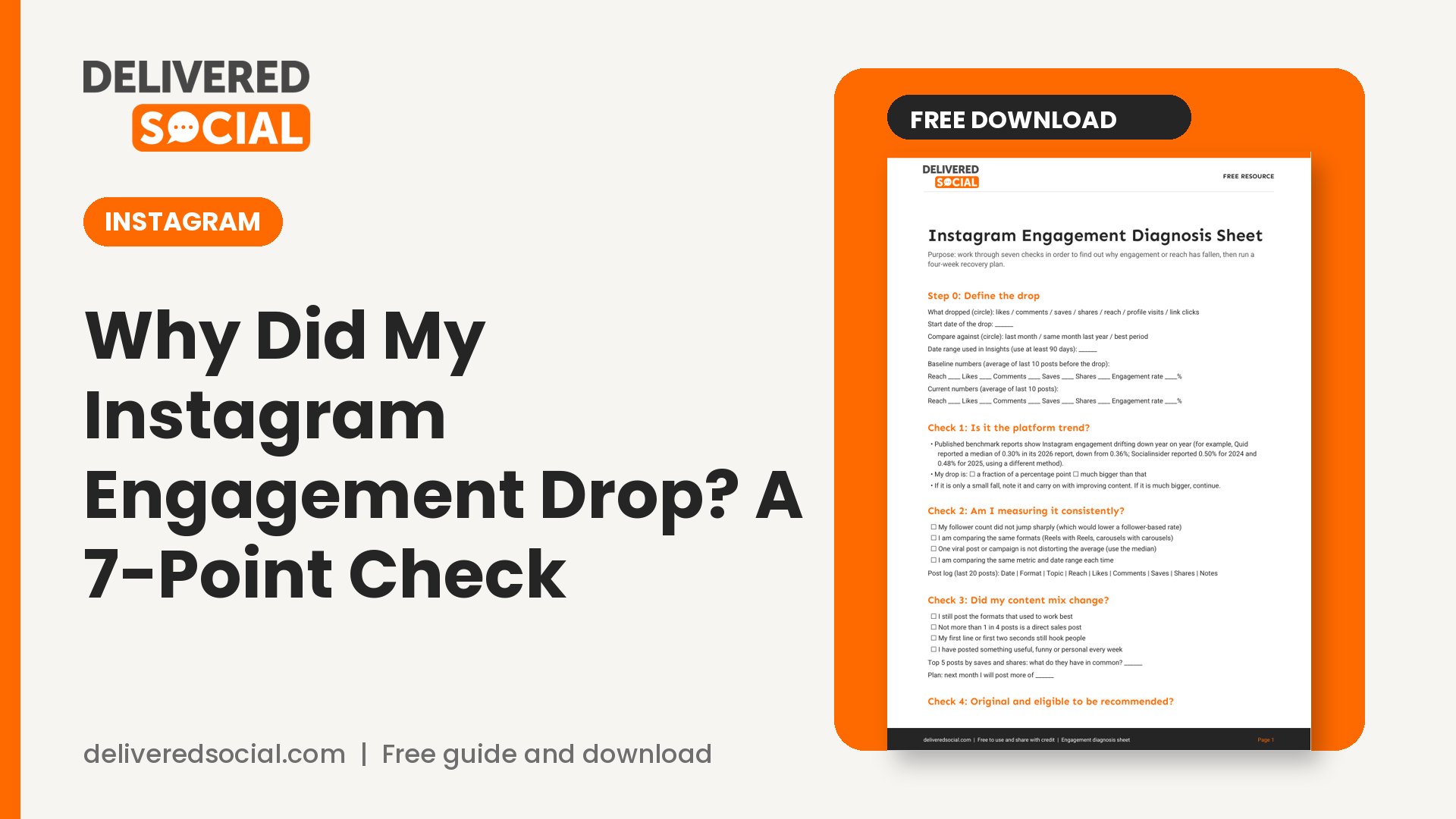
Get the free Engagement diagnosis sheet
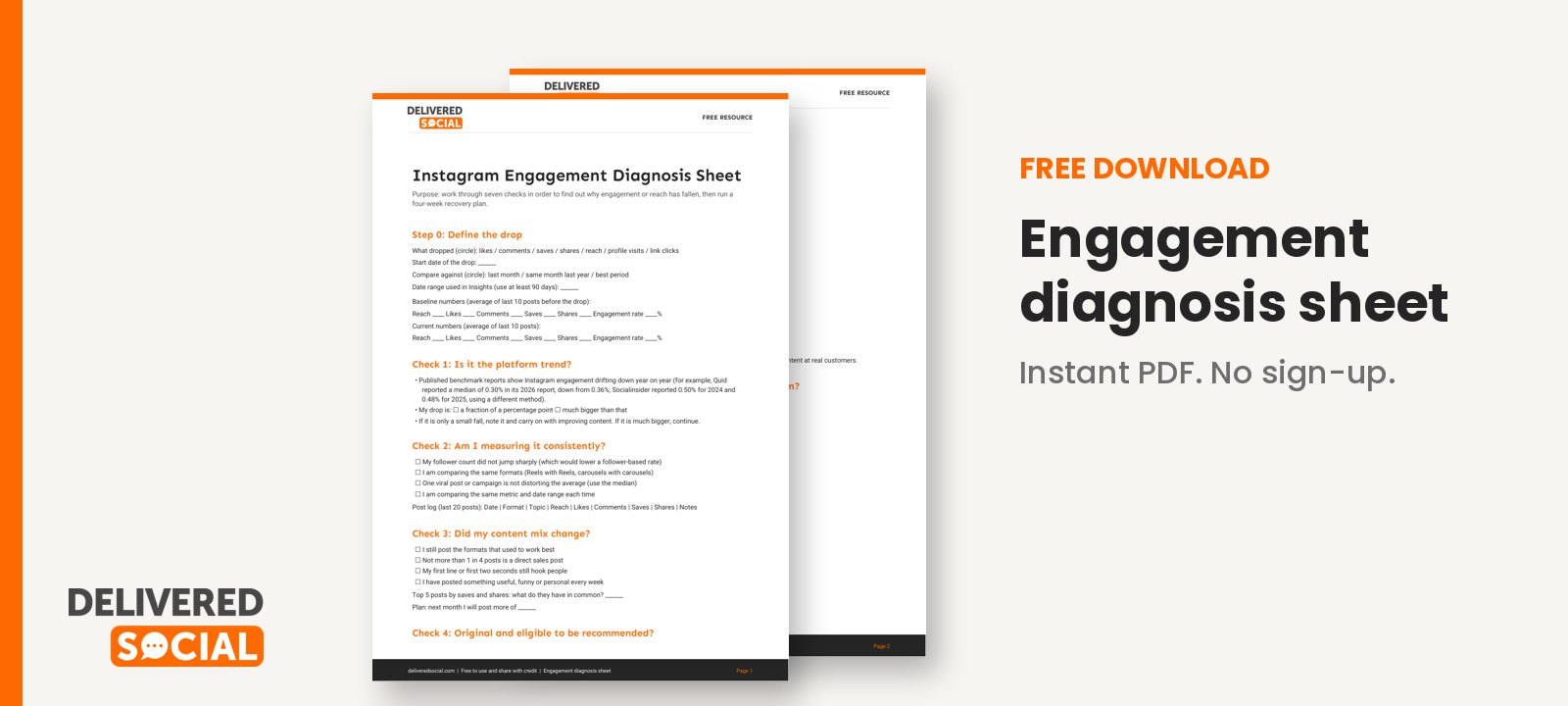
To make this practical, we have put the seven checks into an Engagement diagnosis sheet. It has a short worksheet for each check, a place to record your numbers, and a four-week action planner.
Download the free Engagement diagnosis sheet
If you would rather have an experienced team look at your account, Delivered Social offers social media management and audits, and you are welcome to contact us for a friendly conversation about what is happening on your profile.