

Keep reading
Rather we just did it for you?
Let's get your business seen.
Social media, websites, SEO and ads from a team you can actually meet.
Every business owner has seen it happen: a small company posts a simple video and suddenly it has hundreds of thousands of views. Nobody can guarantee a viral hit, but there are clear patterns behind the short videos that travel furthest on TikTok, Instagram Reels and YouTube Shorts, and most of them cost nothing but time and a bit of nerve.
This guide explains how to create videos for Instagram, TikTok and YouTube that people actually watch and share: what the algorithms reward, the four things that make the biggest difference for our clients, a real example from our own office and a simple process you can follow every week.

What “viral” really means for a business
For most businesses, viral does not mean ten million views. It means a video that reaches far more people than usual, gets shared, brings in new followers and, ideally, new customers. A plumber with 800 followers whose video reaches 60,000 local people has had a viral moment that matters.
Chasing one huge hit is a lottery. Building a habit of videos that regularly outperform is a strategy, and that is what this guide is about.
How TikTok, Instagram and YouTube decide what to show
All three platforms work in a similar way. They show a new video to a small group of people, watch how they react, and show it to more people if the signs are good. The signals that matter most are:
- Watch time and completion: do people watch to the end, or even watch again?
- The first few seconds: do people stop scrolling, or swipe straight past?
- Shares and saves: do people send it to a friend or keep it for later?
- Comments: does it start a conversation?
Followers matter less than they used to. A brand-new account can reach a huge audience with the right video, which is great news for small businesses.
The four things that work for our clients
At Delivered Social, we make short-form video for clients every week. When we look at which videos go furthest, the same four things come up every time.
1. A strong first two seconds
Most people decide whether to keep watching almost instantly. Start with the most interesting moment, a bold statement, a question or something unexpected on screen. Never start with a logo, a slow intro or “Hi everyone, today I’m going to…”.
Good hooks include:
- “Three things your plumber won’t tell you.”
- Showing the finished result first, then how you got there.
- A mistake or a surprise in the first frame.
- On-screen text that promises something useful.
2. Real people, not polish
The videos that perform best for our clients are almost never the most expensive ones. They show real people: the owner, the team, customers, behind the scenes, mistakes and laughter. Phone footage of a genuine moment usually beats a glossy advert, because it feels like the rest of the content people enjoy on these platforms.
3. Trends adapted to your brand
Trending sounds, formats and jokes can give a video a big boost, but only if you make them your own. Copying a trend exactly rarely works for a business. Taking the format and applying it to your trade, your team or your customers does. Move quickly, because trends fade fast, and skip any that do not fit your brand.
4. Posting consistently
One video almost never changes everything. Viral moments usually come after weeks of regular posting, as you learn what your audience responds to. Consistency also gives the algorithm more chances to find the right people for you. A realistic rhythm you can keep, such as three videos a week, beats a burst of daily posting followed by silence.
A real example: our LEGO Star Trek build challenge
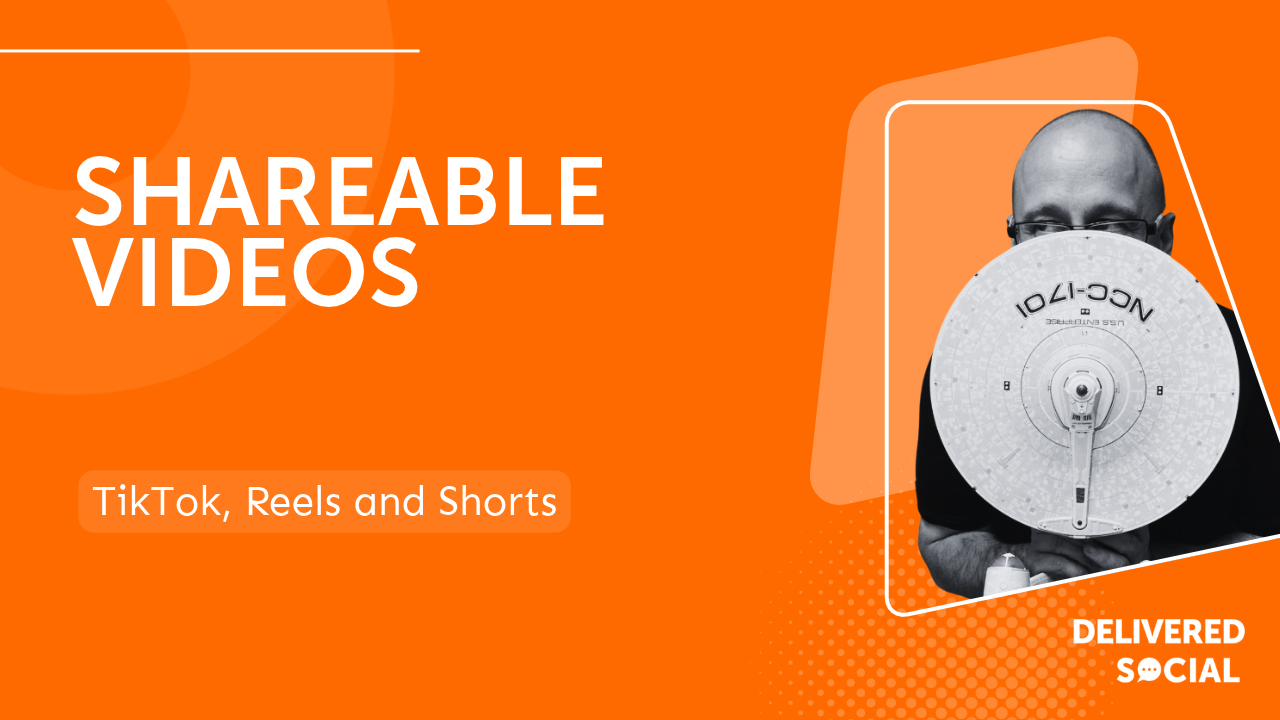
We practise what we preach. Our own long-running video series is a LEGO Star Trek build challenge: local business owners come into the Delivered Social office, build part of a Star Trek LEGO set on camera and answer quiz questions while they do it. We started with the USS Enterprise-D and moved on to the NCC-1701 Bridge set.
It ticks every box above:
- It has a hook: people instantly want to know if the build will survive.
- It shows real people: local business owners, unscripted, laughing and getting things wrong.
- It is consistent: a series gives people a reason to come back for the next episode.
- It spreads itself: every guest shares their own episode with their own followers and customers.
You do not need LEGO. You need a simple, repeatable idea that features real people and gives guests a reason to share. For more on what makes people hit share, see our guide to viral video marketing.
A simple process for creating videos for Instagram, TikTok and YouTube
- Collect ideas. Keep a running list of customer questions, behind-the-scenes moments, before-and-afters and trends you could adapt.
- Write the hook first. If you cannot say why someone would stop scrolling, rethink the idea.
- Film vertically on your phone, in good light, with clear sound. A cheap clip-on microphone makes a big difference.
- Keep it tight. Cut every pause. Most business videos work best under 30 to 45 seconds.
- Add captions. Many people watch with the sound off.
- Post natively to each platform, without another app’s watermark. See our guide on removing the TikTok watermark.
- Reply to comments quickly, especially in the first hour.
- Review weekly. Look at which videos kept people watching longest, and make more like them.
Differences between TikTok, Instagram Reels and YouTube Shorts
- TikTok rewards personality, trends and raw, fast content, and can push videos to huge audiences beyond your followers.
- Instagram Reels leans slightly more polished and works well for showing your work, team and local community. Shares to Stories and DMs matter a lot.
- YouTube Shorts can keep finding viewers for months, and works well for useful, searchable how-to content.
The same core video can often work on all three, with a tweaked caption and cover for each. Our guide to TikTok video size covers the formats.
Mistakes that stop videos spreading
- Slow intros and logos at the start.
- Videos that are really adverts, with no entertainment or value.
- No captions.
- Reposting watermarked videos from another app.
- Giving up after a handful of posts.
- Ignoring comments, which is where much of the reach comes from.
Frequently asked questions about viral video content
Can you guarantee a video will go viral?
No. Anyone who promises that is guessing. You can make it far more likely by following the patterns above and posting consistently.
How long should a short video be?
As short as the idea allows. For most businesses, 15 to 45 seconds works best. Longer videos can work if every second earns its place.
What time should I post?
Check your own analytics for when your followers are online, but the video itself matters far more than the timing.
Do I need expensive equipment?
No. A recent phone, natural light and a cheap microphone are enough for most business videos.
Should I use paid ads to boost videos?
Once a video is already doing well organically, boosting it can be good value. See our guide on TikTok ads costs.
Make videos people want to share
Viral video content is less about luck and more about habits: a strong first two seconds, real people instead of polish, trends adapted to your brand and the patience to post consistently. Do that week after week and the breakout videos will come.
If you would like help planning, filming or editing short-form video, our social media team can help. Get in touch, or find more practical guides on the Delivered Social website.