



Keep reading
Rather we just did it for you?
Let's get your business seen.
Social media, websites, SEO and ads from a team you can actually meet.
Every business owner wants to grow, but “grow” can mean very different things: more customers, bigger orders, new services, new areas or a higher profit margin. The businesses that grow steadily usually have a clear plan, focus on a few things that work, and measure them.
This guide covers practical business growth strategies for small businesses, the four classic routes to growth, the marketing levers we see work best, and a simple 90-day plan to get started.
The four routes to growth
A simple way to think about growth is the Ansoff Matrix, which splits options by whether you’re selling existing or new products to existing or new markets:
| Strategy | What it means | Small business example | Risk |
|---|---|---|---|
| Market penetration | Sell more of what you do to the customers and areas you already serve | A café increasing midweek visits with a loyalty scheme | Lowest |
| Product development | New products or services for your existing customers | A plumber adding boiler servicing plans | Medium |
| Market development | Existing products in new areas or to new types of customer | A Guildford trades business expanding into Woking | Medium |
| Diversification | New products in new markets | A restaurant launching a retail sauce range | Highest |
For most small businesses, the quickest and safest wins come from the top row: getting more from the customers and markets you already know.
The growth levers that work best for small businesses
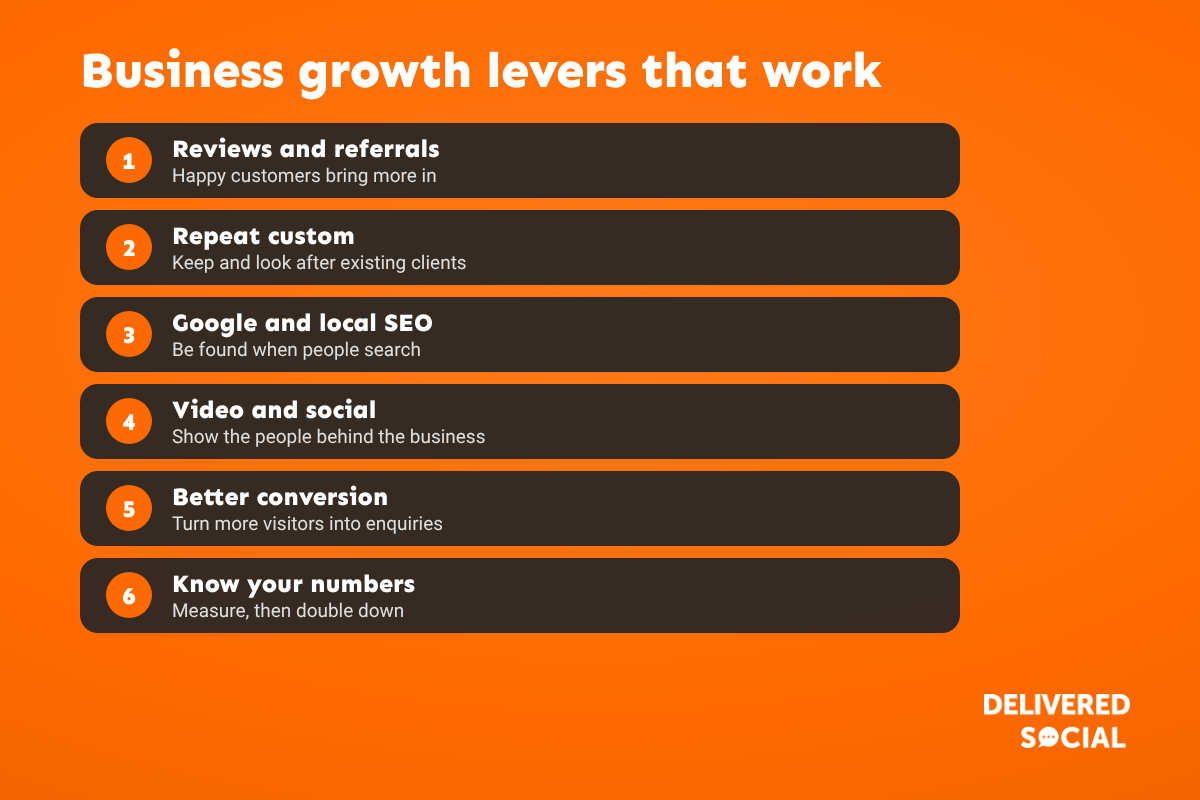
Across the small businesses we work with, four levers consistently drive growth:
1. Reviews and referrals
Happy customers are your best salespeople. A steady flow of Google reviews builds trust and helps you rank locally, while a simple referral habit, such as asking every happy customer who else they know, brings warm leads that convert well. See our guide to getting more Google reviews.
2. Repeat custom
It usually costs far less to keep a customer than to win a new one. Stay in touch with email, service reminders and loyalty offers, look after existing clients properly, and offer the next logical product or service at the right time.
3. Google and local SEO
Being found when people search for what you do, where you are, is one of the most reliable sources of new customers. Start with your Google Business Profile, then build service and location pages on your website. Our SEO strategy guide shows how.
4. Video and social media
People buy from people. Short videos showing the owner, the team and the work behind the scenes build familiarity and trust faster than any advert, and keep you front of mind until people are ready to buy.
Other growth strategies to consider
- Raise your prices where your value supports it. Even a small increase can lift profit more than extra sales.
- Improve your website’s conversion rate so more visitors get in touch. See our guide to conversion rate optimisation.
- Partnerships with complementary businesses that serve the same customers.
- Paid advertising to scale what already works, once tracking is in place.
- Recurring revenue, such as maintenance plans, subscriptions or retainers, for steadier cash flow.
- Systems and people, so the owner isn’t the bottleneck for every decision.
A simple 90-day growth plan
| When | Focus | Actions |
|---|---|---|
| Weeks 1 to 2 | Know your numbers | Where customers come from, average order value, repeat rate, enquiry to sale rate |
| Weeks 3 to 4 | Pick two levers | Choose the two growth levers most likely to work for you and set targets |
| Weeks 5 to 8 | Build habits | Weekly review requests, monthly customer email, weekly social video, Google profile posts |
| Weeks 9 to 12 | Measure and adjust | Compare against week one, double down on what works, drop what doesn’t |
How to measure growth
- Number of enquiries and where they came from.
- Conversion rate from enquiry to sale.
- Average order or project value.
- Repeat customer rate.
- Gross profit, not just turnover.
Common growth mistakes
- Trying every marketing channel at once and doing none of them well.
- Growing turnover while profit shrinks.
- Neglecting existing customers while chasing new ones.
- No tracking, so nobody knows what’s working.
- Expanding before systems and cash flow can cope.
Frequently asked questions
What are the main business growth strategies?
Selling more to existing customers, developing new products or services, reaching new markets and diversifying. Most small businesses grow fastest with the first.
What is the cheapest way to grow a small business?
Looking after existing customers, asking for reviews and referrals, and making the most of your free Google Business Profile.
How fast should a small business grow?
Steady, profitable growth is healthier than rapid growth that strains cash flow and quality.
How does marketing support business growth?
Marketing brings in new customers, keeps existing ones coming back and builds the reputation that makes every sale easier.
Ready to grow?
We help small businesses across Surrey, Hampshire and the UK grow with SEO, social media, websites and paid ads. See our SEO services or call us on 01483 608 303 for a friendly chat.