

Keep reading
Rather we just did it for you?
Let's get your business seen.
Social media, websites, SEO and ads from a team you can actually meet.
Most small businesses don’t fail at SEO because they picked the wrong plugin. They fail because they never had a plan. A few blog posts here, a tweak to the homepage there, and nothing joined up. An SEO strategy fixes that. It decides which searches you want to win, which pages will win them, and what you’ll do each month to get there.
This guide is the process we use at Delivered Social to build SEO plans for small and medium-sized UK businesses. It’s written for owners and small teams, not enterprise marketing departments, so every step has a realistic time and budget attached. There’s a free one-page template at the end you can copy.
What is an SEO strategy?
An SEO strategy is a written plan for getting found on Google (and, increasingly, in AI answers) by the people most likely to buy from you. It answers five questions:
- Who are we trying to reach?
- What do they search for?
- Which page on our site should rank for each of those searches?
- What’s stopping those pages ranking now?
- What will we do each month, and how will we know it’s working?
If you’re new to the basics, start with our guide to what SEO is and how it works.
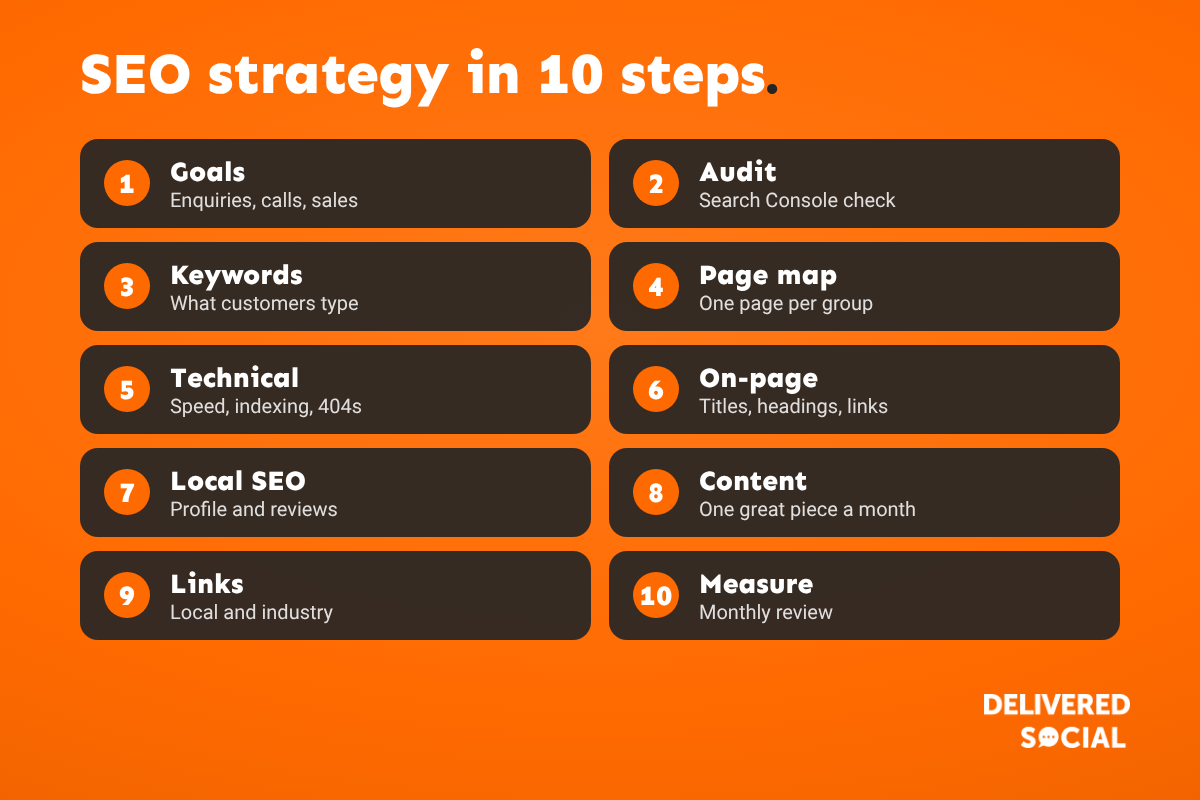
Step 1: Set goals that mean money
“Rank higher” isn’t a goal. Pick one or two outcomes the business actually cares about, then the numbers that show progress.
| Business goal | What to track |
|---|---|
| More enquiries | Form fills and calls from organic search |
| More local customers | Google Business Profile calls, direction requests and website clicks |
| More online sales | Organic revenue and conversion rate |
| Be known for a service | Rankings and clicks for that service’s searches |
Write the goal at the top of your plan, with a target and a date, for example “20 more enquiries a month from Google by June”.
Step 2: Audit where you are now
Spend an hour in Google Search Console (free) and note:
- Which searches you already get impressions for, and your average position.
- Which pages get the most clicks, and which get lots of impressions but few clicks.
- Any pages that aren’t indexed, and why (the Pages report tells you).
- Your Core Web Vitals, especially on mobile.
Searches where you’re already in positions 5 to 20 are your quickest wins. You’re close, and a better page can push you onto page one. If you’d like a professional view, our SEO audit does this in depth.
Step 3: Research the keywords that matter
Start with what customers actually type, not what you call your services internally.
- Start with your services and towns: “boiler repair Guildford”, “wedding photographer Surrey”, “accountant for landlords”.
- Add the questions people ask: type your main service into Google and note the suggestions and the “People also ask” box.
- Check volume and difficulty with a tool such as Google Keyword Planner (free with an Ads account), Semrush or Ahrefs.
- Look at intent. Someone searching “how to fix a leaking tap” wants a guide. Someone searching “emergency plumber near me” wants to call you now. Each needs a different kind of page.
For a small business, a list of 30 to 60 well-chosen keywords is plenty to start.
Step 4: Map each keyword to one page
This is the step most plans skip, and it’s the one that stops your pages competing with each other. Group similar keywords together and give each group one page.
| Keyword group | Page | Type |
|---|---|---|
| boiler repair guildford, boiler engineer guildford | /boiler-repair-guildford/ | Service page |
| how much does a new boiler cost | /new-boiler-cost/ | Guide |
| boiler making noise, boiler losing pressure | /boiler-problems/ | Guide |
If two pages already target the same thing, merge them into one stronger page and redirect the other. Google rarely ranks two similar pages from the same small site.
Step 5: Fix the technical basics
You don’t need to be a developer, but these need to be right:
- Your site loads fast on a phone and doesn’t jump around while loading.
- Important pages are indexed and in your sitemap.
- No broken links or 404s on pages people still visit. Redirect old URLs to the closest live page.
- One version of your site (https, with or without www, not both).
- Pages you don’t want found (thank-you pages, thin tag pages) are set to noindex.
Step 6: Get each page’s on-page SEO right
- Title tag: the main keyword near the start, plus your brand. Under about 60 characters.
- Meta description: a clear reason to click, with a call to action.
- One H1 that matches what the page is about, with clear H2s underneath.
- Answer the question early. Put the key information near the top, then the detail.
- Internal links from related pages and blog posts, using descriptive link text.
- Images compressed, with descriptive alt text.
- A clear next step: call, book or get a quote.
Step 7: Don’t forget local SEO
If you serve customers in an area, the map results often matter more than the normal listings. Make sure you have:
- A complete, active Google Business Profile with the right categories, photos and weekly posts.
- A steady flow of genuine reviews, with replies to every one.
- The same name, address and phone number everywhere online.
- A page for each town or area you genuinely serve.
Our guide to Google Maps marketing covers this in detail, or see our local SEO services.
Step 8: Plan content that earns its place
Every piece of content should either target a keyword group from your map or help a service page rank. A simple rule: one strong, useful article a month beats four thin ones.
- Check what already ranks for your keyword and make yours more useful: more specific, more up to date, with real examples and prices where you can.
- Write for the person, not the robot. Clear, plain English, short paragraphs and headings that match the questions people ask.
- Show real experience. Your own photos, case studies, numbers and opinions help you stand out to Google and to customers.
- Update old posts before writing new ones on the same subject.
Step 9: Earn links and mentions
Links from other relevant websites are still one of the strongest signals. For small businesses, the best ones are usually local and practical:
- Local news, business groups and chambers of commerce.
- Suppliers, partners and trade associations that list members.
- Sponsorships of local clubs and charities.
- Guides or data that other sites want to reference.
Avoid buying links in bulk or joining link schemes. They can do more harm than good.
Step 10: Be visible in AI search too
AI Overviews and tools like ChatGPT increasingly answer questions before people click. To give yourself the best chance of being mentioned:
- Answer common questions clearly and directly on your site.
- Keep your Google Business Profile and reviews strong.
- Be mentioned on other trusted sites in your industry and area.
- Use structured data (schema) for your business, services, FAQs and reviews.
How to measure your SEO strategy
- Google Search Console: impressions, clicks and positions for your keyword groups.
- Google Analytics 4: enquiries, calls and sales from organic search.
- Google Business Profile: calls, direction requests and website clicks.
- A monthly review: what moved, what didn’t, and what you’ll do next month.
Most small businesses see early movement within two to three months, with stronger results building over six to twelve months. SEO compounds: the work you do this year keeps paying back next year.
How much time and money does it take?
| Approach | Typical commitment |
|---|---|
| Do it yourself | Around 4 to 8 hours a month, plus some tool costs |
| Freelancer | Usually a few hundred pounds a month |
| Agency | From a few hundred to a few thousand pounds a month, depending on the work |
For a full breakdown, see our guide to SEO costs in the UK.
Your one-page SEO plan template
- Goal: what we want, by when.
- Audience: who we’re trying to reach.
- Keyword groups: our 5 to 10 priority groups.
- Page map: one page per group (existing or to create).
- Technical fixes: the top 5 issues to fix this quarter.
- Local SEO: profile, reviews and area pages.
- Content plan: one article or page update a month.
- Links: three local or industry sites to approach this quarter.
- Measurement: the numbers we’ll check each month.
- Review date: when we’ll look at it again.
Common SEO strategy mistakes
- Chasing high-volume keywords you can’t realistically rank for yet.
- Several pages targeting the same search.
- Writing blog posts that have nothing to do with what you sell.
- Ignoring Google Business Profile and reviews.
- Measuring rankings instead of enquiries and sales.
- Giving up after a month.
Frequently asked questions
How long does an SEO strategy take to work?
You’ll often see early movement in two to three months, especially for searches where you’re already close to page one. Bigger, more competitive gains usually take six to twelve months.
What’s the difference between an SEO strategy and an SEO plan?
People use them to mean the same thing. If there’s a difference, the strategy is the big picture (goals, audience, keywords) and the plan is the month-by-month list of tasks.
Can I do SEO myself?
Yes, especially local SEO and content. The technical side and link building are where many small businesses get help.
How many keywords should I target?
Start with 5 to 10 keyword groups that match what you sell, each with its own page. Add more once those are working.
Do I need to blog for SEO?
Not always, but useful articles help you rank for questions customers ask and support your service pages. Quality and relevance matter far more than how often you post.
What is the most important part of an SEO strategy?
Matching each important search to one strong page that genuinely answers it. Most other SEO work supports that.
Want an SEO strategy built for you?
We build and run SEO strategies for small and medium-sized businesses across Surrey, Hampshire and the UK, with plain-English monthly reports focused on enquiries, not jargon. See our SEO services or call us on 01483 608 303 for a friendly chat.