

Keep reading
Rather we just did it for you?
Let's get your business seen.
Social media, websites, SEO and ads from a team you can actually meet.
Every booking that comes through an online travel agent costs you commission, often somewhere around 15 to 25 percent. Every booking that comes straight from Google to your own website doesn’t. That’s why hotel SEO matters so much for independent hotels, B&Bs and guest houses: it’s how you win more direct bookings without paying for each one.
This guide is written for smaller UK properties, not big hotel chains with in-house marketing teams. It covers the jobs that make the biggest difference, in the order we’d do them, from your Google Business Profile to your website, reviews, content and measurement.
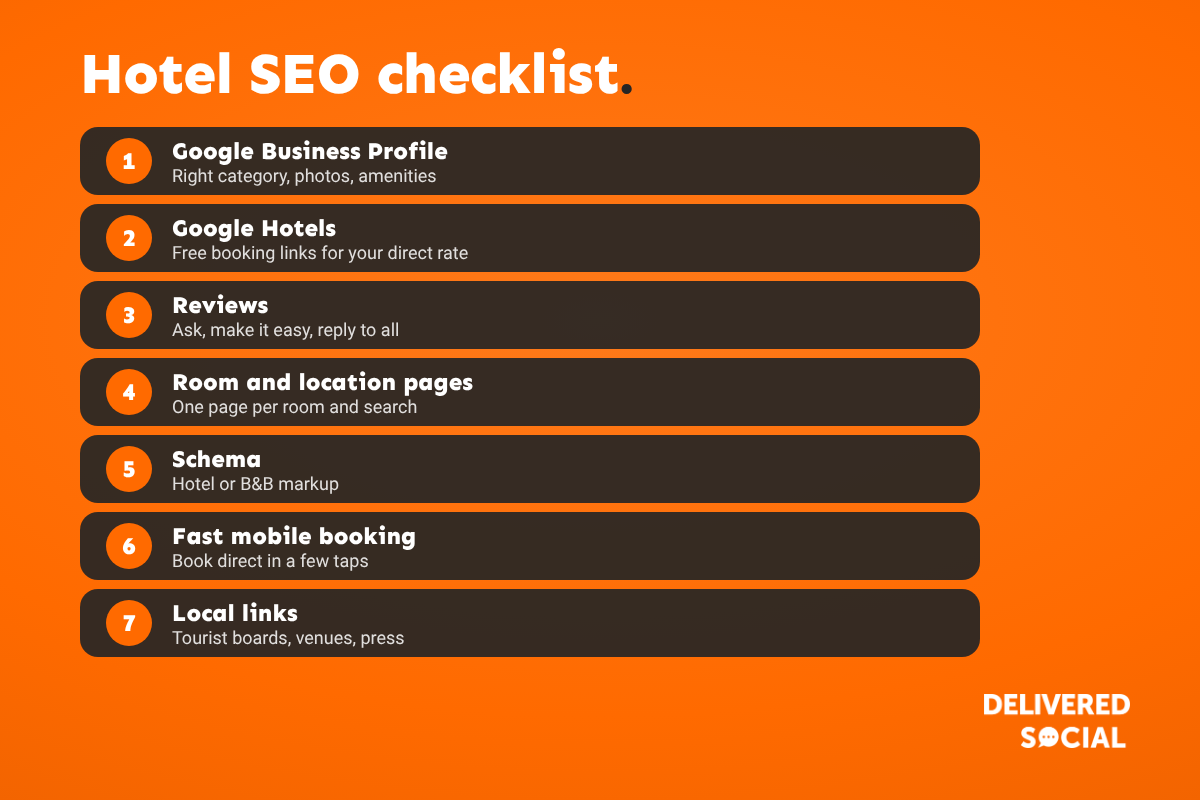
What is hotel SEO?
Hotel SEO is everything you do to help guests find your property in search, and book directly when they do. It covers three places:
- Google Maps and the local results, where people compare places to stay in an area.
- Google Hotels, the price comparison panel that appears for hotel searches.
- Normal search results, where your website, booking site listings and travel guides appear.
Increasingly it also covers AI answers, where tools recommend places to stay based on what they can read about you online.
Why direct bookings matter
- No commission, so you keep more of every room night.
- You own the guest relationship: their email, their preferences and the chance to welcome them back.
- Better guests: direct bookers often stay longer and spend more on extras.
- Less reliance on platforms that can change their rules or rankings at any time.
OTAs still have their place for reaching new guests. The aim of hotel SEO is to make sure that once someone has found you, booking direct is the easiest option.
Step 1: Get your Google Business Profile perfect
For many guests, your Google profile is the first thing they see. Make sure it has:
- The right primary category, such as “Hotel”, “Bed & breakfast”, “Guest house” or “Inn”.
- Accurate amenities: parking, breakfast, pets, accessibility, Wi-Fi, EV charging.
- Lots of real photos: every room type, bathrooms, breakfast, outside, the view and the local area.
- Your own website as the main link, ideally straight to your booking page.
- Regular posts for offers, events and seasonal breaks.
- Answers to common questions such as check-in times, parking and dogs.
Step 2: Turn on free booking links in Google Hotels
Google Hotels shows prices from different booking sites side by side. Through Google’s free booking links, your own website can appear in that list too, at no cost per click. This usually needs your booking engine or channel manager to connect to Google, so ask your provider whether they support it. It’s one of the quickest ways for a small property to put its direct rate in front of people comparing prices.
Step 3: Build a steady flow of reviews
- Ask every happy guest at checkout, and follow up with a short email and a direct review link.
- Reply to every review on Google and Tripadvisor, thanking people by name and mentioning something specific.
- Handle complaints calmly, apologise for the experience and offer to put it right privately.
- Never offer discounts or freebies for reviews. It breaks Google’s rules and UK law on fake and incentivised reviews.
Step 4: Make your website do the booking
- A “Book direct” button at the top of every page, going straight to live availability.
- Show your best rate and the reasons to book direct: best price, free parking, early check-in, a welcome drink, flexible cancellation.
- Fast on a phone. Many guests book on mobile, often on the move.
- A booking engine that matches your site, with as few steps as possible.
- Clear policies on cancellation, check-in, parking and pets, so guests don’t leave to find answers elsewhere.
Step 5: Create the right pages
Guests search for what they want and where. Give each important search its own page.
| What guests search | Page to create |
|---|---|
| B&B in [town], hotel near [landmark or station] | Homepage and location page |
| Dog-friendly hotel [area] | Dog-friendly stays page |
| Family room [town], hotel with parking [town] | Room pages with clear amenities |
| Spa break, romantic break [area] | Breaks and packages page |
| Wedding venue with rooms [area] | Weddings and events page |
| Things to do in [area] | Local guide content |
Give every room type its own page with photos, size, bed type, view, accessibility and price, rather than one long rooms page.
Step 6: Get the on-page basics right
- Page titles that say what you are and where, for example “Dog-Friendly B&B in the New Forest | [Name]”.
- Meta descriptions that give a reason to click, such as “Free parking, breakfast included, 5 minutes from the beach.”
- One clear H1 per page and helpful headings below.
- Descriptive image file names and alt text, such as “sea view double room in Brighton”.
- Your full address and phone number on every page, usually in the footer, with a map on your contact page.
Step 7: Add hotel schema
Schema is code that tells search engines the facts about your property. Hotels can use types such as Hotel, BedAndBreakfast or LodgingBusiness to mark up your name, address, star rating, amenities, check-in times, price range and reviews, plus FAQ schema for common questions. Your web developer can add it, and it helps both search engines and AI tools understand you.
Step 8: Write content about your area
Many guests start by planning the trip, not the hotel. Content that helps them plan gets you found earlier:
- “Things to do near [your hotel]” guides with walking times.
- Event guides: festivals, races, shows and weddings in your area.
- Seasonal breaks: Christmas, spring walks, summer beaches.
- How to get here: parking, trains and taxis.
Write from experience. Your own tips and photos are something no booking site can copy.
Step 9: Get listed and linked locally
- Tourism sites: your local tourist board and VisitEngland, VisitScotland, Visit Wales or Discover Northern Ireland, as relevant.
- Local attractions, wedding venues and event organisers that recommend places to stay.
- Directories such as Tripadvisor, Bing Places and Apple Business Connect, with identical details everywhere.
- Local press for openings, refurbishments, awards and events.
Step 10: Use social media to support search
Social media doesn’t directly raise rankings, but it brings people to search for you by name, look at your profile and book. Our guide to social media for hotels covers what to post.
How to measure hotel SEO
- Direct bookings and revenue from your booking engine, by source.
- Google Search Console: the searches you appear for and your clicks.
- Google Analytics 4: visits and bookings from organic search, with booking engine tracking set up properly.
- Google Business Profile: calls, website clicks and direction requests.
- Your OTA share: the percentage of bookings coming through commission channels, which should fall over time.
Common hotel SEO mistakes
- Sending your Google profile’s website link to a booking site instead of your own.
- One page for all rooms, with no detail.
- Copying room descriptions straight from OTA listings.
- A slow, clunky booking engine on mobile.
- Never replying to reviews.
- Different phone numbers and addresses across directories.
Frequently asked questions
How can a small hotel get more direct bookings?
Perfect your Google Business Profile, turn on free booking links in Google Hotels, give guests a clear reason to book direct, make booking easy on mobile, and collect and reply to reviews.
Is hotel SEO worth it for a B&B?
Yes. Even a few extra direct bookings a month can cover the cost, because you keep the commission you’d otherwise pay an OTA.
How long does hotel SEO take?
Google Business Profile and Google Hotels improvements can show results within weeks. Website rankings for competitive searches usually take a few months.
Should I stop using Booking.com and Expedia?
Most independent properties keep OTAs for reach. The goal is to rely on them less by making direct booking easier and better value.
What is hotel schema?
It’s code on your website that tells search engines key facts such as your address, amenities, check-in times and reviews, in a format they can read easily.
Do reviews affect hotel rankings?
Yes. The number, quality and freshness of reviews, and how you reply, help Google decide how prominent you are in local results, and they strongly influence whether guests book.
Want more direct bookings?
We help independent hotels, B&Bs and travel businesses across the UK get found on Google and book more guests direct. See our SEO for travel and hospitality, explore our local SEO services, or call us on 01483 608 303 for a friendly chat.