

Keep reading
Rather we just did it for you?
Let's get your business seen.
Social media, websites, SEO and ads from a team you can actually meet.
Customers notice when a business treats them as an individual, and they notice when it doesn’t. An email that mentions what they actually bought, a website that shows services in their area, or an offer that arrives at the right moment all feel helpful. Personalisation in digital marketing is about using what you know about customers to make your marketing more relevant, while respecting their privacy.
This guide explains what personalisation means, practical examples for small businesses, the UK rules to follow and how to get started without expensive software.
What is personalisation in digital marketing?
Personalisation means tailoring messages, offers and content to different customers based on information such as:
- Who they are: business or consumer, location, sector.
- What they’ve done: pages viewed, products bought, emails opened.
- Where they are in the journey: new visitor, enquiry, first-time customer, loyal client.
- What they’ve told you: preferences, interests and needs.
It ranges from simple, such as using a first name in an email, to advanced, such as websites that change content for each visitor.
Why personalisation matters
- More relevant messages get more attention, more clicks and more sales.
- It builds loyalty, because customers feel understood.
- It reduces waste, by not sending the wrong offer to the wrong people.
Personalisation examples for small businesses
| Channel | Simple personalisation |
|---|---|
| Separate lists for customers and prospects, offers based on past purchases, service reminders, birthday or anniversary messages | |
| Website | Location pages for each area you serve, service pages for each type of customer, case studies from similar businesses |
| Paid ads | Retargeting people who viewed a product or service, different ads for different audiences and locations |
| Social media | Content for each audience, replying to comments by name, user-generated content from real customers |
| Sales follow-up | Quotes and emails that reference the customer’s actual project and concerns |
Email marketing personalisation
Email is the easiest place to start, because you already know who you’re writing to.
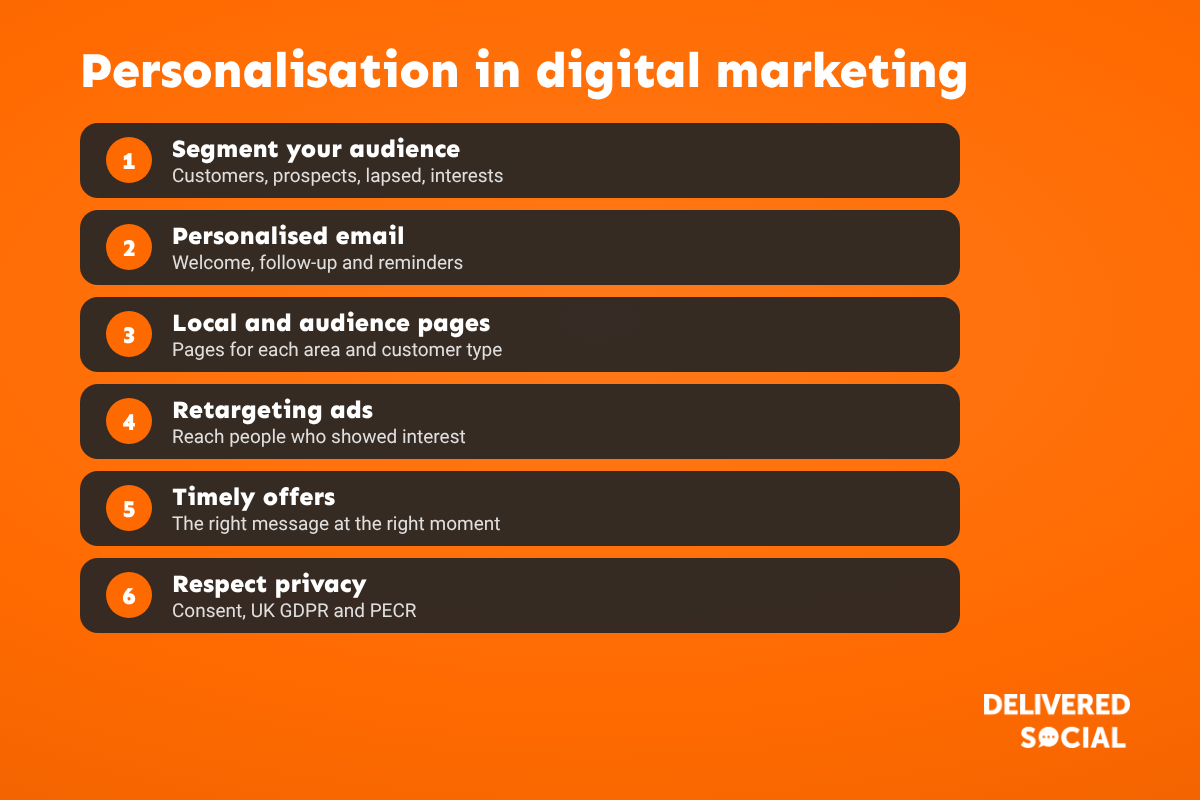
- Segment your list: customers, prospects, lapsed customers, and by service or product interest.
- Use behaviour: welcome emails for new subscribers, follow-ups after an enquiry, reminders when a service is due.
- Personalise the content, not just the name. Relevant offers and advice matter more than “Hi Sarah”.
- Get the timing right: send seasonal reminders before people need them.
Website personalisation
- Location pages for each town you serve, with local reviews and examples.
- Audience pages for each type of customer, such as charities, restaurants or trades.
- Relevant calls to action, such as “Book a table” for diners and “Get a quote” for event enquiries.
- Related content suggestions at the end of articles and service pages.
Personalisation and privacy: the UK rules
Personalisation must respect privacy. In the UK, UK GDPR and the Privacy and Electronic Communications Regulations (PECR) set the rules. In practice:
- Get consent for marketing emails to individuals, unless the soft opt-in applies to existing customers buying similar products, and always offer a simple unsubscribe.
- Use a proper cookie banner and get consent before using non-essential tracking cookies.
- Be transparent in your privacy policy about what you collect and why.
- Collect only what you need, and keep it secure.
- Avoid being creepy. Helpful personalisation feels like good service; overly specific messages feel like surveillance.
The Information Commissioner’s Office (ICO) has clear guidance for small businesses.
Tools that help
- Email platforms such as Mailchimp, Brevo or Klaviyo for segments and automated emails.
- A CRM to keep customer details, purchases and conversations in one place.
- Google Analytics 4 to understand how different visitors behave.
- Ad platforms such as Google Ads and Meta for audiences and retargeting.
How to get started
- Split your list into customers and prospects as a minimum.
- Set up one automated email, such as a welcome or a follow-up after an enquiry.
- Create pages for your main audiences or areas.
- Run one retargeting campaign for people who visited your key service page.
- Measure the difference in opens, clicks and enquiries, and build from there.
Common personalisation mistakes
- Getting names or details wrong because data is out of date.
- Sending the same “personal” email to everyone.
- Following people around with ads long after they’ve bought.
- Collecting data without consent or a clear reason.
Frequently asked questions
What is personalisation in digital marketing?
Using what you know about customers to make your emails, website, ads and content more relevant to each person or group.
Is personalisation only for big brands?
No. Small businesses can personalise with simple email segments, location pages and retargeting, without expensive software.
What is email marketing personalisation?
Tailoring emails by audience, behaviour and timing, such as follow-ups after an enquiry or offers based on past purchases.
Is personalised marketing legal in the UK?
Yes, as long as you follow UK GDPR and PECR, including consent for marketing emails and non-essential cookies where required.
Want marketing that feels personal?
We help small businesses across Surrey, Hampshire and the UK with websites, email, social media and ads that speak to the right people. See our social media services or call us on 01483 608 303 for a friendly chat.