

Keep reading
Rather we just did it for you?
Let's get your business seen.
Social media, websites, SEO and ads from a team you can actually meet.
Search has changed more in the last two years than in the ten before. Google now shows AI Overviews above many results, AI Mode answers questions in a conversation, and millions of people ask ChatGPT, Gemini and Perplexity for recommendations instead of searching at all. AI SEO covers both sides of this: using AI tools to do SEO faster, and making sure your business still gets found when AI writes the answer.
This guide explains how Google’s AI features work, what it means for small business websites, the AI SEO tools worth using and the practical steps we take on the websites we build and manage.
What is AI SEO?
The term is used in two ways:
- Using AI for SEO: tools that help with keyword research, content outlines, technical audits, internal links and reporting.
- SEO for AI search: making your website and brand the source that AI Overviews, AI Mode, ChatGPT and other assistants pick up, quote and link to. This is sometimes called GEO (generative engine optimisation) or AEO (answer engine optimisation).
The good news: the second one is mostly good SEO done properly. The basics haven’t been replaced, they’ve become more important.
How does Google’s AI work in search?
AI Overviews
An AI Overview is a short AI-written summary shown at the top of some results, with links to the pages it drew on. Google generates it using its Gemini models together with its normal search systems, so the sources are usually pages that already rank well and answer the question clearly.
AI Mode
AI Mode is a separate, conversational search tab. It breaks a question into several searches behind the scenes, pulls together an answer and lets the user ask follow-ups. It tends to appear for longer, more complicated questions.
What this means for clicks
Simple informational questions, such as “what is a canonical tag”, are increasingly answered on the results page, so some of those clicks go away. Searches where people want to buy, book, compare or get a quote still send plenty of visitors, and the people who do click through are often further along in deciding. For most small businesses, the searches that bring enquiries are the ones that matter, and those are holding up far better.
How ChatGPT, Gemini and Perplexity find businesses
AI assistants that browse the web look things up in search indexes (ChatGPT search draws on sources including Bing, Gemini uses Google), then summarise what they find. They lean on:
- Pages that answer the question directly and clearly.
- Well-known, consistent information about your business across the web: your website, Google Business Profile, directories, reviews and press mentions.
- Mentions on other trusted sites, such as “best of” lists, local news and industry sites.
Our guide to brand visibility in ChatGPT, Perplexity and Gemini goes into more detail.
How to optimise your website for AI search
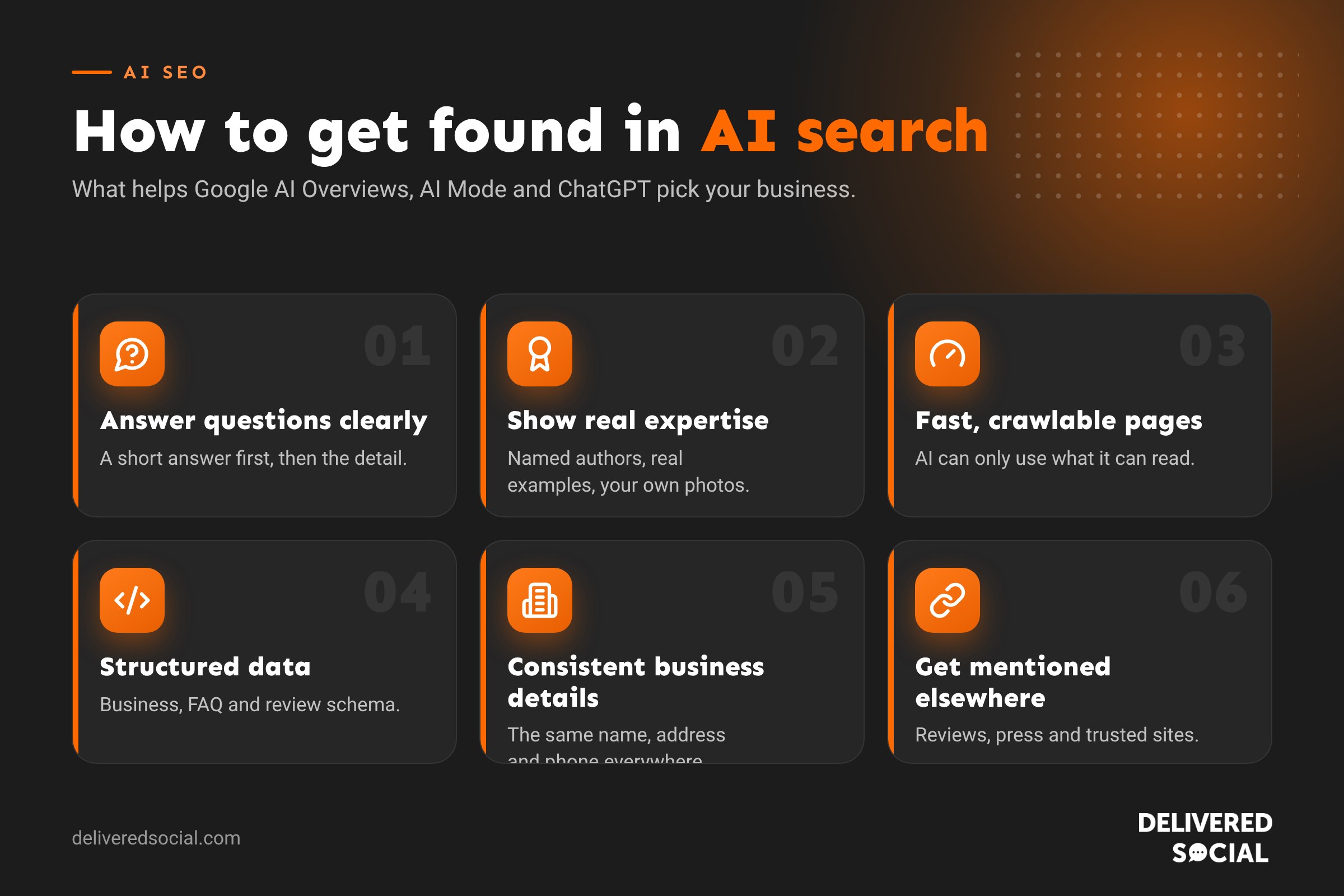
| Step | What to do | Why it helps |
|---|---|---|
| Answer questions clearly | Put a short, direct answer near the top of each page, then go into detail | Easy for AI to understand and quote |
| Show real expertise | Named authors, real examples, your own photos, prices and process | Google rewards experience and trust |
| Structure your pages | Clear headings, lists, tables and FAQs | Makes facts easy to pull out |
| Keep it crawlable | Fast pages, important text in the HTML, no blocked sections | AI can only use what it can read |
| Add structured data | LocalBusiness, Organization, FAQ, Product and Review schema where relevant | Spells out key facts for machines |
| Be consistent everywhere | Same name, address, phone and services on every profile | Builds confidence in who you are |
| Get mentioned elsewhere | Reviews, local press, directories, partner sites | AI looks for agreement across sources |
| Keep content up to date | Review key pages at least once a year | Fresh, accurate pages are preferred |
Google itself says there are no special tricks needed for AI Overviews: the same practices that help you rank in normal search apply. That’s why the basics in our SEO strategy guide still come first.
ChatGPT SEO: can you rank in ChatGPT?
There’s no ChatGPT ranking you can buy or submit to. What you can do is make it more likely that ChatGPT finds and recommends you:
- Make sure your website isn’t blocking AI search crawlers such as OAI-SearchBot in robots.txt, unless you’ve chosen to.
- Check your business is listed correctly on Bing Places as well as Google.
- Create pages that match how people ask: “best [service] in [town] for [type of customer]”.
- Build reviews and mentions on trusted sites, which AI tools use as evidence.
- Ask ChatGPT, Gemini and Perplexity about your services and area every few months and note who gets recommended.
The best AI SEO tools
New SEO tools appear every week. These are the ones that genuinely save time:
| Tool | Good for | Cost |
|---|---|---|
| Google Search Console | Seeing which searches bring visitors, indexing and errors | Free |
| ChatGPT, Claude or Gemini | Outlines, FAQs, meta descriptions, schema and spreadsheets | Free and paid plans |
| Semrush or Ahrefs | Keyword research, competitor gaps, backlinks, AI visibility tracking | Paid |
| Screaming Frog | Technical audits of your whole site | Free up to 500 URLs |
| Surfer, Clearscope and similar | Checking content covers a topic fully | Paid |
| PageSpeed Insights | Mobile speed and Core Web Vitals | Free |
For more free options, see our list of the best free SEO tools in the UK.
How to use AI for SEO without hurting your rankings
- Use AI for the legwork: research, outlines, first drafts of FAQs, title and description ideas, schema code and spotting gaps.
- Add what AI can’t: your experience, examples, opinions, prices, photos and local knowledge. That’s what makes a page worth ranking.
- Check every fact. AI tools still get things wrong with confidence.
- Don’t publish in bulk. Google’s spam policies target large amounts of low-value content made mainly to rank, however it’s produced.
- Protect your data. Don’t paste customer details or confidential information into AI tools, in line with UK GDPR.
SEO trends to plan for
- Fewer clicks on simple questions, more value in pages that help people decide and buy.
- Brand matters more: people search for names they’ve heard of, and AI recommends brands it sees mentioned.
- Local search stays strong: Google Business Profile and reviews remain key for “near me” searches.
- Video and images appear more often in results and AI answers.
- Measuring changes: watch enquiries and conversions, not just traffic. AI Overview and AI Mode clicks are included in your normal Search Console totals.
Frequently asked questions
What is AI SEO?
Using AI tools to help with SEO, and optimising your website so AI search features and assistants find, understand and recommend your business.
Will AI replace SEO?
No. AI search still relies on web pages for its answers. SEO is shifting towards clear, trustworthy content and a strong brand presence across the web.
How do I get my business into Google’s AI Overviews?
There’s no separate process. Rank well for the question, answer it clearly near the top of the page, show real expertise and keep the page crawlable and fast.
Is AI-written content bad for SEO?
Not in itself. Google judges quality, not how content was made. Thin, unchecked content published in bulk is the problem.
What is GEO?
Generative engine optimisation: improving how often AI assistants mention and link to your business. It overlaps heavily with good SEO and digital PR.
Want to be found in AI search?
We build and manage fast, well-structured WordPress websites for small businesses across Surrey, Hampshire and the UK, with SEO built in from the start. See our SEO services or call us on 01483 608 303 for a friendly chat.