

Keep reading
Rather we just did it for you?
Let's get your business seen.
Social media, websites, SEO and ads from a team you can actually meet.
How much does a social media manager earn in the UK? Whether you’re thinking about a career in social media, asking for a pay rise or working out whether to hire someone for your business, the answer matters. This guide covers the average social media manager salary in the UK, how pay changes with experience, the difference between job titles, what affects pay, freelance options and the real cost of hiring a social media manager compared with outsourcing.
Average social media manager salary in the UK
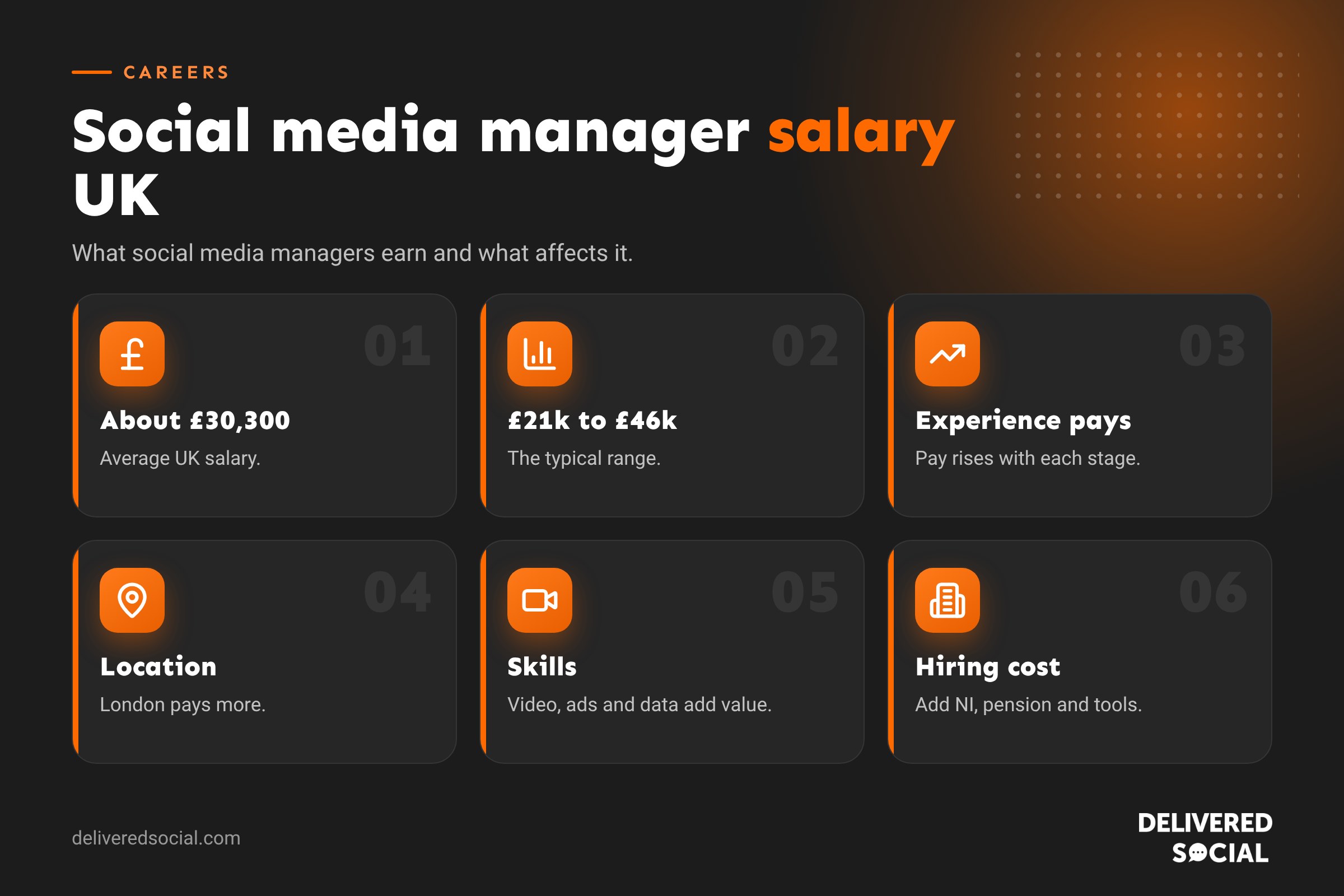
According to PayScale’s UK data, updated in October 2026, the average social media manager salary in the UK is around £30,300 a year. The middle range runs from about £21,000 for the lowest-paid 10 percent to £46,000 for the highest-paid 10 percent. With bonuses, total pay ranges from roughly £21,000 to £48,000.
| Measure | Figure |
|---|---|
| Average base salary | About £30,300 |
| Typical range | £21,000 to £46,000 |
| Bonus | £150 to £6,000 |
| Total pay range | £21,000 to £48,000 |
Salary surveys vary depending on who responds, so treat these as a guide rather than a fixed rate. Job adverts in your area are the best check on what employers are paying right now.
Social media manager salary by experience
| Experience | Typical role | Average total pay |
|---|---|---|
| Under 1 year | Social media assistant or junior executive | About £20,800 |
| 1 to 4 years | Social media executive or manager | About £27,800 |
| 5 to 9 years | Social media manager or senior manager | Above the national average |
| 10 years or more | Head of social or social media director | Well above the national average |
PayScale’s data suggests pay rises steadily with experience. Mid-career social media managers typically earn around 14 percent more than the average, and late-career professionals considerably more again. Senior roles such as head of social, which manage teams and budgets, can pay significantly more, especially in London and in large companies.
Social media salaries by job title
Social media job titles vary a lot, and so does pay. Here’s how the common titles compare:
| Job title | What they do | Typical pay level |
|---|---|---|
| Social media assistant or administrator | Scheduling, replying to comments, simple content | Entry level |
| Social media executive | Creating and posting content, reporting | Entry to mid level |
| Social media content manager | Planning and producing content | Around £26,000 average (PayScale) |
| Social media marketing manager | Strategy, campaigns and sometimes paid ads | Around £25,000 average (PayScale, smaller sample) |
| Social media manager | Strategy, content, community and reporting | Around £30,300 average (PayScale) |
| Senior social media manager | Leads campaigns, manages juniors | Above average |
| Head of social | Owns social strategy across a business | Senior level |
Some PayScale figures for specialist titles come from small samples, so they can look lower than you’d expect. Compare them with live job adverts before drawing conclusions.
What affects a social media manager’s salary?
Location
London salaries are usually higher than the UK average, reflecting living costs and the number of large brands and agencies based there. Major cities such as Manchester, Birmingham, Bristol and Edinburgh also tend to pay above smaller towns. Remote and hybrid roles have narrowed the gap a little.
Type of employer
- Large brands often pay more and offer bigger budgets.
- Agencies offer variety and fast learning, with pay that varies widely.
- Small businesses may pay less but give you broad responsibility.
- Charities and the public sector often pay a little less but may offer better pensions and flexibility.
Skills
Skills that tend to push pay up include:
- Paid social advertising on Meta, TikTok and LinkedIn.
- Video filming and editing, especially short-form video.
- Data analysis and reporting that links social to sales.
- Strategy and campaign planning.
- Community management and crisis handling.
- Managing people, budgets and agencies.
Industry
Finance, technology and large consumer brands often pay more than hospitality, retail and the not-for-profit sector.
Freelance social media manager rates
Many social media managers work freelance, charging by the hour, day or month. Rates vary hugely depending on experience, location and what’s included. Some charge a monthly retainer for a set number of posts and platforms, while others charge a day rate for strategy or content shoots.
When comparing freelancers, look at exactly what’s included: how many posts a month, which platforms, whether they create the photos and videos, whether they reply to comments and messages, and whether reporting is included. A low monthly fee that only covers scheduling isn’t the same as a full service.
What does a social media manager do?
- Plans a social media strategy linked to business goals.
- Creates or commissions photos, videos, graphics and captions.
- Schedules and publishes content across platforms.
- Replies to comments and messages, and manages the community.
- Runs and optimises paid social campaigns.
- Tracks results and reports on what’s working.
- Keeps up with platform changes and trends.
How to become a social media manager
- Learn the platforms. Understand how Instagram, Facebook, TikTok and LinkedIn work for businesses.
- Build a portfolio. Run social media for a local business, a charity, a club or your own project.
- Get qualified if it helps. Free courses from Meta Blueprint, Google and HubSpot show commitment, and a CIM qualification can help later in your career.
- Develop creative skills. Learn to film and edit short videos and design simple graphics in tools such as Canva.
- Learn the numbers. Understand reach, engagement, clicks and conversions.
- Start as an assistant or executive and work up.
Many social media managers don’t have a marketing degree. A strong portfolio and evidence of results often matter more.
How to negotiate a higher social media salary
- Research live job adverts for similar roles in your area.
- Bring evidence: follower growth, engagement, leads, sales and campaign results.
- Highlight skills such as paid ads, video and analytics.
- Ask about training, flexible working and progression as well as salary.
- Time your conversation after a successful campaign or at your annual review.
The real cost of hiring a social media manager
If you’re a business owner, salary is only part of the cost. When you employ someone, you’ll also pay:
| Cost | What to budget |
|---|---|
| Salary | Around £30,000 for an experienced manager |
| Employer’s National Insurance | 15% of earnings above the £5,000 threshold |
| Pension contributions | At least 3% of qualifying earnings |
| Holiday and sickness cover | Social media doesn’t stop when they’re away |
| Tools and software | Scheduling, design and editing tools |
| Equipment | Laptop, phone, lighting and microphones |
| Training | Keeping up with platform changes |
| Recruitment and management time | Hiring, onboarding and supervision |
Once you add these up, an experienced in-house social media manager can cost a business significantly more than their headline salary. And you’ll typically get one person’s skills, so you may still need help with video, design or ads.
In-house vs agency: which is right for you?
| In-house manager | Agency | |
|---|---|---|
| Cost | Salary plus on-costs | Monthly fee, no employment costs |
| Skills | One person’s skills | A team: strategy, content, video, ads |
| Cover | Gaps during holidays and sickness | Continuous cover |
| Knowledge of your business | Deep, day-to-day | Built through regular contact |
| Flexibility | Fixed cost | Scale up or down |
For many small and medium-sized businesses, an agency or a mix of the two works best. A team member can capture everyday moments while the agency handles strategy, content creation, scheduling and reporting.
Benefits beyond salary
When comparing social media jobs, look at the whole package, not just the salary. Hybrid or remote working can save hundreds of pounds a month in travel. Training budgets, conference tickets and paid courses help you grow your skills and your future earnings. Other perks to weigh up include a better pension contribution than the legal minimum, private healthcare, extra holiday, flexible hours and a bonus scheme linked to results.
Agency roles can also offer something money can’t easily buy: experience across many industries, platforms and campaigns in a short time. For people early in their career, that variety can lead to a faster jump to senior roles and higher pay later on.
Finally, think about progression. A role with a clear path from executive to manager to head of social may be worth more over five years than a slightly higher starting salary in a job with nowhere to go.
Frequently asked questions
How much does a social media manager earn in the UK?
Around £30,300 a year on average, according to PayScale, with most earning between £21,000 and £46,000.
How much do social media managers earn in London?
London pay is usually higher than the UK average. Check current London job adverts for the most accurate picture.
What is the salary of a social media assistant or administrator?
Entry-level social media roles typically start around the £20,000 mark, depending on location and employer.
Is social media management a good career?
Yes. Demand for people who can create content and prove results remains strong, and skills in video, paid ads and analytics can lead to senior roles.
Is it cheaper to hire an agency than a social media manager?
Often, once you include National Insurance, pension, tools, equipment and cover. It depends on how much work you need.
Thinking about outsourcing your social media?
We manage social media for businesses across Surrey, Hampshire and the UK, with a team covering strategy, content, video and reporting. See our social media management services or call us on 01483 608 303.