

Keep reading
Rather we just did it for you?
Let's get your business seen.
Social media, websites, SEO and ads from a team you can actually meet.
Without clear marketing objectives, it’s impossible to know whether your marketing is working. You end up posting, advertising and emailing without a target, then wondering where the money went. This guide explains what marketing objectives are, how they differ from aims and goals, the most common types, how to write them using the SMART method, and plenty of examples of marketing objectives you can adapt for your own business.
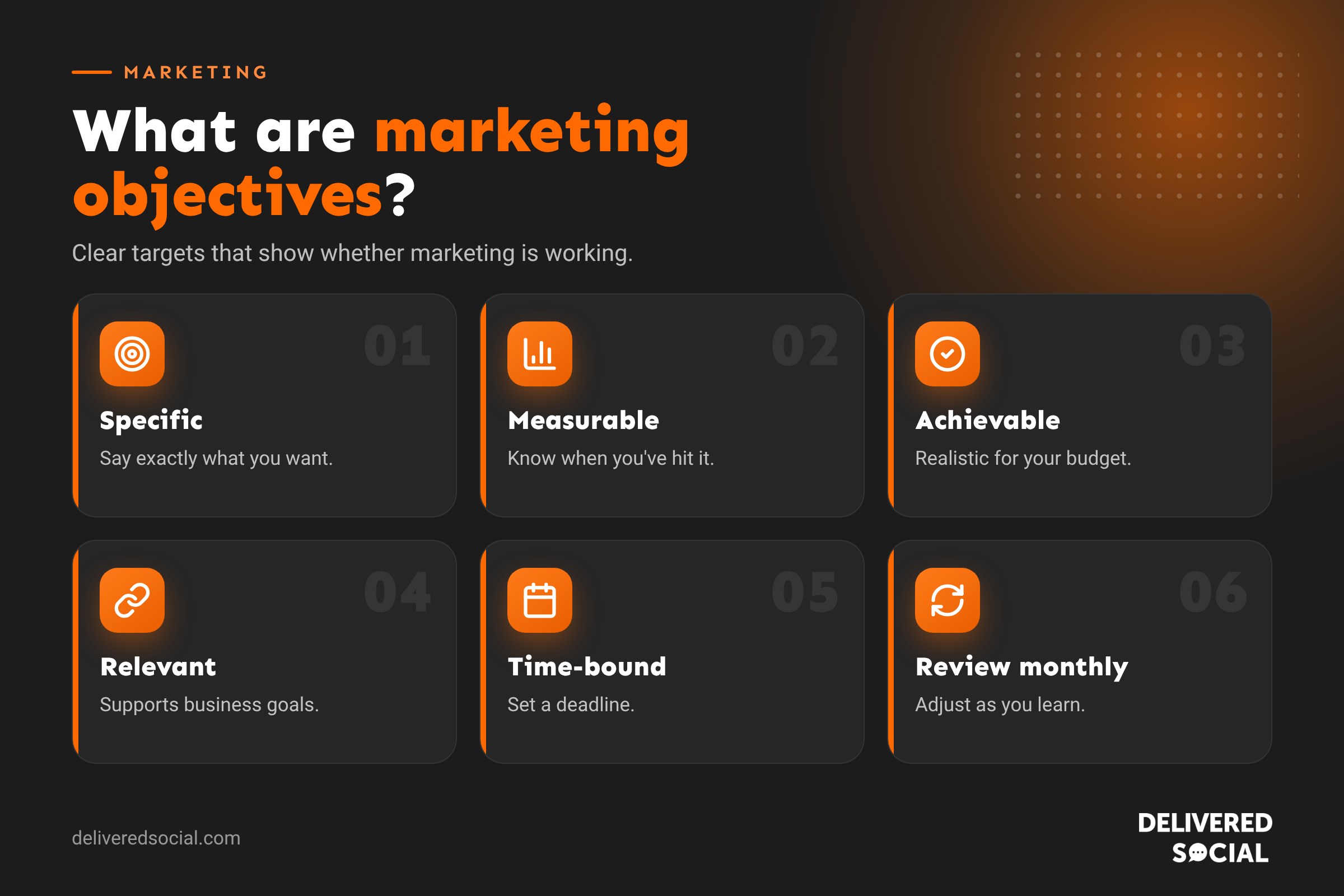
What are marketing objectives?
A marketing objective is a specific, measurable target your marketing activity is designed to achieve within a set time. It turns a general ambition, such as “grow the business”, into something you can plan for and track, such as “generate 40 new enquiries a month from the website by June”.
Marketing objectives sit between your business goals and your marketing tactics. Your business goal might be to increase turnover by 20 percent. Your marketing objectives describe what marketing needs to deliver to help get there. Your tactics, such as social media, SEO, email and adverts, are how you’ll do it.
Marketing aims vs objectives vs goals
| Term | What it means | Example |
|---|---|---|
| Aim | A broad statement of what you want to achieve | Become the best-known bakery in Farnham |
| Goal | A general target, often longer term | Grow online orders |
| Objective | A specific, measurable, time-bound target | Increase online orders by 25% by 31 March |
| Strategy | The overall approach to reach the objective | Promote online ordering to local families |
| Tactic | The specific actions you’ll take | Weekly Instagram Reels and a local Facebook ad |
People often use “aims”, “goals” and “objectives” interchangeably. What matters is that you end up with targets specific enough to measure.
Why marketing objectives matter
- Focus: you spend time and money on what moves the business forward.
- Measurement: you can tell what’s working and what isn’t.
- Budget decisions: you know where to invest more and where to cut back.
- Team alignment: everyone, including any agency you work with, knows what success looks like.
- Motivation: hitting clear targets is more rewarding than vague effort.
The main types of marketing objectives
1. Brand awareness
Getting more of the right people to know you exist. Measured by reach, impressions, website visitors, branded searches and social followers.
2. Lead generation
Getting potential customers to enquire or sign up. Measured by form submissions, calls, quote requests, bookings and email sign-ups.
3. Sales and revenue
Turning interest into paying customers. Measured by online sales, average order value and revenue from marketing channels.
4. Customer retention
Keeping customers and encouraging repeat business. Measured by repeat purchase rate, renewals and customer lifetime value.
5. Engagement
Building a relationship with your audience. Measured by comments, shares, saves, email opens and time on site.
6. Market share and growth
Growing in a market or area. Measured by new customers in a region, or entering a new market.
7. Reputation
Building trust. Measured by the number and rating of Google reviews, testimonials and press mentions.
8. Product or service launch
Making a new offer a success. Measured by pre-orders, launch-week sales and enquiries.
How to write SMART marketing objectives
The SMART method is the simplest way to turn a vague goal into a clear objective. Each objective should be:
| Letter | Meaning | Question to ask |
|---|---|---|
| S | Specific | What exactly do we want to achieve? |
| M | Measurable | How will we know we’ve achieved it? |
| A | Achievable | Is it realistic with our budget and time? |
| R | Relevant | Does it support our business goals? |
| T | Time-bound | By when? |
Not SMART: “Get more followers on Instagram.”
SMART: “Grow our Instagram following from 1,200 to 2,000 local followers by 30 June, by posting four Reels a week and running a monthly giveaway with local businesses.”
Our guide to setting SMART marketing goals goes into more detail.
Examples of marketing objectives
Awareness objectives
- Increase website visitors from Surrey by 30% within six months.
- Reach 50,000 local people with social media content each month by the end of Q2.
- Double branded Google searches for our business name within 12 months.
Lead generation objectives
- Generate 25 quote requests a month from the website by September.
- Collect 500 new email subscribers in the next quarter.
- Book 15 free consultations a month through Instagram and Facebook by the end of the year.
Sales objectives
- Increase online sales by 20% year on year during the Christmas period.
- Raise average order value from £45 to £55 within six months.
- Sell 200 tickets to our spring event by 1 March.
Retention objectives
- Increase repeat customers from 25% to 35% within 12 months.
- Achieve a 40% open rate on our monthly customer newsletter by June.
- Reduce cancellations of our monthly plan by 10% this year.
Reputation objectives
- Grow from 40 to 100 Google reviews with a 4.8 average by December.
- Gain coverage in two local publications this quarter.
Digital marketing objectives by channel
| Channel | Example objective | Key measure |
|---|---|---|
| SEO | Rank on page one for five priority local keywords in 6 months | Rankings and organic traffic |
| Social media | Increase engagement rate to 4% by Q3 | Engagement rate |
| Paid ads | Generate leads at under £25 each | Cost per lead |
| Drive 10% of monthly sales from email by June | Revenue from email | |
| Website | Improve enquiry conversion rate from 2% to 3% | Conversion rate |
| Google Business Profile | Increase calls from Google Maps by 25% | Calls and direction requests |
How to set your marketing objectives step by step
- Start with your business goals. What does the business need this year: more revenue, more customers, a new location?
- Look at your current numbers. Website visitors, enquiries, sales, followers and conversion rates give you a starting point.
- Work backwards. If you need 10 new clients a month and you convert one in four enquiries, you need 40 enquiries a month.
- Choose three to five objectives. Too many and you’ll lose focus.
- Make each one SMART.
- Choose the channels and tactics that will help you hit each objective.
- Assign an owner for each objective.
- Review monthly and adjust.
A worked example
A family-run garden landscaping business wants to grow turnover by £60,000 next year. Their average project is worth £6,000, so they need 10 extra projects. They win about one in five quotes, so they need 50 more quote requests across the year, or about four extra a month.
Their marketing objectives become:
- Increase quote requests from the website from 6 to 10 a month by May.
- Grow Google reviews from 30 to 60 by December to build trust.
- Publish one project case study a month and share it on Instagram and Facebook.
Each one links directly to the business goal and can be measured.
Marketing objectives and the customer journey
It helps to set objectives for each stage of the journey your customers take. Frameworks such as the AIDA model (Awareness, Interest, Desire, Action) make this easy. For example, an awareness objective for reach, an interest objective for website visits, a desire objective for brochure downloads and an action objective for bookings.
Common mistakes when setting marketing objectives
- Being too vague: “do more social media” can’t be measured.
- Chasing vanity metrics: followers and likes are nice, but enquiries and sales pay the bills.
- Setting unrealistic targets: doubling sales in a month with no budget sets you up to fail.
- Not tracking: set up Google Analytics, call tracking and form tracking before you start.
- Setting and forgetting: review progress every month.
- Too many objectives: focus on the few that matter most.
How to track your marketing objectives
- Google Analytics 4: website visitors, sources and conversions.
- Google Search Console: search rankings and clicks.
- Social media insights: reach, engagement and link clicks.
- Your CRM or booking system: enquiries, customers and revenue.
- A simple monthly dashboard or spreadsheet with your objectives and actual results side by side.
Setting objectives with a small budget
You don’t need a big marketing budget to set good objectives. In fact, clear objectives matter even more when money is tight, because they stop you spreading it too thinly. Pick one main objective for the next three months, such as more enquiries from your website, and focus most of your time and budget on the channels most likely to deliver it. Once you hit it, or learn what works, add a second objective. Small, focused wins build momentum and give you real data to plan the next step.
Frequently asked questions
What is a marketing objective?
A specific, measurable target that your marketing activity aims to achieve within a set time, such as increasing enquiries by 20% in six months.
What are the four main marketing objectives?
Many businesses focus on four: building awareness, generating leads, increasing sales and keeping customers.
What’s the difference between a marketing aim and an objective?
An aim is a broad ambition. An objective is a specific, measurable target that helps you achieve it.
How many marketing objectives should I have?
Three to five is a good number for most small businesses.
What is an example of a SMART marketing objective?
“Increase online bookings by 15% between January and June through weekly email campaigns and Instagram Reels.”
Want help setting and hitting your marketing objectives?
We help businesses across Surrey, Hampshire and the UK set clear marketing objectives and deliver against them, with social media, SEO, websites and ads that are measured every month. See our social media services or call us on 01483 608 303.