

Keep reading
Rather we just did it for you?
Let's get your business seen.
Social media, websites, SEO and ads from a team you can actually meet.
Many small businesses run marketing as a series of short bursts: a sale here, a seasonal offer there, a big push when things go quiet. Campaigns like these can bring a quick lift, but when they stop, enquiries often drop straight back down. The missing piece is usually brand awareness: the steady, always-on work that makes people know, like and remember you before they need you. This guide explains what marketing campaigns are, how they differ from brand awareness, why you need both, and how to balance them so your marketing keeps working between the bursts.
What is a marketing campaign?
A marketing campaign is a planned burst of activity with a specific goal, a clear message and a set time frame. Examples include:
- A summer sale with a discount code.
- A new product or service launch.
- A Christmas booking push for a restaurant.
- A recruitment drive for new staff.
- A fundraising appeal for a charity.
Campaigns usually combine several channels, such as social media posts, paid ads, email, website pages and sometimes print, all pointing towards one action. Our campaign planning tips cover how to plan one step by step.
What is brand awareness?
Brand awareness is how familiar people are with your business and what it stands for. It’s the reason someone thinks of you first when they need a plumber, a solicitor or a birthday cake. It’s built over time through consistent, recognisable activity: regular social media, helpful content, community involvement, reviews, word of mouth and a look and voice people remember.
Awareness doesn’t usually produce a sudden spike in sales. Instead, it lifts everything else: more people click your ads, open your emails, trust your reviews and choose you over a cheaper rival.
Campaigns vs brand awareness at a glance
| Campaigns | Brand awareness | |
|---|---|---|
| Goal | A specific action: buy, book, sign up | Familiarity, trust and memory |
| Timing | Short bursts with start and end dates | Always on, every week |
| Results | Quick, measurable lift | Slower, but builds over time |
| Audience | Often people ready to buy now | Everyone who might buy one day |
| Measurement | Sales, leads, conversions, cost per result | Reach, recall, branded searches, direct traffic |
| Risk | Results stop when spending stops | Harder to measure in the short term |
The awareness problem with campaign-only marketing
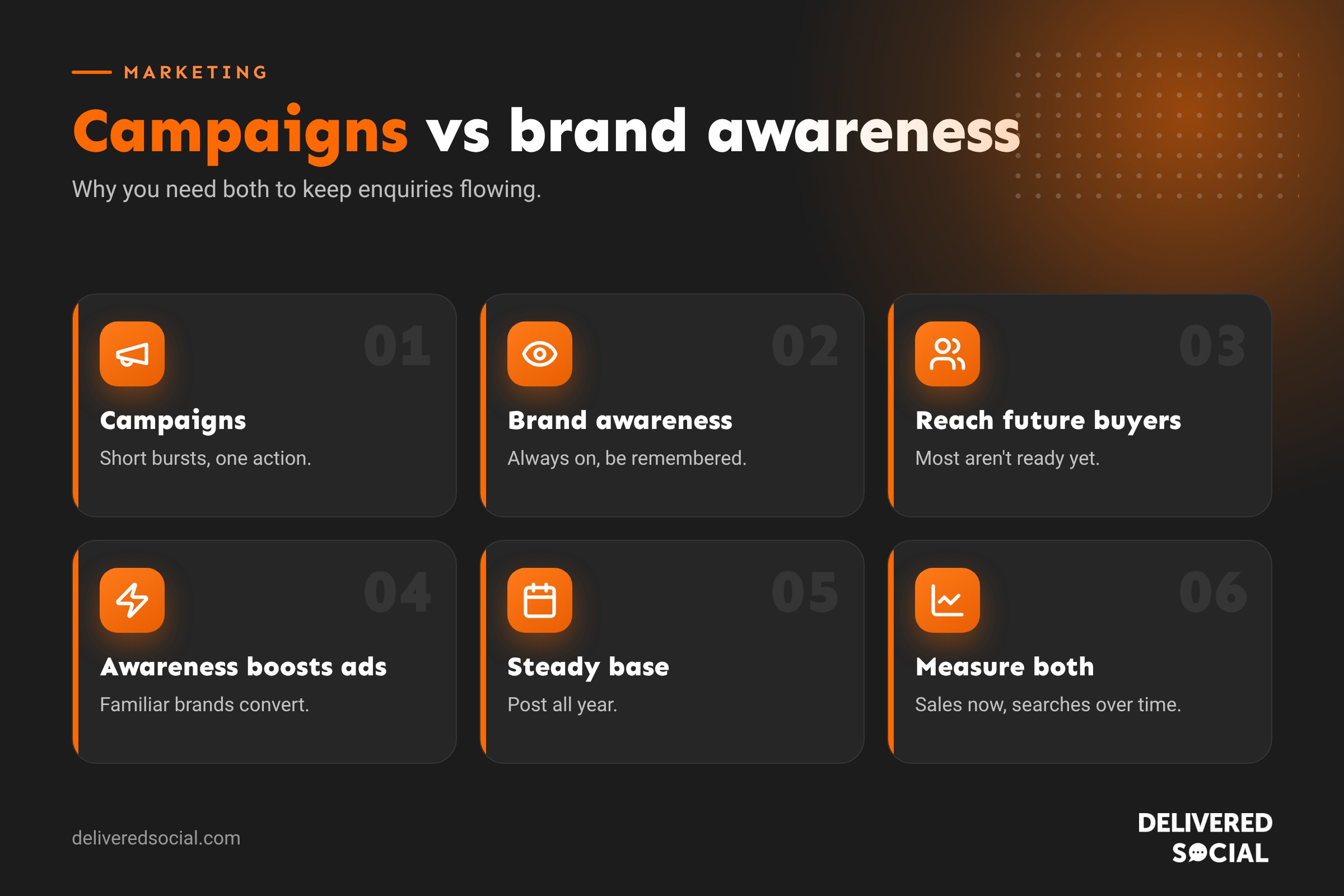
At any moment, only a small share of your potential customers are ready to buy. Most aren’t in the market yet. Campaigns are good at catching the people who are ready now, but if nobody has heard of you, even a great offer has to work much harder. You end up paying more per customer, relying on discounts and starting from scratch each time.
Brand awareness solves this by reaching the much larger group who will need you in the future. When they’re ready, you’re already familiar, which makes your campaigns more effective and cheaper.
Why you need both
- Awareness makes campaigns work harder. People respond better to ads from brands they recognise.
- Campaigns turn awareness into revenue. They give familiar audiences a reason to act now.
- Together they smooth out the peaks and troughs that come from stop-start marketing.
- They protect your prices. Strong brands rely less on discounts to win business.
Think of brand awareness as filling the pipeline and campaigns as opening the tap.
How to balance your marketing budget
There’s no single right split, but many businesses find a healthy balance by putting a good share of their effort into always-on brand activity and the rest into time-limited campaigns. A newer business may need more awareness work to get known. An established business with strong word of mouth may lean more towards campaigns. The mistake to avoid is spending everything on short-term promotions and nothing on being remembered.
| Situation | Leans towards |
|---|---|
| New business or new area | More brand awareness |
| Seasonal business before peak season | Awareness first, then campaigns |
| Established brand with loyal customers | More campaigns, steady awareness |
| Launching a new product | A launch campaign backed by awareness |
| Competitive local market | Strong, consistent awareness |
Brand awareness activities for small businesses
- Consistent social media: regular posts and short videos that show your people, work and personality.
- Helpful content: blogs, guides and videos that answer customer questions.
- Local involvement: sponsoring a team, supporting a charity or joining community events.
- Reviews: a steady flow of genuine Google reviews.
- Networking and partnerships: working with other local businesses.
- Recognisable branding: the same colours, logo and tone everywhere, from vans to Instagram.
- Video ads for reach: low-cost awareness ads to local audiences on Facebook, Instagram, TikTok or YouTube.
Campaign ideas that build on awareness
- Seasonal offers tied to your busiest periods.
- Launch campaigns for new services, with teasers to your existing audience first.
- Retargeting ads to people who have watched your videos or visited your website.
- Email campaigns to your subscriber list.
- Limited-time events, such as open days or workshops.
- Referral pushes asking happy customers to recommend you.
Using frameworks to plan your message
Marketing models like AIDA (attention, interest, desire, action) show how awareness and campaigns fit together. Brand awareness works mostly at the attention and interest stages, while campaigns drive desire and action. Our guide to the AIDA model explains how to use it to plan content for each stage.
How to measure brand awareness
Awareness is harder to measure than sales, but there are useful signs:
- Branded searches: more people searching your business name in Google Search Console.
- Direct website visits: people typing your address straight in.
- Social reach and followers in your target area.
- Video views and watch time from awareness ads.
- “How did you hear about us?” answers on forms and phone calls.
- Mentions and tags on social media.
Look at the trend over months, not days. Our guide to social media KPIs explains which numbers to track.
How to measure campaigns
- Sales, bookings or leads during the campaign period.
- Cost per lead or cost per sale.
- Return on ad spend.
- Click-through and conversion rates.
- Use of campaign codes or landing pages.
Compare campaign results against a normal period, and check whether results improve as your brand awareness grows.
A simple yearly marketing rhythm
- All year: post consistently on social media, publish helpful content and collect reviews.
- Each quarter: run one focused campaign tied to a season, launch or quiet period.
- Before each campaign: warm up your audience with awareness content for a few weeks.
- After each campaign: keep posting so new customers stay engaged and come back.
- Every month: review results and adjust.
Common mistakes
- Only marketing when sales are slow.
- Judging awareness activity by immediate sales alone.
- Changing your look and message with every campaign.
- Relying on discounts until customers wait for the next sale.
- Stopping all activity once a campaign ends.
A worked example: a local café
Imagine a café in Farnham that only advertises when trade is slow. Each time, it boosts a discount post, gets a short rush of visitors, then goes quiet again. Now imagine it posts three times a week all year: the team, new bakes, regulars, local events and behind-the-scenes clips. It collects reviews, supports a school fair and runs small local video ads. When it launches its Christmas menu, people already know it, follow it and trust it. The same campaign budget now fills far more tables, and many of those customers come back in January without any discount.
Keeping your brand consistent across campaigns
Every campaign should look and sound like your brand. Use the same colours, fonts, logo, photography style and tone of voice, even when the offer changes. That way, each campaign adds to the memory people have of you, rather than feeling like a different business each time.
Quick glossary
- Brand awareness: how familiar people are with your business.
- Campaign: a planned, time-limited push towards one goal.
- Always on: marketing that runs continuously rather than in bursts.
- Retargeting: showing ads to people who have already interacted with you.
- Branded search: a search that includes your business name.
Key takeaways
- Campaigns drive short-term action; brand awareness builds long-term demand.
- Campaign-only marketing leaves you starting from scratch each time.
- Awareness makes campaigns cheaper and more effective.
- Keep a steady base of always-on activity and add focused campaigns on top.
- Measure awareness over months using branded searches, reach and direct traffic.
Frequently asked questions
What is the difference between a campaign and brand awareness?
A campaign is a short, focused push for a specific action. Brand awareness is ongoing work to make people know and remember you.
Which is more important for a small business?
Both. Awareness fills the pipeline and campaigns convert it into sales.
How long does it take to build brand awareness?
Usually months of consistent activity, though local businesses can see signs sooner.
Can social media build brand awareness?
Yes. Regular, recognisable posts and short videos are one of the most affordable ways to build it.
How do I know if my brand awareness is growing?
Watch branded searches, direct website visits, local reach and “how did you hear about us” answers.
Want marketing that keeps working between campaigns?
We plan always-on social media and focused campaigns for businesses across Surrey, Hampshire and the UK. See our social media management services or call us on 01483 608 303.