

Keep reading
Rather we just did it for you?
Let's get your business seen.
Social media, websites, SEO and ads from a team you can actually meet.
Marketing and advertising are often used as if they mean the same thing, but they don’t. Mixing them up leads many small businesses to spend money on adverts before they’ve worked out who they’re trying to reach, what they’re offering or why anyone should choose them. This guide explains the difference between marketing vs advertising in plain English, how advertising fits inside marketing, real examples for small businesses, and how to decide where to put your time and budget.
The simple difference
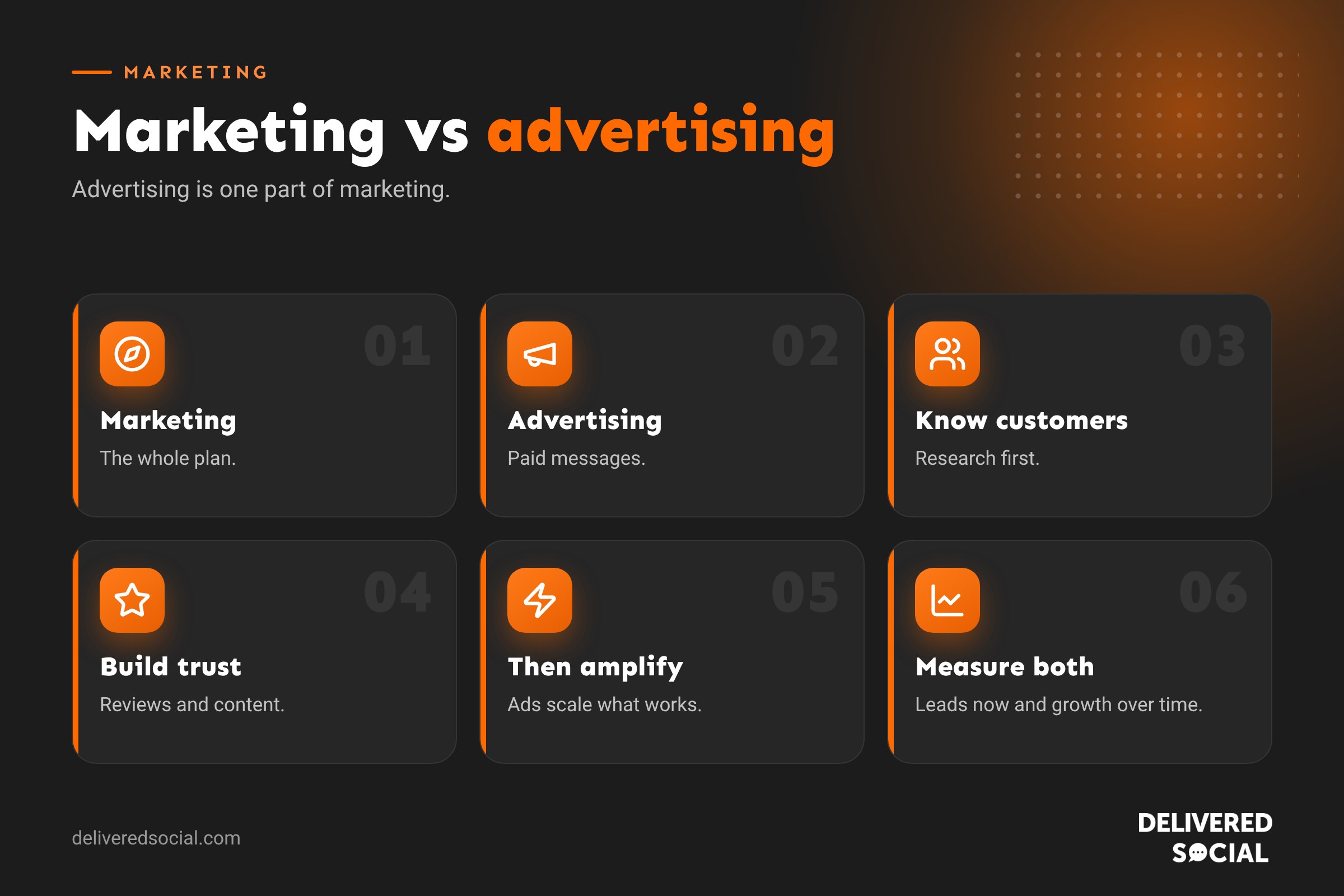
Marketing is everything you do to understand customers and attract, win and keep them. Advertising is one part of marketing: paying to put a message in front of people.
Think of marketing as the whole plan, and advertising as one of the tools in it.
What is marketing?
Marketing covers the full journey from understanding your customers to keeping them coming back. It includes:
- Market research: who your customers are and what they need.
- Positioning: what makes you different and why people should choose you.
- Pricing: what you charge and how you package it.
- Branding: your name, look, tone of voice and reputation.
- Content: blogs, videos, guides and social media.
- SEO: being found on Google.
- Email marketing: newsletters and offers to your list.
- Public relations: press coverage and community involvement.
- Customer experience: how people feel dealing with you.
- Advertising: paid messages across chosen channels.
What is advertising?
Advertising is paid communication designed to reach a specific audience. You pay for space or attention, and you control the message. Examples include:
- Google Ads on search results.
- Facebook, Instagram, TikTok and LinkedIn ads.
- YouTube video adverts.
- Radio, TV and podcast adverts.
- Print ads in local magazines and newspapers.
- Billboards, bus stops and vehicle wraps.
- Sponsored posts and paid listings.
Marketing vs advertising at a glance
| Marketing | Advertising | |
|---|---|---|
| Scope | The whole strategy and process | One part of marketing |
| Cost | Mix of paid and unpaid activity | Always paid |
| Timeframe | Long term and ongoing | Often short campaigns |
| Goal | Understand, attract, win and keep customers | Reach people and prompt action |
| Examples | Research, SEO, content, email, branding | Google Ads, social ads, radio, print |
| Control | Shared, as reputation depends on others too | Full control of the message |
Why the difference matters
Advertising amplifies whatever you already have. If your offer is clear, your website converts and your reviews are strong, advertising can bring excellent returns. If those foundations are weak, advertising simply sends more people to a business that doesn’t convince them, and your money disappears.
That’s why marketing should come first: know your audience, sharpen your message, fix your website and build trust, then use advertising to scale what works.
Examples for small businesses
| Business | Marketing activity | Advertising activity |
|---|---|---|
| Café | Instagram posts, loyalty card, local events, Google reviews | Boosted posts for a new menu, local magazine ad |
| Plumber | Google Business Profile, website service pages, review requests | Google Ads for “emergency plumber” searches |
| Accountant | Helpful blogs, newsletter, LinkedIn posts, referrals | LinkedIn ads before tax deadlines |
| Online shop | Product photography, email flows, SEO | Google Shopping and Instagram ads |
| Charity | Impact stories, volunteer programme, community partnerships | Google Ad Grants, sponsored fundraising posts |
Marketing vs advertising vs PR vs sales
- Marketing: the overall strategy for attracting and keeping customers.
- Advertising: paid messages to reach people.
- PR: earning coverage and reputation through media and community, not paid space.
- Sales: turning interested people into paying customers through conversations, quotes and follow-up.
In a small business, one person may do all four, but it helps to know which hat you’re wearing.
Organic vs paid marketing
Organic marketing is unpaid activity, such as social media posts, SEO, email and word of mouth. It takes time to build but keeps working. Paid advertising delivers faster reach but stops when the budget stops. The strongest approach combines both: organic activity builds trust and awareness, and advertising pushes the best content and offers further. Our guide to campaigns vs brand awareness explores this balance.
How to decide where to spend
- Start with foundations: a clear offer, a website that converts and a complete Google Business Profile.
- Build trust: collect reviews, share real work and post consistently on social media.
- Invest in long-term channels: SEO, content and email keep paying off.
- Add advertising to speed things up, test offers and reach new audiences.
- Measure everything and move budget towards what brings customers.
Which advertising channel should you use?
- Google Ads: best when people actively search for your service. See our Google Ads for beginners guide.
- Meta ads (Facebook and Instagram): great for local awareness, events, offers and visual products.
- TikTok ads: reaching younger audiences with short video.
- LinkedIn ads: B2B services and recruitment.
- Local print and radio: can still work for community-focused businesses and older audiences.
How to measure marketing and advertising
Advertising is usually easier to measure directly: clicks, leads, cost per lead and return on ad spend. Marketing as a whole is measured over a longer period: website traffic, enquiries, branded searches, repeat customers, reviews and revenue growth. Ask every new customer how they found you; it’s simple, free and surprisingly useful.
Common mistakes
- Spending on ads before fixing the website or offer.
- Thinking marketing just means posting on social media.
- Stopping all marketing when ads aren’t running.
- Judging long-term marketing by next week’s sales.
- Copying competitors’ ads without understanding your own customers.
The 4 Ps: where advertising fits
A classic way to understand marketing is the “4 Ps”: product, price, place and promotion. Advertising sits within promotion, alongside PR, social media, email and sales activity. It shows that even the best advertising can’t fix a product people don’t want, a price that doesn’t make sense or a service that’s hard to buy. Getting the other Ps right first makes every pound of advertising work harder.
A small business example
A new bakery opens in Fareham. Its marketing includes deciding to focus on sourdough and celebration cakes, pricing for a premium local audience, creating a warm brand, setting up a Google Business Profile, posting behind-the-scenes Reels, building an email list and asking happy customers for reviews. Its advertising includes a few weeks of local Instagram ads around opening day, a Google Ads campaign for “birthday cakes Fareham” and an advert in a local parish magazine.
Six months on, most of its customers come from word of mouth, Google reviews and Instagram, with advertising used to promote seasonal launches like Christmas and Easter. That’s marketing and advertising working together.
Budgeting for both
Many small businesses find it useful to split their budget into three parts: foundations such as website and branding, ongoing organic marketing such as social media, content and SEO, and flexible advertising spend that can increase or decrease with results and seasons. Reviewing the split every few months keeps money moving towards what works.
Quick glossary
- Marketing mix: the combination of product, price, place and promotion.
- Organic: unpaid marketing activity.
- Paid media: advertising you pay for.
- Earned media: coverage and mentions you don’t pay for.
- Owned media: channels you control, like your website and email list.
Signs you need more marketing, not more advertising
- Ads get clicks, but few enquiries.
- People don’t understand what makes you different.
- Your reviews are few or out of date.
- Your website is slow or confusing on mobile.
- Customers rarely come back or recommend you.
If several of these sound familiar, spending more on adverts is unlikely to help. Fixing the message, website and customer experience will make any future advertising far more effective.
Get the marketing right, and advertising becomes a way to accelerate growth rather than a gamble.
Key takeaways
- Marketing is the whole plan; advertising is one paid part of it.
- Advertising works best when marketing foundations are strong.
- Combine organic activity with paid advertising for the best results.
- Choose ad channels based on where your customers are and how they buy.
- Measure results and keep moving budget to what works.
Frequently asked questions
What is the main difference between marketing and advertising?
Marketing is the overall process of attracting and keeping customers; advertising is paid promotion within it.
Is advertising part of marketing?
Yes. Advertising is one of the tools used within a wider marketing strategy.
Which is more important for a small business?
Marketing foundations come first. Advertising then helps you grow faster.
Is social media marketing or advertising?
Both. Regular posts are organic marketing; paid promoted posts are advertising.
How much should a small business spend on marketing?
It varies, but set a regular budget you can sustain, and track results to guide changes.
Is SEO marketing or advertising?
SEO is marketing. You don’t pay for each click or placement, unlike Google Ads.
Is email marketing advertising?
Email to your own subscribers is marketing; paying to appear in someone else’s newsletter is advertising.
Can a business succeed without advertising?
Yes, many grow through word of mouth, SEO and social media, though advertising can speed growth.
Want marketing that brings in customers?
We plan and run social media, SEO, content and advertising for businesses across Surrey, Hampshire and the UK. See our digital marketing services or call us on 01483 608 303.