

Keep reading
Rather we just did it for you?
Let's get your business seen.
Social media, websites, SEO and ads from a team you can actually meet.
SEO and SEM are two of the most common acronyms in digital marketing, and they’re often used interchangeably, which causes plenty of confusion. Both are about appearing in search engines, but they work differently, cost differently and deliver results on different timescales. This guide explains SEO vs SEM in plain English: what each means, how they compare on cost, speed and long-term value, when to use each, and how they work best together for small and growing businesses.
What is SEO?
SEO (search engine optimisation) is improving your website so it ranks higher in the unpaid, organic search results. It involves technical improvements, helpful content, keyword targeting, local optimisation and earning links from other sites. You don’t pay Google for clicks, but you invest time, effort or agency fees. See our guide to SEO for beginners.
What is SEM?
SEM (search engine marketing) is used in two ways:
- Narrow meaning (most common today): paid search advertising, such as Google Ads and Microsoft Advertising, where you pay to appear in sponsored results.
- Broad meaning: all marketing in search engines, including both SEO and paid search.
In this guide, SEM means paid search, which is how most people use the term now. It’s also called PPC (pay per click).
SEO vs SEM at a glance
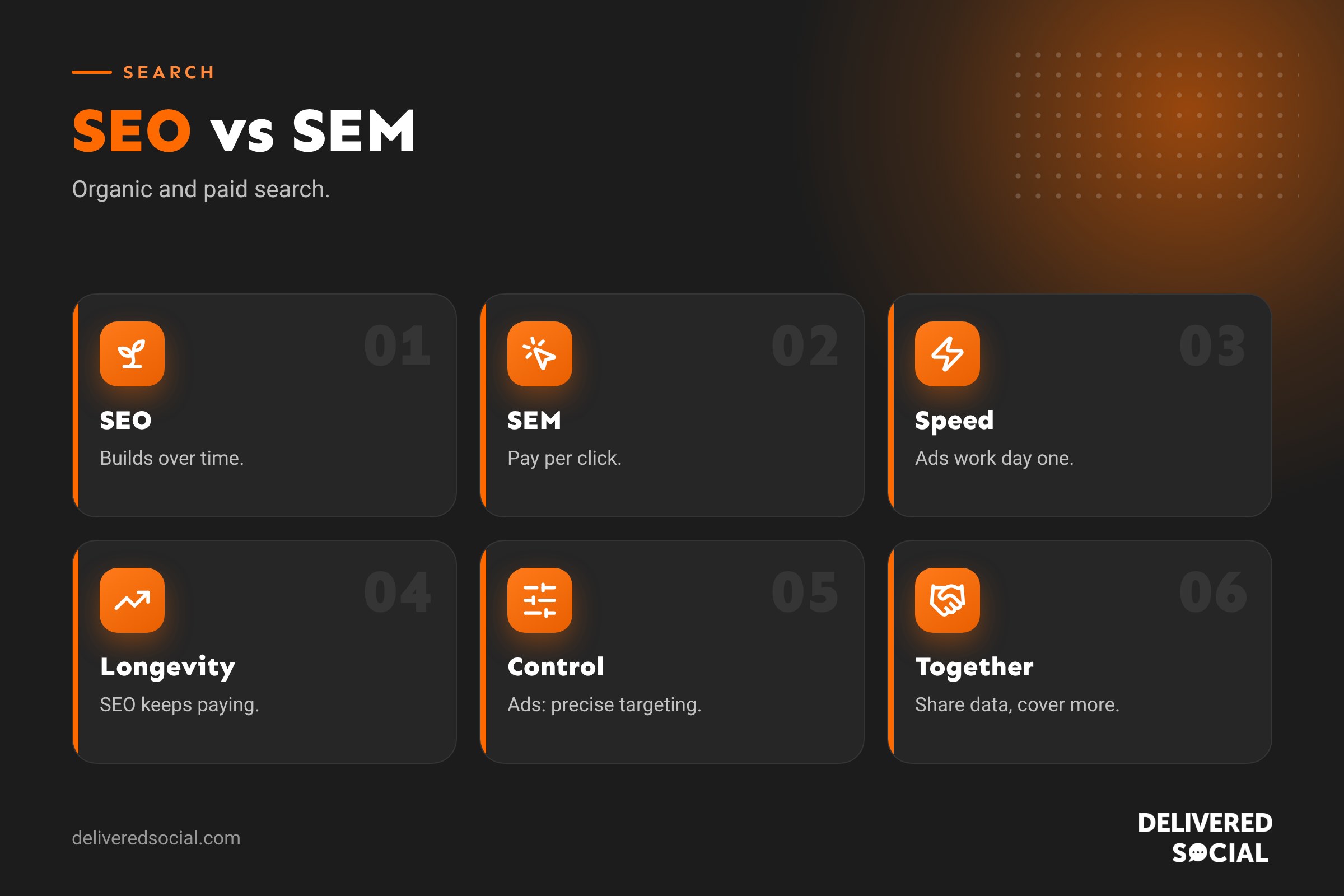
| SEO | SEM (paid search) | |
|---|---|---|
| Where you appear | Organic results | Sponsored results, usually at the top |
| Cost model | Time, content and expertise; no cost per click | Pay for each click |
| Speed | Months to build | Results from day one |
| Longevity | Keeps working after the effort | Stops when you stop paying |
| Control | Less direct; Google decides rankings | High control over keywords, ads, budget and timing |
| Trust | Many users trust organic results more | Clearly labelled as ads |
| Testing | Slow to test changes | Fast testing of messages and offers |
| Best for | Long-term, sustainable traffic | Immediate leads, promotions and testing |
The advantages of SEO
- Compounding returns: rankings keep bringing visitors month after month.
- No cost per click: more traffic doesn’t mean a bigger bill.
- Credibility: organic rankings build trust and brand authority.
- Covers more searches: helpful content can rank for hundreds of related questions.
- Supports AI search: strong content and authority help you appear in AI-generated answers.
The disadvantages of SEO
- Takes time, often months, to see significant results.
- No guarantees; algorithm updates can shift rankings.
- Competitive keywords need sustained effort.
The advantages of SEM
- Speed: appear at the top of results as soon as campaigns go live.
- Precise targeting: by keyword, location, device, time and audience.
- Budget control: set daily limits and adjust any time.
- Measurable: see exactly what clicks and conversions cost.
- Testing: quickly find which messages and offers work.
The disadvantages of SEM
- Costs can rise in competitive markets.
- Traffic stops the moment you stop paying.
- Poorly managed campaigns waste money quickly.
- Some users skip ads.
See our guide to Google Ads for beginners to get started.
When to focus on SEO
- You want sustainable traffic and leads over the long term.
- You can wait a few months for results.
- Your customers research before buying.
- Paid clicks in your industry are expensive.
- You want to build authority and trust.
When to focus on SEM
- You need leads quickly, for a new business, launch or quiet period.
- You’re promoting a time-limited offer or event.
- Your website is new and has little organic visibility yet.
- You want to test which keywords and messages convert before investing in SEO.
- You compete in local services where people search with urgent intent.
Why SEO and SEM work best together
- Cover more of the results page: appearing in both ads and organic results increases clicks and credibility.
- Share data: paid search shows which keywords convert, guiding SEO priorities.
- Fill gaps: use ads for competitive keywords you can’t rank for yet.
- Reduce reliance: as SEO grows, you can shift budget away from ads on terms you rank well for.
- Retargeting: organic visitors can be shown ads later to bring them back.
A simple combined strategy for small businesses
- Fix website basics: speed, mobile design, clear service pages and contact options.
- Set up Google Business Profile and collect reviews.
- Run a focused Google Ads campaign on high-intent local keywords.
- Use the search terms report to find what converts.
- Build SEO content around those proven keywords and common questions.
- Review monthly: shift budget as organic rankings improve.
How budgets compare
SEO budgets typically go on content, technical work and link building, often as a monthly retainer or internal time. SEM budgets split into ad spend (paid to Google) and management. A common starting point for local businesses is a modest monthly ad budget alongside ongoing SEO, adjusting as you learn what delivers enquiries. Use Keyword Planner to estimate click costs.
What about social media advertising?
Paid social (Facebook, Instagram, LinkedIn, TikTok ads) isn’t SEM, because it isn’t search-based. It targets people by interests and demographics rather than what they’re searching for. It’s great for awareness and demand creation, while search captures existing demand. Many businesses use all three. See marketing vs advertising.
Measuring success
| SEO metrics | SEM metrics | |
|---|---|---|
| Visibility | Rankings, impressions | Impression share |
| Traffic | Organic visitors | Clicks, click-through rate |
| Cost | Cost of content and work | Cost per click, cost per conversion |
| Results | Organic enquiries and sales | Conversions, return on ad spend |
Example: a new physiotherapy clinic
A new clinic opens with no search visibility. It launches Google Ads on terms like “physiotherapist near me” and “sports massage Guildford” to start getting bookings in the first week. At the same time, it builds service pages, collects reviews and writes helpful guides on common injuries. After six months, it ranks organically for many local terms, so it reduces ad spend on those and focuses ads on competitive or seasonal searches. Both channels support each other, and the cost per booking falls over time.
Common mistakes when choosing between them
- Stopping SEO because results aren’t instant.
- Running ads to a slow, unclear website.
- Bidding on broad keywords that waste budget.
- Not tracking conversions, so neither channel can be judged fairly.
- Treating SEO and paid search as rivals instead of partners.
- Comparing them on traffic alone rather than enquiries and profit.
Budget split ideas
There’s no perfect split, but a common pattern for new businesses is to lean more on paid search at the start, while SEO builds, then gradually shift towards SEO as organic rankings grow. Established businesses with strong organic visibility might use paid search mainly for competitive terms, promotions and remarketing. Review the split every quarter based on cost per enquiry from each channel.
What about AI search?
AI-generated answers are changing how people search. Strong SEO helps you be cited in those answers, while paid search continues to appear alongside them. Both remain relevant; the mix will keep evolving.
Quick glossary
- SEO: search engine optimisation, for organic results.
- SEM: search engine marketing, usually meaning paid search.
- PPC: pay per click advertising.
- SERP: search engine results page.
- Impression share: how often your ads show compared with how often they could.
Key takeaways
- SEO earns organic rankings; SEM usually means paid search ads.
- SEM is fast and controllable; SEO is slower but compounds over time.
- Use SEM for immediate leads and testing, SEO for sustainable growth.
- They work best together, sharing data and covering more of the results page.
- Measure both by enquiries and sales, not just traffic.
Frequently asked questions
What is the difference between SEO and SEM?
SEO improves organic rankings; SEM usually means paying for ads in search results.
Is SEM the same as PPC?
In everyday use, yes; SEM usually refers to paid search, which is PPC.
Which is better, SEO or SEM?
Neither is better overall; they suit different goals and work best together.
Is SEO cheaper than SEM?
Over the long term often yes, but it needs upfront time and investment.
How quickly does SEM work?
Ads can bring traffic the day they go live.
Does running Google Ads help SEO?
Not directly, but its data can guide your SEO strategy.
Should a new business start with SEO or SEM?
Often both: SEM for immediate leads, SEO for long-term growth.
Is social media advertising SEM?
No, SEM refers to search engines; paid social is separate.
Can I do SEO and SEM myself?
Yes, the basics of both are learnable, though experience saves money in paid search.
Do ads appear above organic results?
Often, yes, at the top and sometimes bottom of results pages, labelled as sponsored.
What happens to SEO if I stop paying for ads?
Nothing directly; organic rankings are separate from ads.
Is SEM worth it for local businesses?
Often, especially for urgent services where people search and call straight away.
What is remarketing?
Showing ads to people who have already visited your website.
Which brings better quality leads?
Both can, if you target the right searches; track enquiries from each to compare.
Does SEO cost anything?
There’s no fee per click, but content, tools and expertise have a cost.
Want help with SEO and Google Ads?
We manage SEO and Google Ads for businesses across Surrey, Hampshire and the UK. Call us on 01483 608 303.