



Keep reading
Rather we just did it for you?
Let's get your business seen.
Social media, websites, SEO and ads from a team you can actually meet.
For years, the top prize in Google search was the featured snippet: a highlighted box quoting the answer from one website, sitting above the normal results. Now Google’s AI Overviews often take that spot, summarising information from several sources at once. Many business owners are confused about how the two differ, whether featured snippets still exist and how to appear in each. This guide explains AI Overviews vs featured snippets in plain English, with practical steps to give your content the best chance in both.
What is a featured snippet?
A featured snippet is a box at or near the top of Google’s results that quotes a short extract from a single web page to answer the search directly. It might be a paragraph, a numbered list, a bulleted list or a table, with a link to the page it came from. Featured snippets have been part of Google since the mid 2010s and were often called “position zero”.
Example: search “how long to boil an egg” and you may see a short paragraph from one cooking website, with that site’s name and link underneath.
What is an AI Overview?
An AI Overview is a summary written by Google’s AI that appears at the top of some search results. Instead of quoting one page, it pulls information from several sources and writes a new answer, with links to the pages it used shown alongside or within the summary. AI Overviews tend to appear for longer, more complex or comparison style questions. You can read more in our guide to Google AI Overviews.
The key differences
| Featured snippet | AI Overview | |
|---|---|---|
| Source | One web page | Several web pages |
| Wording | Quoted directly from the page | Generated by AI, then linked to sources |
| Format | Paragraph, list, table or video | Summary paragraphs, bullet points and links |
| Typical queries | Simple, factual questions | Complex, multi part or comparison questions |
| Clicks | One prominent link | Several smaller links shared between sources |
| Control | You can shape the extract with formatting | You influence it, but Google writes the words |
Do featured snippets still exist?
Yes. Featured snippets still appear for many searches, especially simple factual questions, definitions and how to steps. However, where an AI Overview appears, it usually sits above everything else, which can push the featured snippet and organic results further down the page. The mix varies by query, device and location, and Google continues to test changes, so it is worth checking the searches that matter to your business regularly.
How each one affects your traffic
Featured snippets can send a lot of clicks to the quoted page, though some people get their answer without clicking. AI Overviews share visibility between several sources, so each source tends to get less attention than a single featured snippet. On the other hand, being one of the cited sources builds brand recognition and can still drive valuable visits, especially from people who want more depth than the summary gives.
For businesses, the aim is to be the source Google trusts in both formats. The good news is that the same habits help with both.
How to win featured snippets
- Target question based searches. Find the questions customers ask using “People also ask” boxes and keyword tools.
- Use the question as a heading. For example, “How long does a boiler service take?”
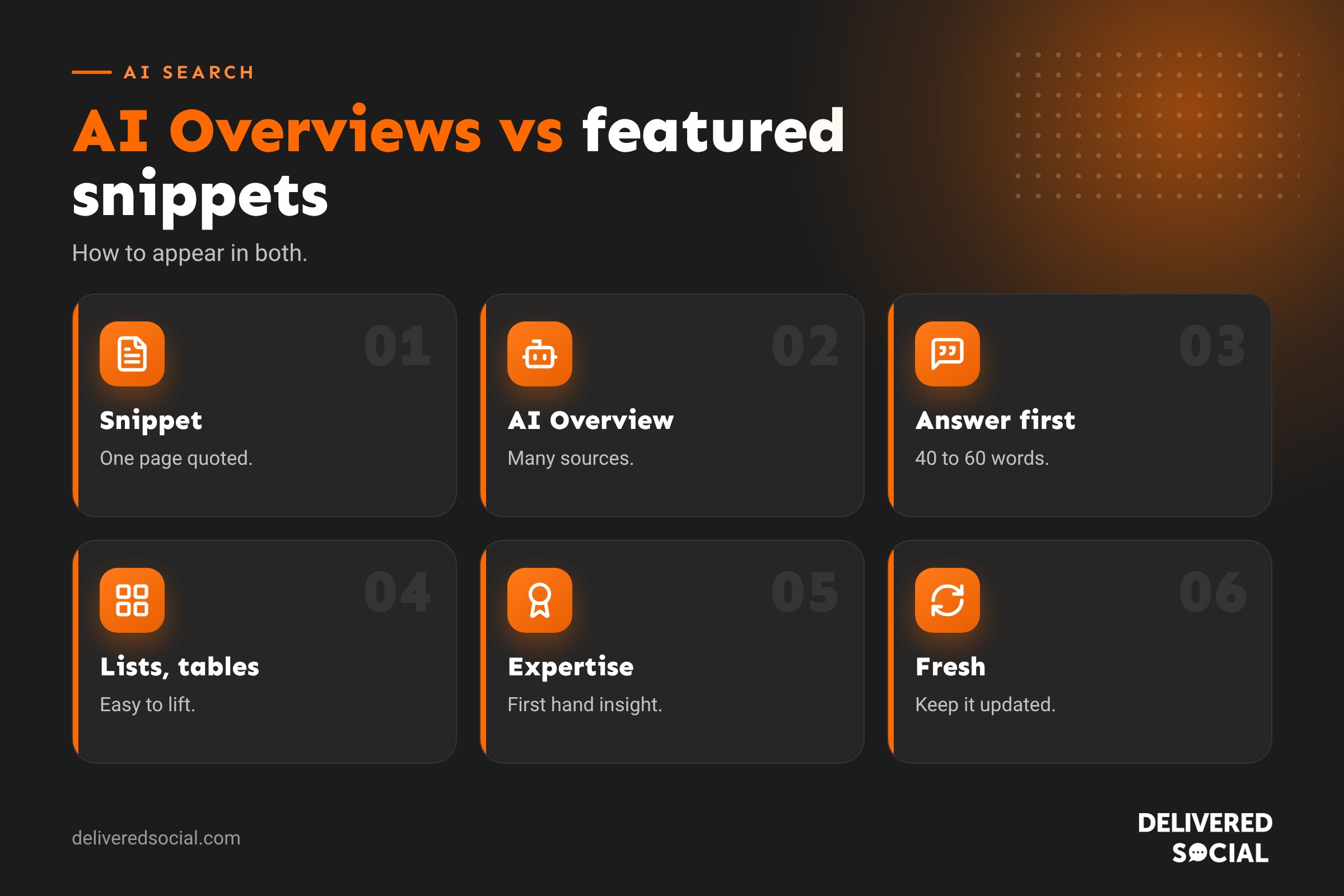
- Answer directly underneath in 40 to 60 words. Clear, complete and to the point.
- Use lists and tables for steps, comparisons and prices, as Google often lifts these.
- Rank on page one first. Featured snippets are usually taken from pages already ranking well.
Our guide to optimising for featured snippets covers this in more detail.
How to appear in AI Overviews
- Cover topics in depth. AI Overviews often answer complex questions, so pages that cover a subject thoroughly, including related questions, are more useful sources.
- Be clear and quotable. Short paragraphs, plain definitions and well labelled sections make it easy for AI to understand and cite your content.
- Show expertise. Add first hand experience, examples, author details and credentials. Google wants trustworthy sources.
- Keep information current. Update prices, dates and facts, and show a last updated date.
- Get the technical basics right. Your page must be crawlable, indexed and eligible to appear in Google with a snippet. There is no special markup needed for AI Overviews.
- Build your reputation. Mentions, links and reviews across the web help Google see you as a reliable source.
Our guides to LLM SEO and generative engine optimisation go further.
One content approach that works for both
You do not need separate strategies. A well structured page can win a featured snippet for a simple question and be cited in an AI Overview for a more complex one. A simple template:
- A clear H1 that matches the main search.
- A short, direct answer in the first paragraph.
- Sections with question headings and concise answers underneath.
- Lists and tables for steps, comparisons and costs.
- Examples and first hand insight that others cannot copy.
- An FAQ section covering related questions.
Can you opt out?
Website owners can use the nosnippet meta tag or data-nosnippet attribute to stop Google showing text from their pages in snippets, and this also affects AI Overviews. But it can reduce how your pages appear in search generally, so for most businesses it is not worth it. Being cited is usually better than being invisible.
How to track your visibility
Google Search Console includes AI Overview appearances within its normal Performance data, rather than as a separate report. Check the queries that matter to you manually, note whether a featured snippet or AI Overview appears and who is cited, and repeat monthly. Third party SEO tools can also track featured snippets and AI Overview citations for your target keywords.
A worked example
Imagine a Surrey kitchen fitter with a page called “How much does a new kitchen cost?”. The page opens with a 50 word answer giving a realistic price range, followed by a table breaking costs down by kitchen size and finish, then sections on what affects the price, how long fitting takes and how to save money. For the simple search “average kitchen cost UK”, Google might lift the opening paragraph as a featured snippet. For a longer question such as “is it cheaper to replace kitchen doors or the whole kitchen”, an AI Overview might cite the section on saving money alongside other sources. One well structured page, two chances to be seen.
What this means for small businesses
AI Overviews and featured snippets both reward the same thing: genuinely helpful content that answers questions clearly. Small businesses have an advantage here, because they can add local knowledge and real experience that big generic websites cannot. A plumber explaining why boilers in older Southsea terraces often struggle, or an accountant explaining a deadline that catches out local landlords, offers something unique for Google to cite.
Which searches trigger each format?
There is no fixed rule, but patterns are clear. Featured snippets tend to appear for short, specific questions with one correct answer: definitions, conversions, quick how to steps and simple facts. AI Overviews tend to appear when a question has several parts, needs comparing options, or benefits from pulling information together, such as “best way to heat a small flat cheaply” or “difference between a will and a trust”. Neither tends to appear for searches with a strong local intent, such as “electrician near me”, where the map pack takes over, or for searches for a specific brand. Check your own important searches to see which formats appear, and plan your content around what Google is actually showing.
Common mistakes
- Hiding the answer below long introductions.
- Writing vague content with no clear definitions or steps.
- Ignoring tables and lists for comparisons and processes.
- Never updating old articles.
- Blocking snippets without understanding the effect.
Key takeaways
- Featured snippets quote one page; AI Overviews summarise several.
- Both still appear, and AI Overviews often sit above featured snippets.
- Clear answers, good structure and genuine expertise help with both.
- Rank well in normal results first; both formats draw from strong pages.
- Track the searches that matter to you each month.
Frequently asked questions
Are AI Overviews replacing featured snippets?
Not entirely. Both appear, but AI Overviews often take the top spot for complex questions.
Can a page be a featured snippet and in an AI Overview?
Yes. A strong page can appear in both, for different searches or even the same one.
Do I need special code for AI Overviews?
No. Normal SEO best practice applies. There is no special markup required.
Do AI Overviews reduce clicks?
They can for simple questions, but being cited still builds visibility and trust.
Are featured snippets worth chasing?
Yes, especially for simple questions your customers ask.
How long should a snippet answer be?
Around 40 to 60 words for a paragraph answer.
Do AI Overviews show in the UK?
Yes, AI Overviews appear in UK search results for many queries.
Want to show up at the top of Google?
We help businesses across Surrey, Hampshire and the UK get found in Google search and AI results. Call us on 01483 608 303.
































