



Keep reading
Rather we just did it for you?
Let's get your business seen.
Social media, websites, SEO and ads from a team you can actually meet.
LinkedIn is where business buyers spend their working day, which makes it one of the best places for B2B companies, professional services and recruiters to find customers. But how much does it cost? LinkedIn marketing cost can mean anything from a free company page and your own time, to a few hundred pounds a month for content support, to thousands on LinkedIn ads. This guide breaks down the real costs in the UK, what affects them, and how to work out whether LinkedIn is worth it for your business.
The short answer
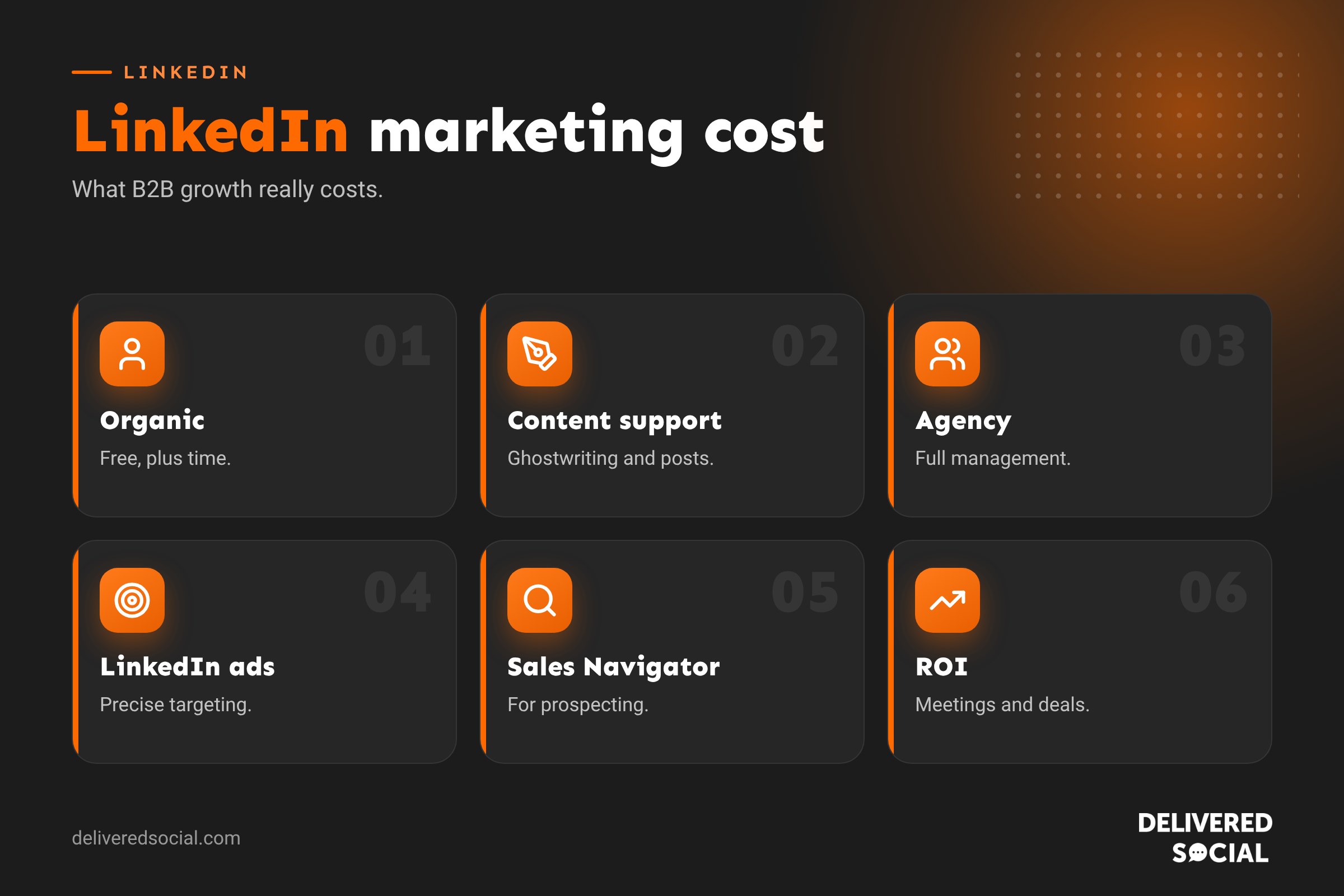
| Option | Typical monthly cost | Best for |
|---|---|---|
| Organic (DIY) | Free, plus your time | Founders and small teams building a personal brand |
| Freelance content support | Roughly £250 to £1,000 | Businesses wanting regular posts without hiring |
| Agency management | Roughly £500 to £2,500+ | Businesses wanting strategy, content, company page and reporting |
| LinkedIn ads | Your choice; many tests start around £500 to £1,500 | Reaching specific job titles, industries and companies |
| Premium and Sales Navigator | Monthly subscriptions per user | Sales teams and active prospecting |
These are typical market ranges rather than fixed prices. What you pay depends on how much content you need, who creates it and whether ads are involved.
Organic LinkedIn marketing
A LinkedIn company page and personal profiles are free. For many small businesses, organic LinkedIn, especially posting from the founder’s or team’s personal profiles, is the best value marketing they do. The cost is time. A realistic routine might be:
- Two to three posts a week: one to two hours.
- Commenting on other people’s posts: 15 minutes a day.
- Replying to messages and connection requests: 10 minutes a day.
- Updating your profile and company page: an hour a month.
That is around four to six hours a week. If your time is worth £50 an hour, that is a real cost, even if no money changes hands. Our guide to LinkedIn marketing for small business shows how to make that time count.
Content support and management
If you know LinkedIn matters but cannot find the time, you can pay for help. Options include:
- Ghostwriting: a writer interviews you and drafts posts in your voice for your personal profile.
- Company page management: regular posts, graphics and updates for your business page.
- Video and graphics: short videos, carousels and branded images.
- Engagement and reporting: monitoring comments, suggesting people to engage with and reporting results.
Prices depend on volume and quality. Always ask exactly how many posts are included, who writes them, whether you approve them first, and how results are measured.
LinkedIn ads costs
LinkedIn ads are known for being more expensive per click than Facebook or Instagram. That is because the audience is professional and you can target precisely by job title, seniority, industry, company size and even specific companies. For B2B businesses selling high value services, that precision often justifies the higher cost.
LinkedIn ads work on an auction, like other platforms. You set a budget and bid, and pay per click, per thousand impressions or per lead, depending on your objective. Costs vary with:
- Audience: senior decision makers in competitive industries cost more to reach.
- Audience size: very narrow audiences can push costs up.
- Ad format: sponsored content, lead gen forms, message ads, video and document ads all perform differently.
- Relevance: ads that people engage with tend to cost less.
- Competition: busy periods, such as the end of the financial year, can be more expensive.
Because costs per click are higher, small test budgets can run out quickly. Many B2B advertisers allow at least a few weeks and a meaningful budget to gather enough data before judging results.
LinkedIn Premium and Sales Navigator
LinkedIn offers paid subscriptions for individuals. Premium Business gives extra profile insights, InMail credits and learning courses. Sales Navigator is designed for prospecting, with advanced search, lead lists and account tracking. Prices are per user and vary by plan and whether you pay monthly or yearly. For salespeople actively prospecting, Sales Navigator can pay for itself; for occasional use, it may not. If you already pay and are not sure it is worth it, see our guide on cancelling LinkedIn Premium.
What affects your LinkedIn marketing budget?
- Your goals: brand awareness, leads, recruitment or thought leadership.
- Deal size: if one new client is worth £10,000, you can justify far more than if one is worth £200.
- Your audience: reaching niche, senior roles costs more.
- Content volume and quality: video and in depth content take longer to create.
- Who does the work: in house, freelancer or agency.
How to set a sensible budget
- Work out the lifetime value of a typical client.
- Decide how many new clients you want from LinkedIn in a year.
- Estimate what you could afford to spend to win each client.
- Start with organic posting from key people’s profiles.
- Add ads once you know which messages resonate.
- Review every quarter and adjust.
Example budgets
| Business | Approach | Example monthly spend |
|---|---|---|
| Freelance consultant | Organic personal profile, no ads | Time only |
| Small accountancy firm | Freelancer for company page and partner posts | £300 to £700 |
| B2B software company | Agency content plus LinkedIn ads | £2,000 and above |
| Recruitment agency | Organic posting plus job ads and Recruiter tools | Varies with roles |
Measuring LinkedIn return on investment
Track more than likes. Useful measures include:
- Profile views and connection requests from your target audience.
- Inbound messages and enquiries mentioning LinkedIn.
- Website visits from LinkedIn, tracked in Google Analytics with UTM links.
- Leads from LinkedIn lead gen forms and their cost.
- Meetings booked and deals won that started on LinkedIn.
B2B sales cycles can be long, so look at results over months rather than weeks.
Ways to keep costs down
- Prioritise personal profiles. Posts from people usually reach more than company page posts.
- Repurpose content. Turn a blog into a carousel, a video into several short posts.
- Use lead gen forms in ads to reduce friction.
- Retarget website visitors rather than only cold audiences.
- Test small, then scale what works.
- Involve your team. Encourage staff to share and comment on company posts.
Is LinkedIn marketing worth it?
For B2B businesses, professional services, recruiters and anyone selling high value services to other businesses, LinkedIn is often the most effective social platform. For consumer brands selling low cost products, Instagram, Facebook or TikTok usually offer better value. If you are not sure, start with organic posting from your own profile for three months. It costs only time, and it will quickly show you whether your audience is there.
What a month of LinkedIn activity looks like
To make the numbers easier to picture, here is a realistic monthly plan for a small professional services firm. The founder posts twice a week from their personal profile: one practical tip and one story from client work. The company page shares one update a week, such as a case study or team news, and staff reshare it with a comment. The founder spends ten minutes each morning commenting on posts from clients, prospects and local business contacts, and accepts or sends a handful of targeted connection requests. Once a month, a short newsletter or longer article goes out. If budget allows, a small ad campaign retargets website visitors with a case study. That plan takes a few hours a week in house, or can be supported by a freelancer or agency who drafts posts and graphics for approval.
Free LinkedIn tools worth using first
Before spending money, make the most of what LinkedIn gives you for free. Company page analytics show who views and follows your page. Your personal profile shows who has viewed it and how your posts perform. Creator mode features, newsletters and events are available without paying, and the Featured section on your profile lets you showcase case studies, articles and offers. Many small businesses get significant results from these free tools alone, so it makes sense to use them well before adding paid options.
Key takeaways
- LinkedIn company pages and profiles are free; the main cost is time.
- Content support and management typically cost from a few hundred pounds a month.
- LinkedIn ads cost more per click but offer precise B2B targeting.
- Set your budget against the value of a new client.
- Measure meetings and deals, not just engagement.
Frequently asked questions
How much does LinkedIn marketing cost?
From free for organic posting to thousands a month for agency support and ads, depending on your goals.
Why are LinkedIn ads so expensive?
The audience is professional and highly targetable, so competition for clicks is higher.
What is a good LinkedIn ads budget to start?
Many businesses test with a few hundred to around a thousand pounds a month over several weeks.
Is LinkedIn Premium worth it for business?
It can be for active sales prospecting. For occasional use, the free version is often enough.
Is LinkedIn good for small businesses?
Yes, especially B2B and professional services, through consistent posting from personal profiles.
How long does LinkedIn marketing take to work?
Organic results usually build over a few months. Ads can generate leads faster.
Should I post from my company page or my profile?
Both, but personal profiles usually reach more people.
Want LinkedIn to bring in new business?
We help businesses across Surrey, Hampshire and the UK grow on LinkedIn. Call us on 01483 608 303.
































