



Keep reading
Rather we just did it for you?
Let's get your business seen.
Social media, websites, SEO and ads from a team you can actually meet.
Shopify is one of the most popular ways to start an online shop, but the monthly plan price is only part of what you will pay. Card fees, transaction fees, apps, themes and your domain all add up. Before you commit, it helps to know what a realistic month looks like. This guide explains Shopify pricing in the UK: the plans, what each one costs, the fees on every sale, the hidden extras most people forget, and how to work out which plan is right for your business.
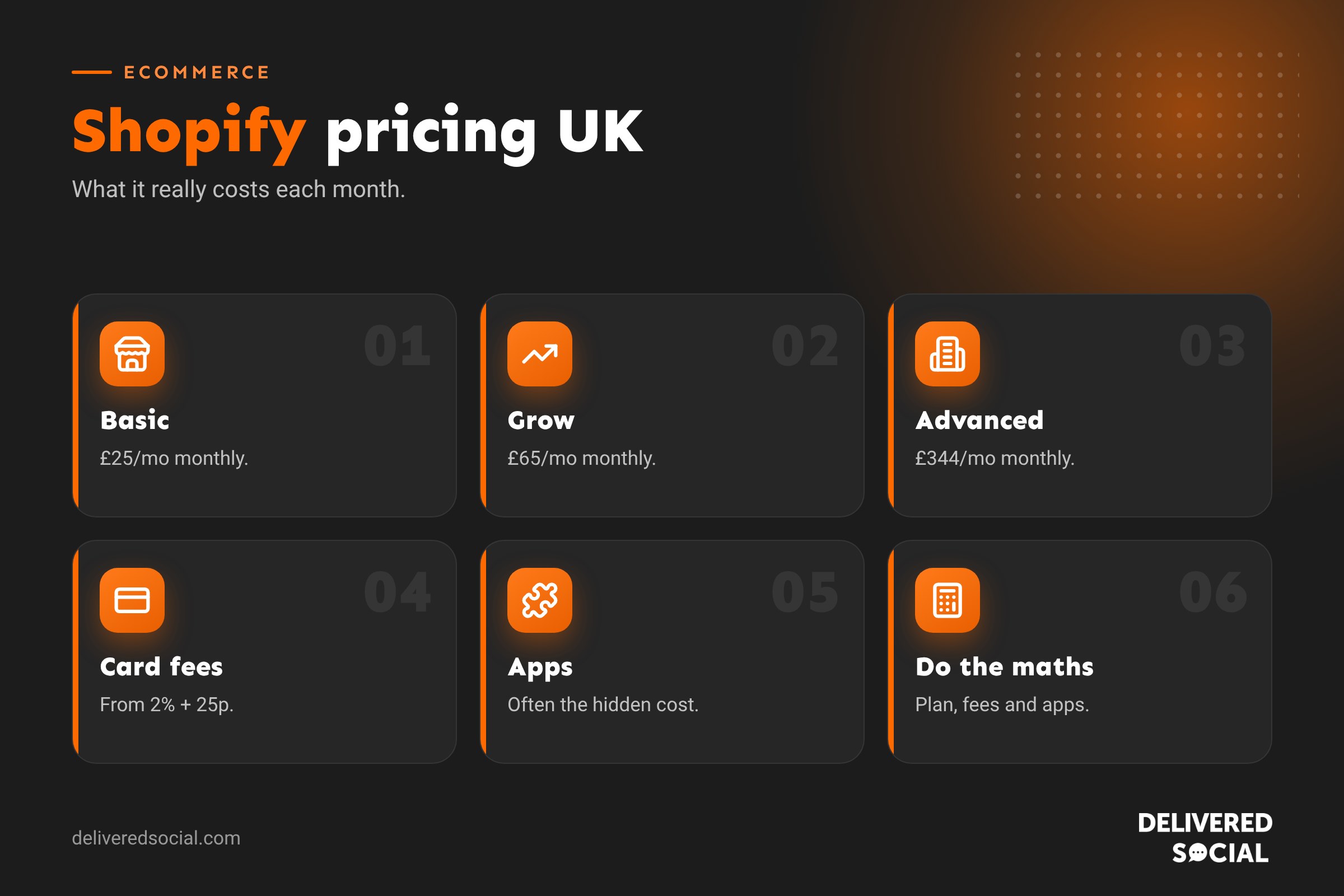
Shopify UK plans at a glance
At the time of writing (November 2026), Shopify’s UK pricing page lists these main plans. Prices are per month and Shopify gives a discount if you pay yearly rather than monthly.
- Basic: £25 a month billed monthly, or £19 a month billed yearly. For new and small shops.
- Grow: £65 a month billed monthly, or £49 a month billed yearly. For growing shops that want more staff accounts and better reports.
- Advanced: £344 a month billed monthly, or £259 a month billed yearly. For larger shops with higher sales.
- Plus: from around £1,800 a month, usually on a longer term. For high volume and enterprise brands.
Shopify also offers a low cost Starter plan for selling through social media and links rather than a full online store, and regularly runs trials and introductory offers for the first few months. Prices and offers change, so always check Shopify’s UK pricing page before you sign up.
Card fees: what you pay on every sale
On top of the monthly plan, you pay a fee each time a customer pays by card. If you use Shopify Payments, Shopify’s own payment system, the online card rates on the UK pricing page are:
- Basic: 2% + 25p per online transaction.
- Grow: 1.7% + 25p.
- Advanced: 1.5% + 25p.
- Plus: 1.3% + 25p.
In person card rates through Shopify POS are lower. Higher plans have lower card rates, which is one reason a bigger plan can work out cheaper once your sales grow.
Transaction fees if you do not use Shopify Payments
If you use a different payment provider, such as a separate card processor, Shopify charges an extra transaction fee on top of that provider’s own fees. On the Basic plan this is 2% of each sale, and it reduces on higher plans. For most small UK shops, using Shopify Payments is the simplest and cheapest option because it avoids this extra fee. PayPal, Apple Pay and Google Pay can all run alongside it.
The extra costs most people forget
The plan and card fees are only the start. A realistic Shopify budget usually includes some of these:
- Domain name: roughly £10 to £20 a year for a .co.uk or .com.
- Theme: Shopify has free themes, but premium themes are usually a one off cost of a couple of hundred pounds.
- Apps: reviews, email marketing, subscriptions, product options, upsells and SEO apps often charge monthly fees. Five or six apps can easily cost more than the plan itself.
- Email marketing: tools such as Klaviyo or Shopify Email have their own pricing once your list grows.
- Design and setup: if you hire someone to design and build the shop, that is a separate project cost.
- Photography: good product photos make a huge difference to sales and are often underestimated.
- Marketing: ads, SEO and social media to bring people to the shop. Without traffic, even a beautiful store will not sell.
- Shipping: courier costs and packaging, which you may or may not pass on to customers.
- VAT: UK businesses should budget for VAT on subscriptions and apps where it applies.
What does a typical month cost?
Here is a simple example for a small UK shop on the Basic plan, paid monthly, selling £3,000 a month online through Shopify Payments with an average order of £40:
- Basic plan: £25.
- Card fees: 75 orders at 2% + 25p comes to roughly £78.75.
- Apps (reviews, email, product options): around £40.
- Domain spread across the year: around £1.50.
That is roughly £145 a month before marketing, shipping and stock. The plan itself is a small part of the total, while card fees grow with your sales. Running the same numbers for your own expected sales is the best way to compare plans.
When to upgrade from Basic to Grow
The Grow plan costs more each month but has a lower card rate. As a rough guide, the extra monthly cost starts to pay for itself once you are taking several thousand pounds a month online, because the 0.3% saving on every sale adds up. You also get more staff accounts and better reporting, which matter as a team grows. Work out your own break even point using your typical monthly sales rather than relying on a general rule.
Is Shopify expensive compared with WooCommerce?
Shopify is simple and quick to launch, with hosting, security and updates handled for you. The trade off is a monthly fee, transaction based costs and app subscriptions that grow with your shop. WooCommerce, the free ecommerce plugin for WordPress, has no platform fee, but you pay for hosting, some paid extensions and maintenance. For some businesses WooCommerce works out cheaper over time and offers more flexibility, especially if they already have a WordPress website. Our guide to WordPress vs Shopify compares them in detail, and our cons of Shopify for UK businesses article covers the downsides worth knowing.
How to keep Shopify costs down
- Pay yearly if you are confident you will stay, as the discount is significant.
- Use Shopify Payments to avoid the extra transaction fee.
- Audit your apps every few months and remove any you no longer use. App costs creep up quietly.
- Start with a free theme and customise it rather than paying for a premium theme on day one.
- Compare plans against your real sales each quarter, as upgrading can lower your card fees.
- Invest in organic traffic through SEO and email so you are not paying for every visitor with ads.
Is Shopify worth the money?
For many small businesses, yes. Shopify lets you launch a professional shop quickly without worrying about hosting or security, and it scales well as you grow. It is less suitable if you sell very low margin products, need lots of custom features, or want to avoid monthly subscriptions and app costs. The right answer depends on your products, your margins and how much control you want. If you are still deciding where to sell, our guide to ecommerce websites vs marketplaces may help, and our UK ecommerce website cost guide covers build costs.
Questions to ask before you sign up
Before choosing a plan, write down the answers to a few simple questions. They will tell you far more about your real costs than the headline price.
- How many orders do you expect each month in your first year, and what is your average order value?
- Which features do you need on day one, and which apps would provide them?
- Will you sell in person at markets or a shop, as well as online?
- How many people need access to the admin?
- Do you need to sell in other currencies or countries?
- Will you design the shop yourself or pay someone to do it?
- How will you bring visitors to the shop, and what will that cost?
Once you have these answers, plug them into Shopify’s plan comparison and add your app list. You will have a realistic monthly figure to compare against other platforms, rather than a surprise on your first few bills.
Key takeaways
- Shopify UK plans run from £25 a month (Basic, monthly billing) up to Plus at around £1,800 a month.
- Card fees on every sale often cost more than the plan itself.
- Using Shopify Payments avoids an extra transaction fee.
- Apps, themes, domains and marketing are the costs people forget.
- Check Shopify’s UK pricing page for current prices, as they change.
Frequently asked questions
How much is Shopify per month in the UK?
The Basic plan is £25 a month on monthly billing or £19 a month on yearly billing, at the time of writing. Grow and Advanced cost more, with lower card fees.
Does Shopify take a percentage of sales?
You pay card processing fees on each sale. If you do not use Shopify Payments, Shopify also adds a transaction fee.
Is there a free version of Shopify?
No, but Shopify usually offers a free trial and introductory offers for the first months.
Are Shopify prices in the UK shown with VAT?
Check your billing details, as VAT may be added to subscriptions and apps depending on your situation.
Which Shopify plan should I start with?
Most new shops start on Basic and upgrade once sales grow enough for lower card fees to outweigh the higher monthly price.
Is WooCommerce cheaper than Shopify?
It can be over time, as there is no platform fee, but you pay for hosting, extensions and maintenance instead.
Need help with your online shop?
We build and market online shops for businesses across Surrey, Hampshire and the UK, on Shopify and WooCommerce. Call us on 01483 608 303.
































