



Keep reading
Rather we just did it for you?
Let's get your business seen.
Social media, websites, SEO and ads from a team you can actually meet.
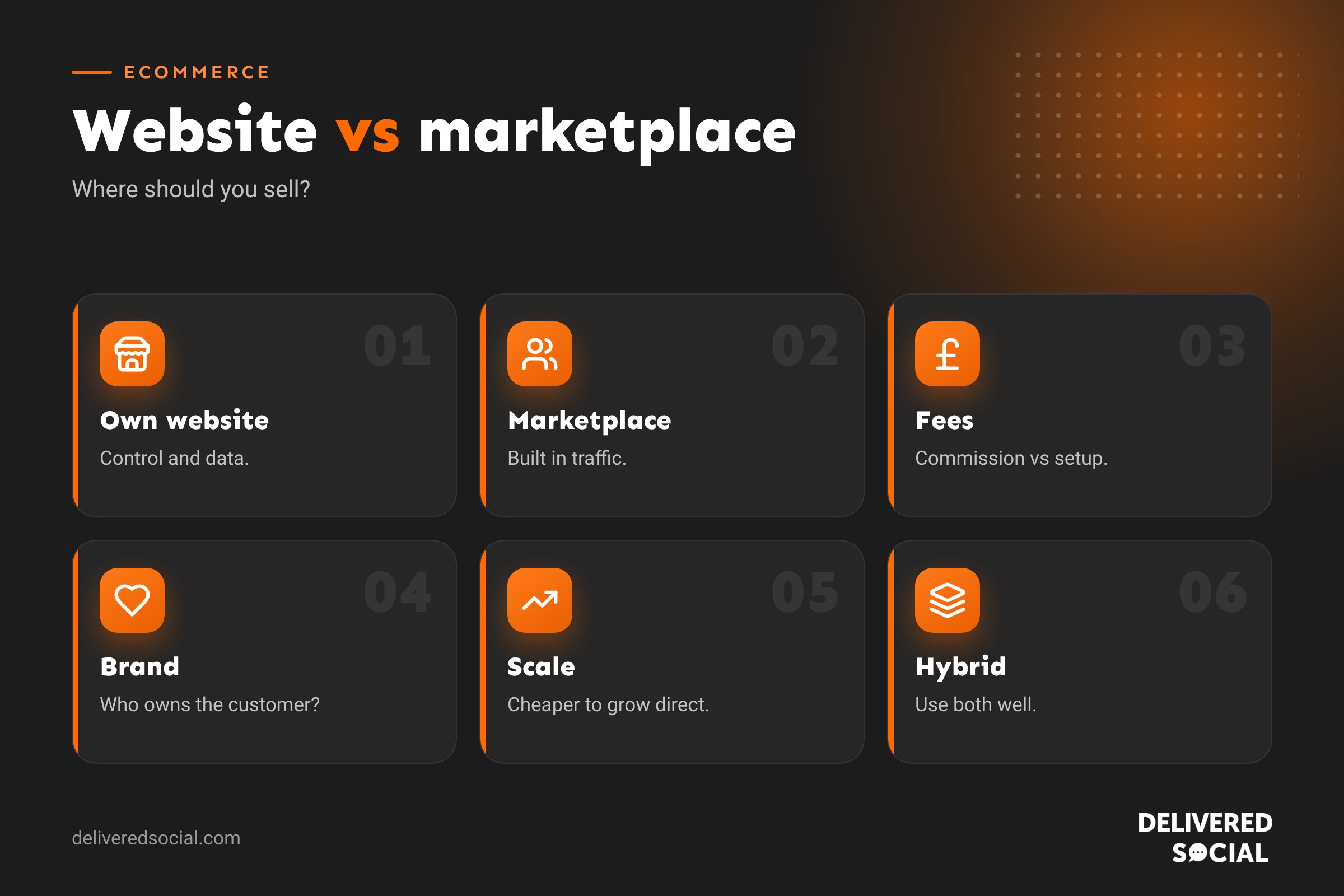
If you want to sell products online, one of the first big decisions is where to sell. Do you build your own ecommerce website, list on marketplaces such as Amazon, eBay or Etsy, or do both? Each route has very different costs, levels of control and growth potential. This guide compares an ecommerce website vs marketplace selling for UK businesses, covering fees, traffic, branding, customer data and risk, so you can choose the right mix for your products and goals.
What is the difference?
An ecommerce website is your own online shop on your own domain, built on a platform such as WooCommerce, Shopify or BigCommerce. You control the design, the prices, the customer experience and the data, but you are responsible for bringing in visitors.
A marketplace is a large website where many sellers list products, such as Amazon, eBay, Etsy, Not On The High Street, OnBuy or TikTok Shop. The marketplace brings the shoppers, handles much of the trust and payment process, and takes a fee for each sale. You play by its rules and compete directly with other sellers on the same page.
Ecommerce website: the pros
- Full control. You choose the design, the layout, the product information and the whole customer journey.
- Your own brand. Customers buy from you, not from “a seller on Amazon”. This builds recognition and loyalty.
- Customer data. You collect email addresses and purchase history, so you can market to customers again and build lifetime value.
- Better margins. There are no commission fees on each sale, only payment processing and platform costs.
- Freedom on pricing and offers. You can run bundles, loyalty schemes, subscriptions and promotions however you like.
- A business asset. A website with traffic, rankings and an email list adds real value to your business if you ever sell it.
Ecommerce website: the cons
- You must find the traffic. A new site has no visitors until you invest in SEO, ads, social media or email.
- Upfront costs. Design, build, photography and setup cost more at the start than opening a marketplace account.
- Trust takes time. Shoppers who have never heard of you may hesitate until you build reviews and reputation.
- More to manage. You are responsible for hosting, security, updates, payments and customer service.
Marketplaces: the pros
- Built in traffic. Millions of shoppers already search on Amazon, eBay and Etsy every day.
- Instant trust. Shoppers trust the marketplace’s payments, delivery promises and returns process.
- Quick to start. You can list products within days, with little technical knowledge.
- Fulfilment options. Services such as Fulfilment by Amazon can store, pick, pack and deliver for you.
- Test demand. Marketplaces are a cheap way to test whether a new product sells before investing in a full website.
Marketplaces: the cons
- Fees eat margins. Referral fees, listing fees, subscription fees, fulfilment fees and advertising costs add up quickly, often to a significant share of each sale.
- Fierce competition. Your product sits next to competitors, often with the cheapest shown first. Price wars are common.
- Little brand building. Customers often remember “I bought it on Amazon” rather than your brand name.
- Limited customer data. Marketplaces restrict how you can contact buyers, so building repeat business is much harder.
- Rules can change. Fees, policies, search algorithms and account requirements change, and a suspended account can stop your income overnight.
- Pressure to advertise. On busy marketplaces, sponsored listings are increasingly needed to be seen.
Cost comparison
Costs vary by platform and category, but here is the general shape:
- Own website: a one off design and build cost, plus hosting, domain, platform or plugin subscriptions, payment processing fees (typically a small percentage per transaction) and ongoing marketing. Your cost per sale falls as traffic grows.
- Marketplace: low setup cost, but a commission on every sale, possible monthly seller fees, optional fulfilment fees and usually advertising spend. Your cost per sale stays roughly the same as you grow.
As a rule of thumb, marketplaces are cheaper to start and an own website is cheaper to scale. Always check the current fee pages of each marketplace for your product category before you decide, because fees differ widely between categories.
Traffic and visibility
Marketplaces win on day one traffic. Your own site wins over time if you invest in it. SEO, Google Shopping, social media, email and increasingly AI search can all bring buyers straight to your website, where you do not pay commission. Our ecommerce SEO and GEO for ecommerce guides explain how to build that traffic.
Brand and customer relationships
This is often the deciding factor. On your own website you own the relationship. You can welcome new customers by email, recommend products based on what they bought, run a loyalty scheme and invite them to review. On a marketplace, the marketplace owns the relationship. That makes marketplace sales more like wholesale: useful volume, but harder to turn into a loyal following.
Which is right for your business?
A marketplace first approach suits you if:
- You are testing a new product or brand with a small budget.
- You sell commodity products that people search for by name or type.
- You want to reach overseas buyers quickly.
- You have little time or budget for marketing a website.
An own website first approach suits you if:
- You have a distinctive brand, story or product range.
- You rely on repeat purchases or subscriptions.
- Your margins cannot absorb marketplace fees.
- You want to build a long term asset and an email list.
- You sell handmade, premium or personalised products where presentation matters.
The best of both: a hybrid approach
Many successful UK sellers use both. A common pattern is to use marketplaces for reach and discovery, and your own website for brand building, repeat customers and better margins. To make a hybrid approach work:
- Keep product information, prices and stock in sync across channels, ideally using a multichannel tool.
- Offer something extra on your own website, such as exclusive bundles, a loyalty scheme or free gifts, to encourage direct purchases.
- Include a branded insert in marketplace parcels inviting customers to your website, while following each marketplace’s rules on contacting buyers.
- Track profit by channel, not just revenue, so you know where you really make money.
Common mistakes to avoid
- Relying on a single marketplace for all your income.
- Building a website and expecting traffic without any marketing plan.
- Underestimating marketplace fees and advertising costs when setting prices.
- Letting stock levels get out of sync and overselling.
- Using the same generic product descriptions everywhere.
A worked example
Imagine a small UK brand selling handmade candles at £24 each. On a marketplace, once referral fees, a share of advertising and fulfilment costs are taken into account, the seller might keep noticeably less of each sale than on their own site, and they will not get the customer’s email address. On their own WooCommerce site, the main costs per sale are payment processing and the marketing used to bring the customer in. The first sale may cost more to win through ads, but every repeat purchase from email costs very little. If a typical customer buys three or four times a year, the own website quickly becomes the more profitable channel.
The same brand might still use a marketplace in the run up to Christmas, when gift shoppers search there in huge numbers, then focus on turning those buyers into direct customers through great packaging and a reason to visit the website next time.
How to move from marketplace to your own website
If you already sell mainly on marketplaces, you can shift gradually rather than all at once:
- Launch a simple website with your best sellers and strong branding.
- Start collecting emails through your site with a welcome offer.
- Build a small budget for Google Shopping and social ads to drive direct traffic.
- Write buying guides and helpful content to grow organic search traffic.
- Gradually raise marketplace prices slightly to reflect fees, while keeping your own site competitive.
Our ecommerce marketing strategy guide covers the channels in more detail, and our ecommerce website features guide shows what to include when you build.
Key takeaways
- Marketplaces offer instant traffic and trust, but at the cost of fees, competition and control.
- Your own website offers control, brand building, customer data and better margins, but you need to find the traffic.
- Marketplaces are cheaper to start; an own website is usually cheaper to scale.
- Many businesses do best with a hybrid approach.
- Track profit by channel to see what really works.
Frequently asked questions
Is it better to sell on Amazon or my own website?
It depends on your products and goals. Amazon offers huge reach, while your own website offers better margins, brand control and repeat customers. Many businesses use both.
Are marketplace fees worth it?
They can be, especially when starting out or testing products, because you pay for traffic only when you sell. As you grow, the fees often become a strong reason to build your own channel.
Can I sell on Etsy and my own website at the same time?
Yes. Many makers do, keeping stock in sync and using their website for repeat customers and custom orders.
How do I get traffic to a new ecommerce website?
Use a mix of SEO, Google Shopping, social media, email marketing and partnerships. Paid channels work faster, while SEO builds over months.
Which marketplaces are popular in the UK?
Amazon, eBay, Etsy, Not On The High Street, OnBuy, TikTok Shop and specialist marketplaces for particular industries.
Do I own my customers on a marketplace?
Not in the same way. Marketplaces limit how you contact buyers, which makes building repeat business harder.
Need help choosing the right route?
We help businesses across Surrey, Hampshire and the UK build online shops and marketing plans that grow direct sales. Call us on 01483 608 303.
































