



Keep reading
Rather we just did it for you?
Let's get your business seen.
Social media, websites, SEO and ads from a team you can actually meet.
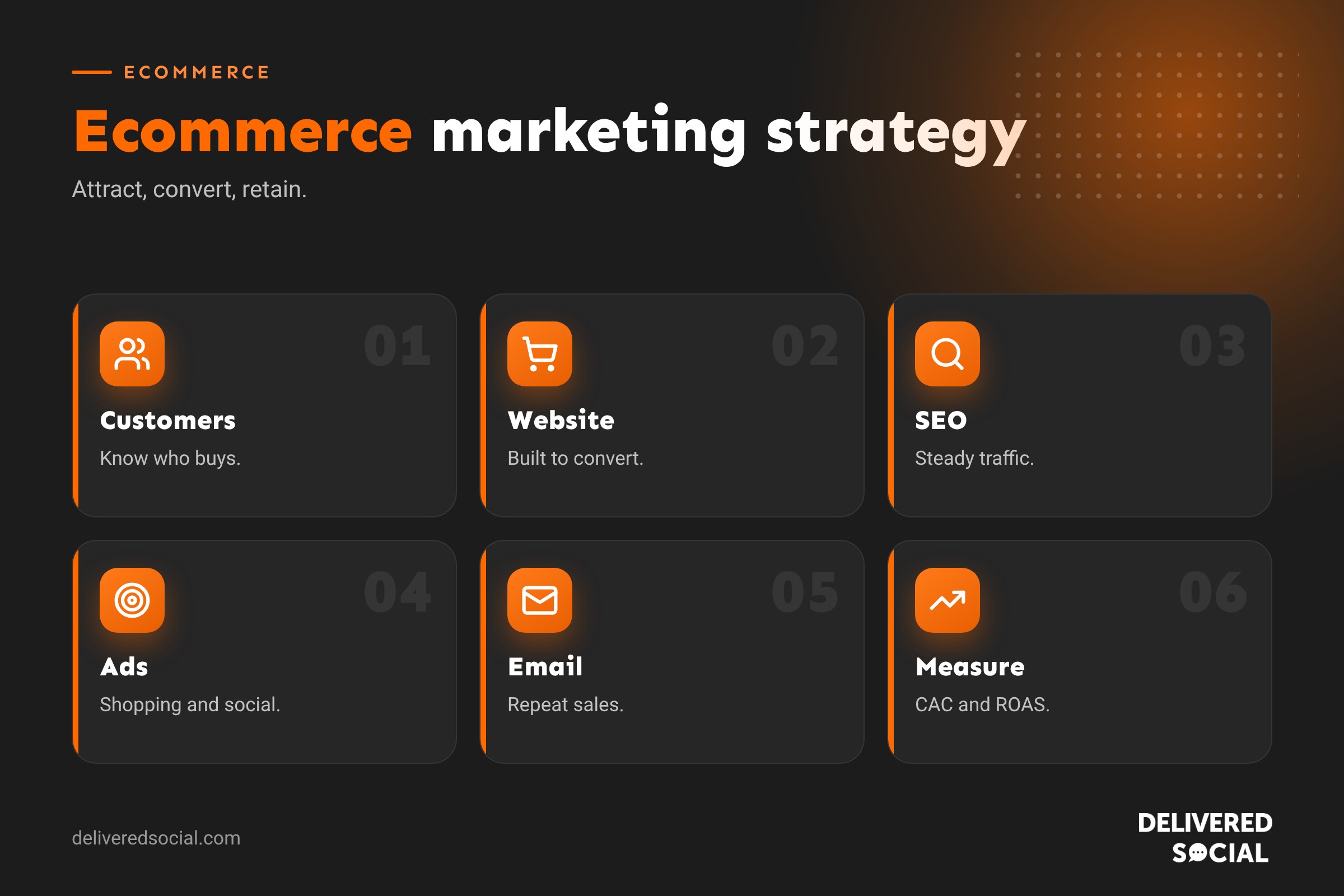
A great online shop is only half the job. Without a clear plan to bring in visitors, turn them into buyers and keep them coming back, even the best products can sit unsold. This guide sets out a practical ecommerce marketing strategy for UK businesses: how to build your plan, which channels to use, how to set budgets and measure results, plus a simple marketing plan template you can copy.
What is an ecommerce marketing strategy?
An ecommerce marketing strategy is your plan for attracting the right shoppers to your online store, persuading them to buy and encouraging them to buy again. It covers who you are targeting, what makes you different, which channels you use, how much you spend, and how you measure success. A written plan stops you jumping from tactic to tactic and helps you put money where it works.
Step 1: know your customer
Every good strategy starts with a clear picture of who buys from you. Work out:
- Who your best customers are: age, location, lifestyle, budget.
- What problem your products solve or what desire they meet.
- Where they spend time online: Google, Instagram, TikTok, Pinterest, YouTube, marketplaces.
- What makes them hesitate: price, delivery costs, returns, trust.
- What triggers a purchase: gifting occasions, seasons, life events.
Look at your existing sales data, reviews and customer service emails. They are full of insight.
Step 2: get your offer and website right
Marketing magnifies whatever is already there. Before spending on ads, make sure your store converts:
- Clear product photos and honest, detailed descriptions.
- Prices, delivery costs and timescales shown early.
- Simple returns policy.
- Fast, mobile friendly pages.
- Easy checkout with popular payment options.
- Reviews and trust signals on product pages.
Our ecommerce website features checklist covers the essentials.
Step 3: choose your channels
| Channel | Best for | Timeframe |
|---|---|---|
| SEO | Steady, low cost traffic from people searching for your products | Months to build, long lasting |
| Google Shopping and search ads | Capturing shoppers ready to buy | Immediate |
| Meta ads (Facebook and Instagram) | Reaching new customers by interest and lookalike audiences | Immediate, needs testing |
| TikTok and short video | Discovery and viral reach, especially younger audiences | Fast but unpredictable |
| Organic social media | Building brand, community and trust | Ongoing |
| Email marketing | Repeat purchases and recovering abandoned baskets | Immediate once set up |
| Influencers and partnerships | Trust and reach in a niche | Campaign based |
| Marketplaces | Extra reach on Amazon, Etsy or eBay | Fast, but with fees and less control |
You do not need every channel. Pick two or three that suit your customers and budget, do them well, then expand.
Step 4: build a funnel
Think of your marketing in three stages:
- Attract: bring new people to your brand through SEO, social content, ads and influencers.
- Convert: turn visitors into buyers with strong product pages, retargeting ads, abandoned basket emails and first order offers.
- Retain: keep customers coming back with email, loyalty schemes, great service and new product launches.
Many stores focus all their effort on attracting new visitors and neglect retention, even though repeat customers are usually far cheaper to market to. Our guide to the ecommerce marketing funnel goes deeper.
Step 5: set your budget
A sensible way to set a budget is to work backwards from what you can afford to pay to win a customer. If your average order is worth £50 with a £20 profit, and customers typically buy three times, each customer is worth around £60 in profit. That tells you how much you can spend to acquire one and still make money. Our guide to ecommerce marketing budgets explains this in more detail.
Step 6: plan your content and calendar
Ecommerce is seasonal. Plan around key dates:
- January sales and new year goals.
- Valentine’s Day, Mother’s Day and Father’s Day.
- Easter and spring.
- Summer holidays.
- Back to school.
- Black Friday and Cyber Monday.
- Christmas, with last order dates.
Add your own dates: product launches, anniversaries and restocks. Our ecommerce marketing calendar is a useful starting point.
Step 7: measure what matters
Track these numbers every month:
- Sessions and traffic sources: where visitors come from.
- Conversion rate: the share of visits that become orders.
- Average order value.
- Customer acquisition cost: marketing spend divided by new customers.
- Return on ad spend: revenue from ads divided by ad spend.
- Repeat purchase rate and customer lifetime value.
- Email revenue, including abandoned basket recovery.
Use Google Analytics 4 with ecommerce tracking, plus the reports in your store platform and ad accounts.
A simple ecommerce marketing plan template
| Section | What to write |
|---|---|
| Goals | For example, grow online revenue by 30% this year, with 40% from repeat customers |
| Target customers | Two or three customer profiles |
| Unique selling points | Why people should buy from you |
| Channels | Your chosen two or three main channels and why |
| Budget | Monthly spend by channel |
| Calendar | Key dates, launches and campaigns |
| Website improvements | Changes to boost conversion |
| Retention | Email flows, loyalty and aftercare |
| Measurement | Which numbers you track and how often |
Example: a small UK homeware brand
A Hampshire candle maker selling online sets a goal to double online sales in a year. They focus on three channels: SEO for product and gift guide pages, Instagram and TikTok for behind the scenes making videos, and email for repeat customers. They improve product photos, add reviews to product pages and set up an abandoned basket email. In the run up to Christmas, they add Google Shopping ads and a gift guide. Repeat customers make up a growing share of revenue as their email list grows.
Making your product pages work harder
Product pages are where most ecommerce marketing either pays off or falls flat. Every channel, from SEO to ads to email, eventually sends people there. Strong product pages answer every question a shopper might have before they need to ask it: what it is, who it is for, what it is made of, how big it is, how long delivery takes and what happens if it is not right. Use several photos, including the product in use, and a short video where you can. Add reviews with photos, a clear price including any delivery cost, and a single obvious button to add to basket. Small improvements here lift the results of every other channel at once.
Common mistakes
- Spending on ads before the website converts.
- Trying every channel at once.
- Ignoring email and repeat customers.
- Discounting too often and training customers to wait for sales.
- Not tracking results properly.
- Leaving seasonal planning too late.
Ecommerce marketing strategies for 2026
A few trends are worth building into your plan this year:
- AI search visibility: shoppers increasingly ask AI tools for product recommendations. Clear product information, reviews and helpful buying guides make you easier to recommend. See our guide to GEO for ecommerce.
- Short form video: product demos, unboxings and behind the scenes clips drive discovery on TikTok, Reels and YouTube Shorts.
- User generated content: real customer photos and videos build trust and make strong ads.
- First party data: growing your own email and SMS lists reduces reliance on rising ad costs.
- Social commerce: selling directly on platforms such as Instagram and TikTok Shop.
Retention ideas that pay for themselves
Keeping existing customers is often the quickest way to grow. Simple ideas that work well for small online shops include a welcome email series for new subscribers, a thank you email with care tips after purchase, a review request a week or two after delivery, a “running low?” reminder for consumable products, a birthday or anniversary offer, early access to new products for previous customers, and a small surprise in the parcel, such as a handwritten note or sample. Each of these builds loyalty and encourages a second purchase, which is where ecommerce profit really comes from.
Key takeaways
- Start with a clear picture of your customer and a website that converts.
- Choose two or three channels and do them well.
- Think in stages: attract, convert, retain.
- Set budgets based on what a customer is worth.
- Plan around seasonal dates and track the right numbers.
Frequently asked questions
What is the best marketing strategy for ecommerce?
A mix of SEO, paid ads and email, built on a fast, trustworthy website, with a focus on repeat customers.
How much should I spend on ecommerce marketing?
Work backwards from what a customer is worth, then start small and scale what works.
Is SEO worth it for ecommerce?
Yes. It brings steady, low cost traffic over time, especially for product and category pages.
Which social platform is best for ecommerce?
It depends on your audience. Instagram, TikTok and Pinterest suit many consumer brands.
How do I increase repeat customers?
Email flows, loyalty schemes, great service and regular new products.
How long does ecommerce marketing take to work?
Paid ads and email can work within weeks. SEO and brand building usually take several months.
Do I need a marketing plan?
Yes. Even a one page plan keeps your efforts focused.
Want help growing your online store?
We help ecommerce businesses across Surrey, Hampshire and the UK grow with SEO, ads and social media. Call us on 01483 608 303.
































