

Keep reading
Rather we just did it for you?
Let's get your business seen.
Social media, websites, SEO and ads from a team you can actually meet.
Most people don’t buy the first time they see an online shop. They discover you on social media, browse a few products, leave, see an advert, read some reviews, sign up for an email, and maybe buy a week later. That journey is your marketing funnel. Understanding it helps you spend money in the right places and fix the leaks that cost you sales. This guide explains how an ecommerce marketing funnel works, what to do at each stage, the numbers to track, and how to build a simple funnel for a small online shop.
What is an ecommerce marketing funnel?
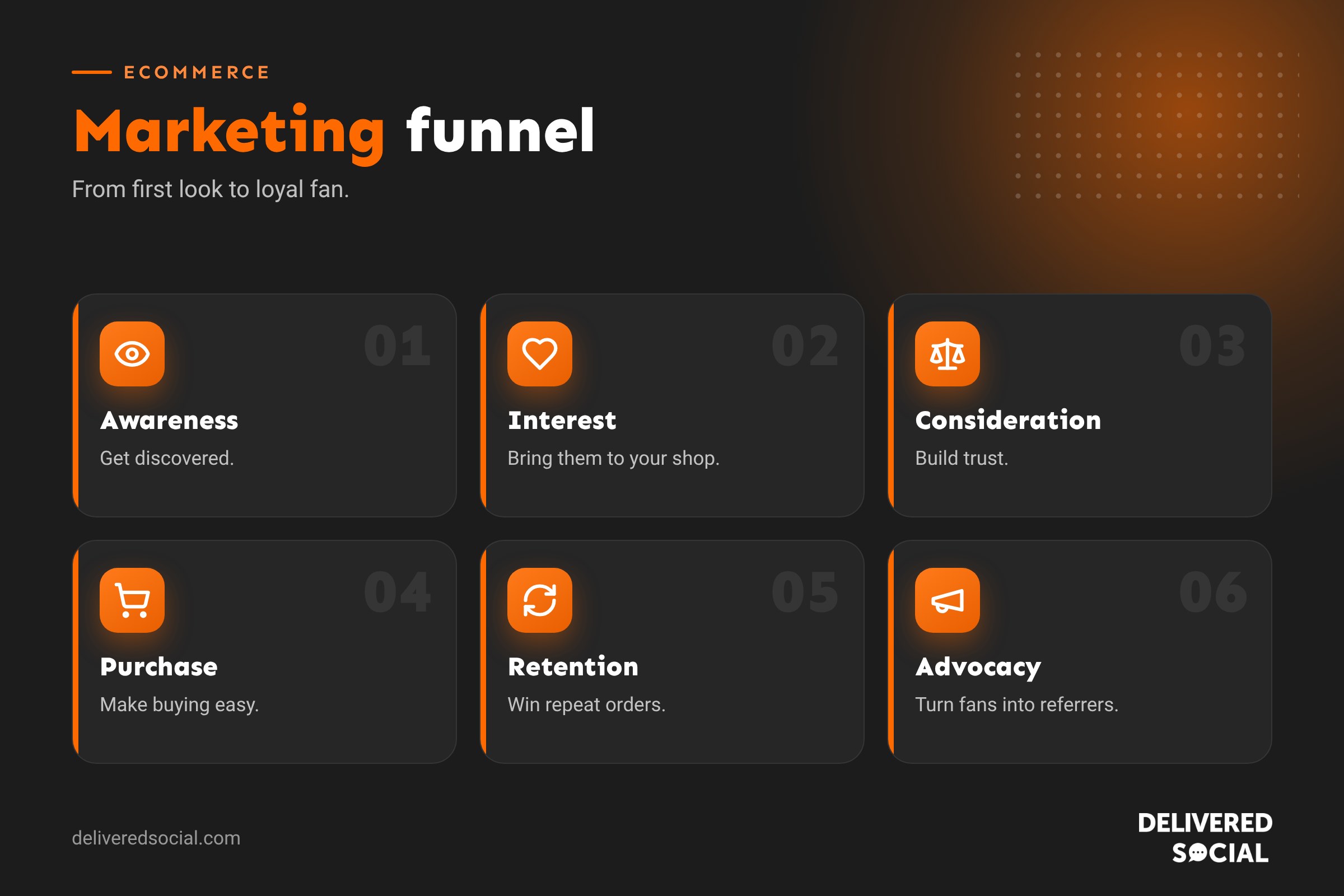
An ecommerce marketing funnel is a way of mapping how strangers become customers, and then loyal fans. It’s called a funnel because many people enter at the top and fewer make it to each next step. Your job is to attract the right people at the top, guide them through each stage, and keep as many as possible moving towards a purchase and beyond.
The stages of the funnel
| Stage | What the shopper is thinking | Your goal |
|---|---|---|
| Awareness | “I didn’t know this brand existed.” | Get discovered by the right people |
| Interest | “That looks good, tell me more.” | Bring them to your shop and keep them engaged |
| Consideration | “Is it right for me? Can I trust them?” | Answer questions and build trust |
| Purchase | “I’ll buy it.” | Make buying easy and reassuring |
| Retention | “That was great, what else do they have?” | Encourage repeat orders |
| Advocacy | “You should try this.” | Turn customers into reviewers and referrers |
Some people call these top, middle and bottom of the funnel (TOFU, MOFU and BOFU), with retention and advocacy after the sale.
Stage 1: Awareness
At the top of the funnel, people don’t know you yet. Focus on reaching new audiences who match your ideal customer.
- Social media content: short videos, Reels and TikToks showing products in use.
- Paid social ads: broad targeting with eye-catching creative.
- SEO and blog content: helpful guides that answer what your customers search for.
- Influencers and creators: introduce you to engaged audiences.
- PR and partnerships: features in relevant publications and collaborations with other brands.
- Google Shopping and free listings: appear when people search for products like yours.
Measure reach, impressions, video views and new visitors rather than sales at this stage.
Stage 2: Interest
Now people have seen you and want to learn more. They may follow you, visit your site or browse a few products.
- Make your home page and category pages clear and inviting.
- Offer an email sign-up with a genuine reason to join, such as early access or a guide.
- Share behind-the-scenes and brand story content.
- Use retargeting ads to stay in front of recent visitors.
- Post consistently so followers see you regularly.
Stage 3: Consideration
Shoppers are comparing options and looking for reasons to trust you. This is where many small shops lose people.
- Strong product pages with great photos, clear benefits, sizing and delivery information.
- Reviews and user-generated content on product pages and social media.
- Comparison and buying guides that help people choose.
- FAQs answering common worries about quality, delivery and returns.
- Browse abandonment emails reminding people what they viewed.
Our guide to writing product descriptions helps here.
Stage 4: Purchase
At the bottom of the funnel, remove every reason not to buy.
- Quick, mobile-friendly checkout with guest checkout available.
- Clear delivery costs and dates before the final step.
- Popular payment options, including digital wallets.
- Abandoned basket emails and retargeting ads.
- Reassurance near the buy button: returns policy, secure payment and reviews.
Our ecommerce website audit checklist helps you spot checkout problems.
Stage 5: Retention
Winning a repeat order is usually far cheaper than finding a new customer. After the first purchase:
- Send a warm post-purchase sequence with care tips and how-tos.
- Recommend related products at sensible times.
- Run a loyalty programme or VIP early access.
- Send replenishment reminders for products that run out.
- Win back lapsed customers with new arrivals or a thank-you reward.
See our guide to ecommerce marketing automation for the flows to set up.
Stage 6: Advocacy
Happy customers can become your best marketers.
- Ask for reviews after delivery.
- Encourage customers to share photos and tag you.
- Run a refer-a-friend scheme.
- Feature customer stories on social media and your site.
Advocacy feeds the top of the funnel again, bringing in new people through word of mouth.
Matching channels to funnel stages
| Channel | Best stages |
|---|---|
| Organic social | Awareness, interest, advocacy |
| Paid social prospecting | Awareness |
| Retargeting ads | Interest, consideration, purchase |
| SEO and blog | Awareness, consideration |
| Google Shopping | Consideration, purchase |
| Email and SMS | Interest through retention |
| Reviews | Consideration, advocacy |
Key funnel metrics
| Stage | Metrics to watch |
|---|---|
| Awareness | Reach, impressions, new visitors, cost per thousand impressions |
| Interest | Engagement, click-through rate, email sign-ups |
| Consideration | Product page views, add-to-basket rate, time on page |
| Purchase | Conversion rate, checkout completion, cost per purchase |
| Retention | Repeat purchase rate, customer lifetime value |
| Advocacy | Reviews collected, referrals, user-generated content |
Our guide to ecommerce conversion rate explains the purchase stage numbers in more detail.
Finding leaks in your funnel
Look at where the biggest drop-offs happen:
- Lots of traffic, few product views: wrong audience or confusing navigation.
- Lots of product views, few add-to-baskets: weak product pages, price or trust issues.
- Lots of baskets, few orders: checkout friction or surprise delivery costs.
- Lots of first orders, few repeats: weak post-purchase experience or product issues.
Fix the biggest leak first. A small improvement low down the funnel often adds more revenue than more traffic at the top.
Building a simple funnel for a small shop
- Awareness: three to five social posts a week, plus a small prospecting ad budget.
- Interest: an email sign-up with a welcome series.
- Consideration: reviews on every product page and a short FAQ.
- Purchase: a simple checkout and an abandoned basket flow.
- Retention: a post-purchase email sequence and a review request.
- Advocacy: a refer-a-friend offer and regular customer features.
Start with these basics, measure, then improve one stage at a time.
Budgeting across the funnel
Many shops spend almost everything on bottom-of-funnel ads aimed at people already close to buying. That works for a while, then results plateau because the pool of warm shoppers runs dry. Keep some budget for awareness so new people keep entering the funnel, and invest in retention so every customer is worth more over time. Planning campaigns around key dates helps; see our ecommerce marketing calendar.
The funnel isn’t a straight line
Real shoppers jump around. Someone might go straight from a friend’s recommendation to buying, or see five adverts before visiting. The funnel is a planning tool, not a rule. Use it to make sure you have the right content and messages for people at every stage, wherever they enter.
Example: a candle brand’s funnel
An independent candle brand posts short videos of candles being poured and lit (awareness), runs a “find your scent” quiz that captures email addresses (interest), shows reviews mentioning burn time and scent strength on product pages (consideration), offers free delivery over a set amount with a simple checkout (purchase), emails care tips and a reminder after six weeks when candles burn down (retention), and invites customers to share photos for a monthly giveaway (advocacy). Each stage has one clear job, and the owner checks the numbers monthly to see where people drop off.
Quick glossary
- TOFU, MOFU, BOFU: top, middle and bottom of the funnel.
- Prospecting: advertising to people who haven’t engaged with you yet.
- Retargeting: advertising to people who have visited or engaged.
- Lifetime value: the total a customer spends with you over time.
- Add-to-basket rate: the share of product page visitors who add an item.
Key takeaways
- An ecommerce funnel maps the journey from discovery to repeat purchase and referral.
- Each stage needs different content, channels and metrics.
- Find and fix the biggest drop-off first.
- Keep feeding the top of the funnel while investing in retention.
- Happy customers fuel new awareness through reviews and referrals.
Frequently asked questions
What is an ecommerce marketing funnel?
A model of how shoppers move from discovering your brand to buying, buying again and recommending you.
What are the main funnel stages?
Awareness, interest, consideration, purchase, retention and advocacy.
Which stage should I focus on first?
The one with the biggest drop-off, often product pages or checkout.
Do I need ads for every stage?
No. Organic social, SEO and email can cover many stages; ads speed things up.
How do I measure my funnel?
Use analytics to track visitors, product views, add-to-baskets, checkouts and repeat orders.
What is retargeting?
Showing ads to people who visited your shop but didn’t buy.
How long does a shopper take to move through the funnel?
It varies from minutes for impulse buys to weeks for higher-priced products.
Is the funnel the same for every shop?
The stages are similar, but the best channels and messages depend on your products and customers.
Want help filling your shop’s funnel?
We run social media, content and ad campaigns for online shops across Surrey, Hampshire and the UK. See our social media management services or call us on 01483 608 303.