



Keep reading
Rather we just did it for you?
Let's get your business seen.
Social media, websites, SEO and ads from a team you can actually meet.
“How much should we spend on marketing?” is one of the hardest questions for online shop owners. Spend too little and you never build momentum. Spend too much, or in the wrong places, and you burn cash on ads that don’t pay back. There’s no single right number, but there is a sensible way to work it out. This guide explains how to set an ecommerce marketing budget: typical percentages, how to calculate what you can afford per customer, how to split spend across channels and how to measure whether it’s working.
Typical ecommerce marketing budgets
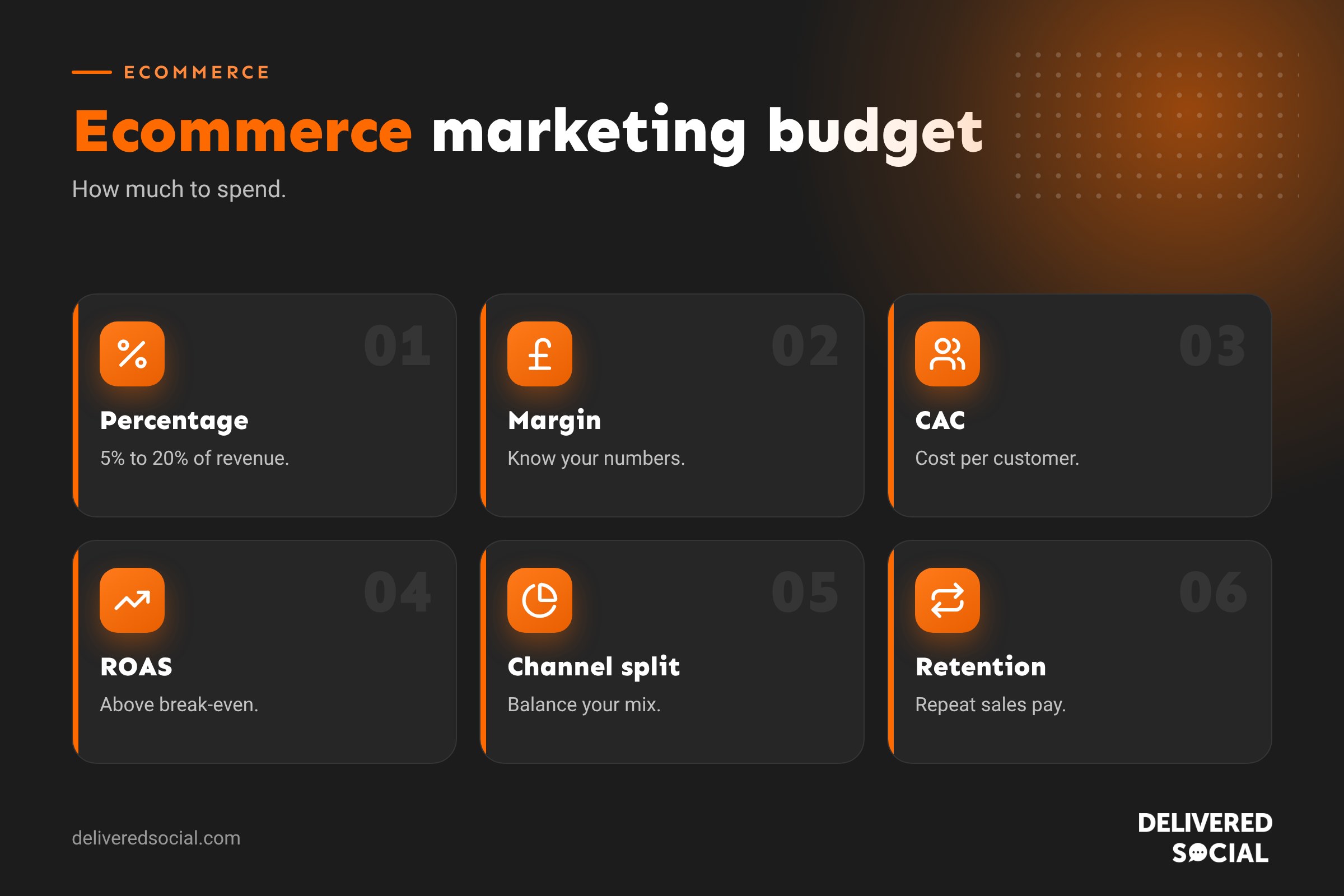
Many online businesses spend somewhere between 5% and 20% of revenue on marketing, but the range is wide:
| Stage | Typical approach |
|---|---|
| New shop, building awareness | Higher share of revenue, sometimes more than 20%, often funded by investment |
| Growing shop | Around 10% to 20% of revenue |
| Established shop with loyal customers | Around 5% to 10% of revenue |
These are rules of thumb, not targets. Your margins, competition and growth goals matter far more than an industry average.
Start with your numbers, not percentages
The most reliable way to set a budget is to work out what you can afford to spend to win a customer. You need four figures:
- Average order value (AOV): how much a typical order is worth.
- Gross margin: what’s left after product cost, packaging and delivery.
- Repeat purchase rate: how often customers come back.
- Customer lifetime value (LTV): the total profit from a typical customer over time.
Example calculation
A shop has an average order of £60 and a 40% gross margin, so each order makes £24 gross profit. Customers buy on average three times, so lifetime gross profit is about £72. If the shop is happy to spend a third of that winning a customer, its target customer acquisition cost (CAC) is around £24. To win 300 new customers a month, it needs roughly £7,200 of marketing spend, provided the channels can deliver customers at that cost.
If you only count the first order, you’d cap acquisition at less than £24 and might underinvest. If you overestimate repeat purchases, you’ll overspend. Use real data where you have it.
Key metrics to know
| Metric | What it tells you |
|---|---|
| CAC | Cost to win a new customer |
| LTV | Profit from a customer over time |
| LTV to CAC ratio | Whether acquisition is profitable; many aim for around 3:1 |
| ROAS | Revenue for every pound spent on ads |
| Break-even ROAS | The ROAS needed to cover product costs, based on margin |
| MER | Total revenue divided by total marketing spend |
Break-even ROAS is simply 1 divided by your gross margin. At a 40% margin, you need a ROAS of 2.5 just to break even on the first order. Many shops chase high ROAS figures without realising some campaigns are losing money.
How to split your budget across channels
There’s no perfect split, but a balanced plan for a growing shop might look like this:
| Channel | Role | Example share |
|---|---|---|
| Google Shopping and search ads | Capture people ready to buy | 30% to 40% |
| Social ads (Meta, TikTok, Pinterest) | Create demand and retarget | 20% to 30% |
| SEO and content | Long-term free traffic | 15% to 20% |
| Email and SMS | Repeat sales and loyalty | 5% to 10% |
| Organic social and creative | Brand, community, content for ads | 10% to 15% |
| Testing new channels | Influencers, marketplaces, PR | 5% to 10% |
Adjust based on where your customers are and what’s working. A shop selling niche spare parts may rely heavily on search, while a fashion brand may lean on social and creators.
Don’t forget the hidden costs
- Agency or freelancer fees.
- Software: email platforms, review tools, analytics and design tools.
- Content creation: photography, video and copywriting.
- Discounts and free delivery offers.
- Marketplace fees if you sell on Amazon or eBay.
Our ecommerce marketing tools guide covers useful software.
Plan for seasonality
Most shops have peaks: Black Friday, Christmas, Mother’s Day, summer or back to school. Plan to spend more ahead of and during peaks, when people are ready to buy, and build email lists and audiences in quieter months. See our ecommerce marketing calendar.
Budget for retention, not just acquisition
Winning new customers is expensive; keeping them is cheaper. Email flows, loyalty schemes, great packaging and service all increase repeat purchases and lifetime value, which lets you afford more to acquire new customers. See ecommerce marketing automation for flows that pay back quickly.
Start small, test, then scale
- Set a modest test budget for each new channel.
- Run it long enough to gather meaningful data, usually several weeks.
- Compare cost per acquisition and ROAS against your targets.
- Cut what doesn’t work and move budget to what does.
- Scale gradually; costs often rise as you spend more.
Tracking: make sure you can measure it
- Set up ecommerce tracking in Google Analytics.
- Install conversion tracking for Google Ads and Meta.
- Use UTM tags on email and social links.
- Track new versus returning customers.
- Review total marketing spend against total revenue each month, not just platform reports, which can overlap and over-claim.
Common budgeting mistakes
- Copying an industry percentage without checking your margins.
- Judging campaigns on ROAS without knowing break-even ROAS.
- Spreading a small budget across too many channels.
- Stopping SEO or email because results aren’t instant.
- Ignoring retention and repeat purchases.
- Not tracking properly, so decisions are guesses.
Example budgets
Small shop, £15,000 monthly revenue
Monthly marketing budget around £1,500 to £2,500: Google Shopping, a little Meta retargeting, email automation and steady SEO content.
Growing brand, £80,000 monthly revenue
Monthly budget around £8,000 to £14,000: Shopping and search, prospecting and retargeting on social, creator content, SEO and a strong email programme.
These are illustrations only; your margins and goals should drive the numbers. For broader budgeting help, see how to set a marketing budget.
Building a simple budget spreadsheet
You don’t need complicated software to manage your marketing budget. A simple spreadsheet with one row per channel works well. Add columns for planned spend, actual spend, revenue attributed, new customers, cost per acquisition and notes. Fill it in monthly. Over time, you’ll see which channels bring profitable customers, which are getting more expensive and where to move money. Add a separate tab for seasonal campaigns so you can compare Black Friday or Christmas year on year.
How to justify a bigger budget
If you need to convince a business partner or investor to spend more, show the maths rather than the hope. Present your lifetime value, current cost per acquisition, payback period (how long until a new customer’s profit covers the cost of winning them) and evidence from small tests. A clear case such as “every £1,000 in Shopping ads brings 40 new customers worth £72 each over their lifetime” is far more persuasive than a percentage pulled from an industry report.
When to cut spend
Cut or pause spend when cost per acquisition is consistently above your target, when tracking is broken and you can’t tell what’s working, or when stock levels can’t support demand. Pausing ads on products that are out of stock is one of the quickest savings many shops overlook.
Quick glossary
- AOV: average order value.
- CAC: customer acquisition cost.
- LTV: customer lifetime value.
- ROAS: return on ad spend.
- MER: marketing efficiency ratio, total revenue divided by total marketing spend.
Key takeaways
- Many shops spend 5% to 20% of revenue, but margins should guide you.
- Work out what you can afford per customer using LTV and margin.
- Know your break-even ROAS before judging ads.
- Balance acquisition with retention.
- Test small, track properly and scale what works.
Frequently asked questions
How much should an online shop spend on marketing?
Often 5% to 20% of revenue, depending on margins, stage and goals.
What is a good ROAS for ecommerce?
It depends on margin; it must be above your break-even ROAS to be profitable.
How do I calculate break-even ROAS?
Divide 1 by your gross margin; at 40% margin it’s 2.5.
Should a new shop spend more on marketing?
Usually, to build awareness, as long as it’s tracked carefully.
Is SEO worth it for small shops?
Yes, it builds free traffic over time, though it takes months.
How much should I spend on Google Ads?
Enough to gather data and hit your target cost per acquisition. See our Google Ads cost guide.
What’s more important, acquisition or retention?
Both; retention makes acquisition more affordable.
How often should I review my budget?
Monthly for performance, and quarterly for the overall split.
Do I need an agency?
Not always, but expertise can stop costly mistakes, especially with ads.
What should I cut first if money is tight?
Channels with the worst cost per acquisition; protect email and proven campaigns.
Should I include discounts in my marketing budget?
Yes. Discount codes and free delivery offers are a real marketing cost and should be tracked like ad spend.
Is Amazon advertising part of my budget?
If you sell on marketplaces, yes; include their ad spend and fees in your totals.
How long before I see a return?
Paid ads can show results in weeks; SEO and email build value over months.
Want a marketing plan that pays for itself?
We plan and manage ecommerce marketing, SEO and ads for online shops across Surrey, Hampshire and the UK. Call us on 01483 608 303.
































