



Keep reading
Rather we just did it for you?
Let's get your business seen.
Social media, websites, SEO and ads from a team you can actually meet.
Google search is changing. AI Overviews now summarise answers at the top of many results, and AI Mode lets people ask longer, conversational questions and follow-ups. Naturally, advertisers want to know: where do ads fit, and what should we change? This guide explains Google Ads in AI Mode and AI Overviews in plain English: how ads appear in AI-powered search, which campaign types can show there, how it affects small businesses and the practical steps to take now so your ads stay visible as search evolves.
What are AI Overviews and AI Mode?
AI Overviews are AI-generated summaries that appear at the top of some Google search results, pulling together information from across the web with links to sources.
AI Mode is a more conversational search experience. People can ask detailed, multi-part questions, such as “best family-friendly hotels in Cornwall with a pool, under £200 a night, near the beach”, and refine with follow-up questions, much like chatting with an assistant.
Both change how people search: queries are getting longer and more specific, and Google is better at understanding intent. See what is generative engine optimisation? for the organic side of this shift.
Do ads appear in AI Overviews and AI Mode?
Yes. Google has been showing ads within and alongside AI Overviews, and has been rolling out ads in AI Mode, expanding them to more countries and languages over time. Ads are clearly labelled as sponsored, and they appear when they’re relevant to both the question and the AI-generated answer. Availability varies by market and continues to change, so check Google’s latest announcements and your account’s reporting for what applies to your campaigns.
How do ads get shown there?
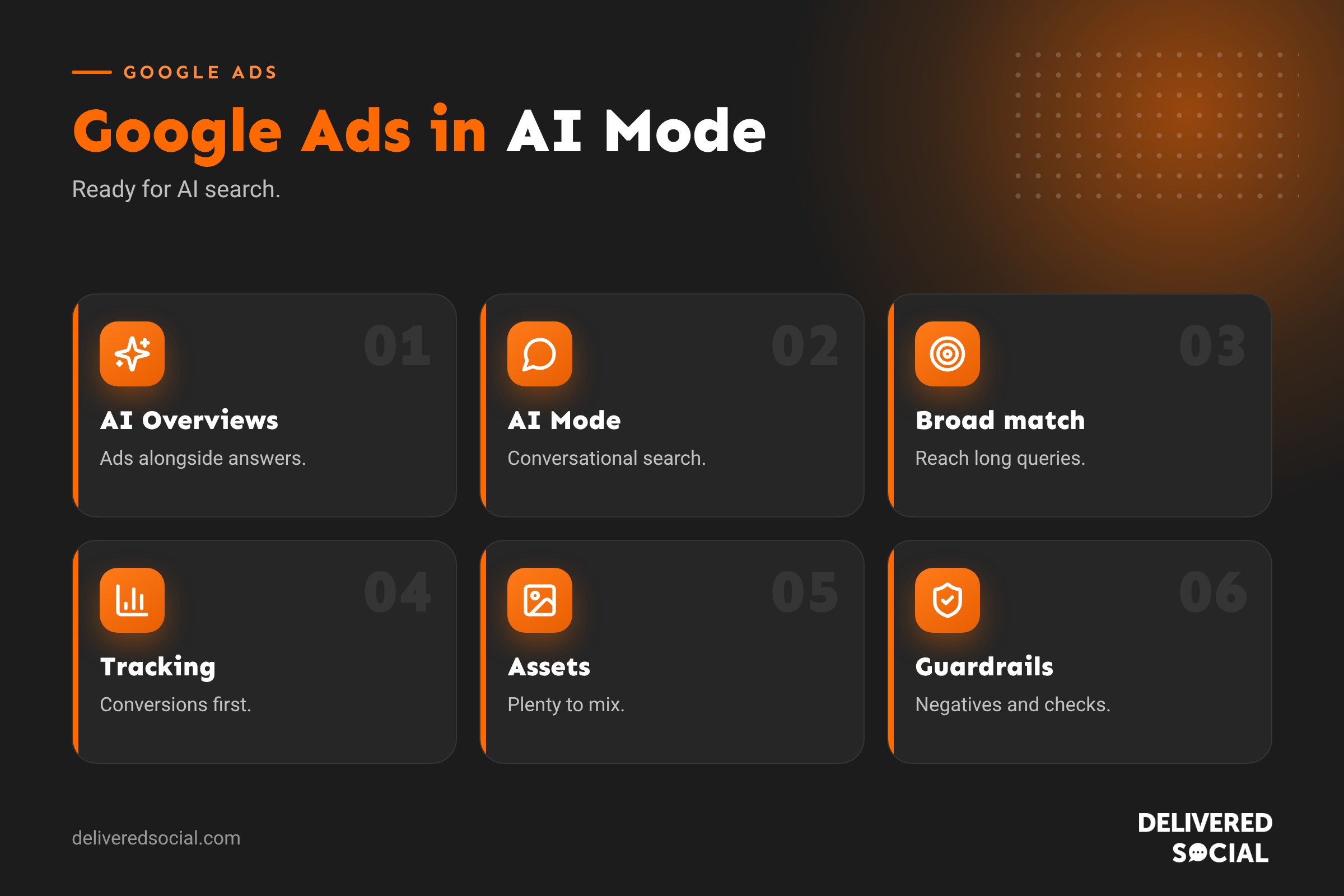
You don’t usually buy “AI Mode ads” as a separate product. Instead, eligible existing campaigns can serve in these placements when Google’s systems judge them relevant. Generally, that means campaigns that use Google’s AI to match ads to intent rather than relying only on exact keywords:
- Performance Max campaigns.
- Shopping campaigns, using your product feed.
- Search campaigns using broad match and, where available, AI Max for Search, which expands matching and tailors ad text and landing pages.
Campaigns that rely only on narrow exact-match keywords are less likely to appear for the long, conversational queries people type into AI Mode.
Why this matters for small businesses
- Longer, more detailed searches mean people reveal exactly what they want, which can create very high-intent opportunities.
- Fewer clicks to organic results on some searches mean paid placements may become more important for visibility.
- Quality of information matters: your website, product feed and assets give Google what it needs to match and present your ads well.
- Less manual control: matching is increasingly automated, so good conversion tracking and clear goals are essential to steer the system.
What to do now: a practical checklist
1. Fix your conversion tracking
AI-driven campaigns learn from conversions. Make sure calls, forms, bookings and sales are tracked accurately, and that you’re optimising for real business outcomes rather than clicks. Import offline conversions if sales happen by phone or in person.
2. Test broad match with smart bidding
Broad match paired with automated bidding (such as Maximise Conversions or a target cost per acquisition) lets Google match your ads to longer, conversational queries. Start with a controlled test and monitor search terms closely.
3. Consider AI Max for Search and Performance Max
Where available, AI Max for Search can extend reach in AI-powered results while keeping you in a Search campaign structure. Performance Max reaches across Google’s inventory. Both need strong conversion data and good assets.
4. Get your product feed in shape
For online shops, detailed product titles, descriptions, attributes, prices and images in Google Merchant Center help your products appear for specific, conversational searches. See Google Shopping ads.
5. Improve your assets
Provide plenty of high-quality headlines, descriptions, images, sitelinks, callouts and, where possible, video. The system mixes and matches these for different contexts.
6. Make your landing pages answer questions
Clear, detailed landing pages with prices, FAQs, service areas, reviews and specifics help Google understand when your ad is relevant and help visitors convert.
7. Use negative keywords and brand controls
Automation still needs guardrails. Add negative keywords for irrelevant searches, use brand exclusions where appropriate and review search term and placement reports regularly.
8. Keep your organic presence strong
AI Overviews often cite trusted websites. Helpful content, strong reviews and a complete Google Business Profile support both organic visibility and ad performance. See SEO vs SEM.
What changes in reporting?
Reporting on AI-powered placements is still evolving. You may not always see neat, separate figures for AI Mode or AI Overviews, so focus on overall results: cost per conversion, conversion value and return on ad spend by campaign. Watch search terms reports for longer, question-style queries and adjust negatives and landing pages accordingly.
Old approach vs new approach
| Older approach | AI-era approach |
|---|---|
| Exact keywords only | Broad match plus strong negatives |
| Manual bids per keyword | Smart bidding towards conversion goals |
| A few fixed ad texts | Many assets the system can combine |
| Generic landing pages | Detailed pages answering specific questions |
| Clicks as success | Conversions and value as success |
Risks to watch
- Wasted spend on loosely related searches if negatives and tracking are weak.
- Less transparency about exactly where ads appeared.
- Brand safety concerns about appearing next to AI-generated answers.
- Over-reliance on automation without human review.
The answer isn’t to avoid automation, but to give it good data, clear goals and regular checks.
Budget considerations
Broad matching and AI-driven campaigns often need enough budget and conversions to learn effectively. Very small budgets spread across many campaigns tend to struggle. Consolidate where you can, focus on your most profitable services or products and give tests time to run. See Google Ads cost for small businesses.
Example: a local kitchen company
A kitchen company in Surrey has run exact-match campaigns for years. Searches are getting longer, such as “who fits shaker kitchens with an island near Guildford and how long does it take”. The team fixes call and form tracking, adds a broad match campaign with smart bidding alongside its existing keywords, adds project photos and detailed FAQs to its landing page and reviews search terms weekly. It starts appearing for longer, high-intent questions it never targeted before, while negatives stop spend on DIY and job-seeker searches.
What’s next?
Google will keep developing AI-powered search and new ad formats, including richer shopping experiences and more conversational ads. The fundamentals won’t change: understand your customers, track what matters, provide great information and test carefully. Advertisers who get those right will adapt fastest.
Questions to ask your agency
- Are our campaigns eligible to show in AI-powered search results?
- Is our conversion tracking accurate and optimising for real outcomes?
- Are we testing broad match or AI Max with proper negatives?
- How are our assets and product feed being improved?
- How will we judge success over the next three months?
Quick glossary
- AI Overview: an AI-generated summary at the top of some search results.
- AI Mode: Google’s conversational AI search experience.
- Broad match: keyword matching that includes related searches.
- Smart bidding: automated bidding towards conversion goals.
- Performance Max: a Google Ads campaign type that runs across Google’s channels.
- AI Max for Search: a set of AI features for Search campaigns that expands matching and tailors ads.
Key takeaways
- Ads can appear in AI Overviews and AI Mode, with availability expanding over time.
- Eligible campaigns typically use broad match, AI Max, Shopping or Performance Max.
- Accurate conversion tracking is essential.
- Strong assets, feeds and landing pages help you show for detailed questions.
- Keep guardrails in place and review results regularly.
Frequently asked questions
Can I buy ads specifically for AI Mode?
Generally no; eligible campaigns can serve there automatically when relevant.
Which campaigns can show in AI Overviews?
Typically Search with broad match or AI Max, Shopping and Performance Max.
Are ads in AI Mode available in the UK?
Google has been expanding availability by market; check current announcements and your account.
Will AI search reduce clicks to my website?
For some informational searches, yes, which makes ads and strong content more important.
Do I need to change my keywords?
Consider testing broad match with smart bidding and strong negatives.
Can I see AI Mode performance separately?
Reporting is still developing; judge by overall conversions and value.
Is this suitable for small budgets?
Yes, if campaigns are focused and tracking is solid.
Does SEO still matter?
Yes, AI Overviews cite trusted sources and organic visibility supports ads.
What is AI Max for Search?
A set of features that uses AI to expand matching and tailor ad text in Search campaigns.
Should I worry about brand safety?
Review placements and use available exclusions and controls.
Will exact match keywords still work?
Yes, but they are less likely to reach long, conversational AI searches.
Do I need new ad copy?
Provide plenty of varied headlines and descriptions so the system can tailor ads.
Want your Google Ads ready for AI search?
We set up and manage Google Ads for businesses across Surrey, Hampshire and the UK. Call us on 01483 608 303.
































