



Keep reading
Rather we just did it for you?
Let's get your business seen.
Social media, websites, SEO and ads from a team you can actually meet.
“Social media marketing” and “social media management” are often used as if they mean the same thing, and agencies use both terms on their websites. But they are not quite the same, and knowing the difference helps you buy the right service, set the right goals and judge results fairly. This guide explains social media marketing vs management in plain English, how social media advertising fits in, and which one your business actually needs.
The short answer
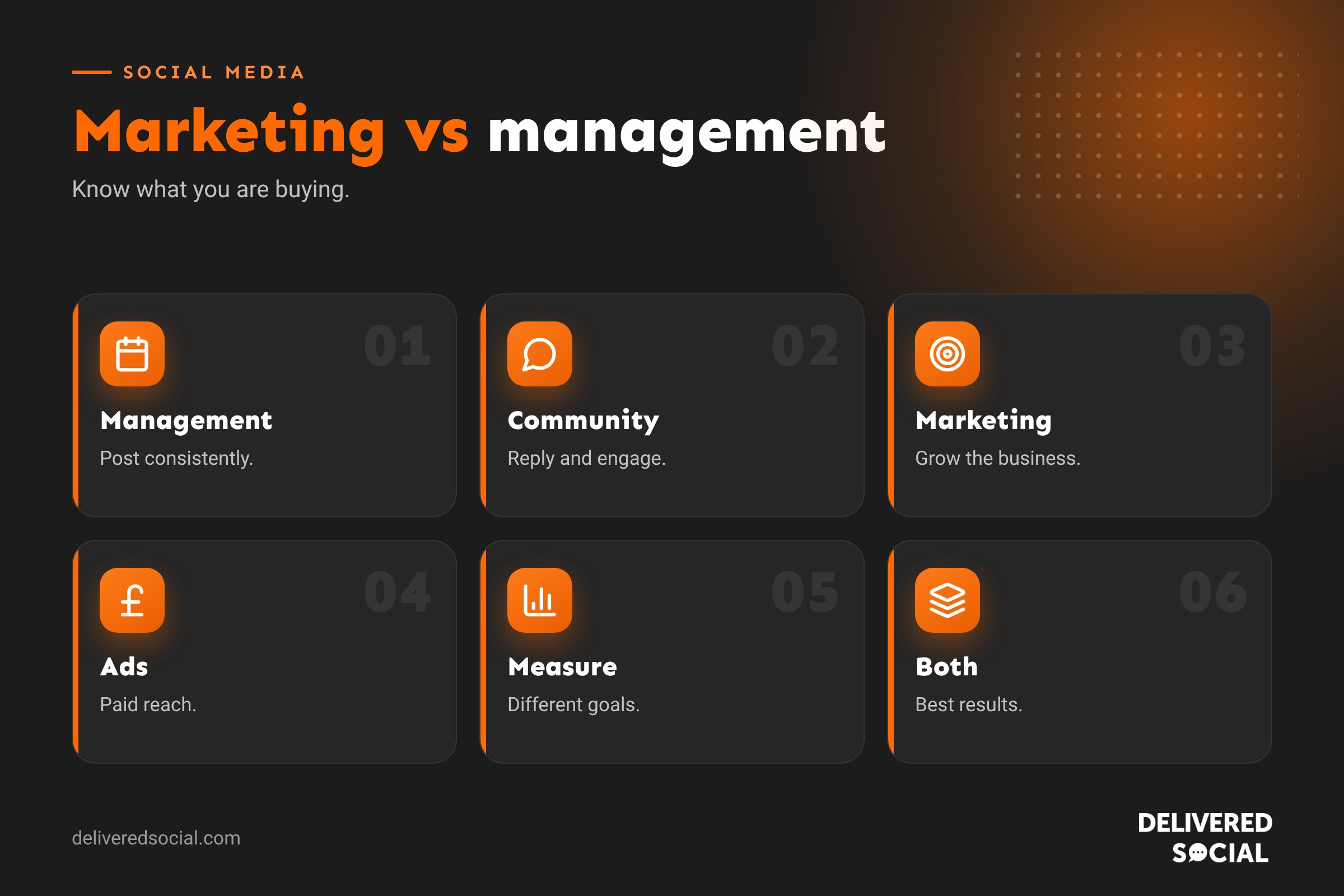
- Social media management is the day to day running of your social accounts: planning, creating and posting content, replying to comments and messages, and reporting.
- Social media marketing is the bigger picture: using social media strategically to reach new people and achieve business goals, often including campaigns, paid ads, influencers and promotions.
- Social media advertising is one part of marketing: paying to show ads to targeted audiences.
Management keeps your accounts active and professional. Marketing uses those accounts, and paid tools, to grow your business.
Side by side comparison
| Social media management | Social media marketing | |
|---|---|---|
| Focus | Running your accounts consistently | Achieving business goals through social |
| Typical tasks | Content calendars, posting, captions, community replies, monthly reports | Strategy, audience research, campaigns, ads, influencers, launches, conversion tracking |
| Timeframe | Ongoing, every week | Campaign based and ongoing strategy |
| Main measures | Consistency, engagement, follower growth, response times | Leads, sales, cost per result, return on spend |
| Budget | Usually a monthly fee | Monthly fee plus ad or campaign spend |
| Best for | Keeping your brand visible and trusted | Growth, launches and measurable results |
What social media management includes
A typical management service covers:
- Content planning: a monthly calendar of posts based on your business, seasons and events.
- Content creation: graphics, photos, short videos and captions.
- Scheduling and posting across your chosen platforms, often using tools such as Metricool.
- Community management: replying to comments and messages, and flagging enquiries.
- Profile upkeep: bios, highlights, cover images and links.
- Reporting: a monthly summary of reach, engagement and growth.
For many small businesses, management alone is what they need: a reliable, professional presence that builds trust and reminds existing customers you are there.
What social media marketing adds
Social media marketing goes further, aiming to grow your business through social channels. It often includes:
- Strategy: deciding which platforms, audiences and messages will meet your goals.
- Audience research: understanding who your customers are and where they spend time.
- Campaigns: focused pushes around launches, offers, events or seasons.
- Paid social advertising: targeted ads on Facebook, Instagram, TikTok and LinkedIn.
- Influencer and partner marketing.
- Conversion tracking: setting up pixels and analytics to measure enquiries and sales.
- Testing and optimisation: trying different messages, creative and audiences.
Social media marketing vs advertising
Advertising is the paid part of marketing. Organic social media, the free posts on your accounts, mainly reaches people who already follow you. Ads let you reach new people based on location, interests, demographics and behaviour, and drive specific actions such as visiting a page or filling in a form. Most effective social media marketing combines both: organic content to build trust and ads to reach and convert new customers. See our guides to Meta ads best practices and TikTok ads vs Meta ads.
Which does your business need?
Choose management if:
- You want a consistent, professional presence but do not have time to post.
- Most of your customers come from referrals and you want to stay front of mind.
- You are not ready to spend on ads.
Choose marketing if:
- You want social media to bring in new customers, leads or sales.
- You are launching a product, service or location.
- You are ready to invest in ads and want to track results.
Choose both if:
- You want a strong everyday presence and a steady flow of new business.
What it costs
Management is usually priced as a monthly package based on the number of platforms, posts and videos. Marketing adds strategy and campaign work, plus your advertising budget. Our guides to social media management costs and Instagram marketing costs give typical UK ranges.
Questions to ask an agency
- Is this a management service, a marketing service or both?
- Who creates the content, and how much video is included?
- Do you reply to comments and messages, and when?
- Are ads included, and is the ad spend separate from your fee?
- How will you measure success, and what will the monthly report show?
- Who owns the accounts and the content?
How to measure each one
Judge management and marketing by different yardsticks. For management, look at consistency (did posts go out as planned?), engagement rate, follower growth, response times and how professional your profiles look. For marketing, look at business outcomes: enquiries, bookings, sales, cost per lead, return on ad spend and how many new customers mention social media. Mixing up the two leads to frustration, such as expecting a posting service to deliver lots of leads without any ad budget.
A simple way to think about it
Imagine a shop. Social media management keeps the shop window tidy, the lights on and the staff friendly at the door. Social media marketing puts up signs around town, runs promotions and brings new people through the door. Both matter, and the best results come when they work together.
Common misunderstandings
- “More posts means more customers.” Not on its own. Without a strategy and, often, some ad spend, organic posts mainly reach existing followers.
- “Ads will fix everything.” Ads work best when your profile and organic content already build trust.
- “Followers are the goal.” Followers matter less than the right people taking action.
- “It is the same on every platform.” Each platform has its own audience and style, and both management and marketing should adapt.
How the two work together in practice
Take a local wedding venue. Its social media management covers three posts a week showing real weddings, behind the scenes set ups and supplier shout outs, plus Stories, prompt replies to enquiries and a monthly report. That builds a feed couples trust when they look the venue up. Its social media marketing then runs a campaign each January and September, when couples are most likely to be planning, with targeted ads to recently engaged people within an hour’s drive, a show round offer and tracking on the enquiry form. The ads bring new couples to the profile, and the well managed feed persuades them to book a visit. Neither would work as well on its own.
Signs you need to move from management to marketing
Many businesses start with management and later add marketing. It is time to consider the step up when your accounts are active and look professional but you are not getting enough new enquiries from them, when you have a launch or a quiet season to fill, when competitors are clearly advertising and winning attention, or when you have a clear offer and know what a new customer is worth. At that point, adding strategy, campaigns and a test ad budget can turn a tidy presence into a source of new business.
Equally, businesses that only run ads without managing their profiles often struggle, because people who click an ad check the profile and find it quiet or out of date. Getting the everyday management right first gives your marketing a much better chance of working.
Doing it in house vs outsourcing
Both management and marketing can be done in house, outsourced, or split. Management is often the easiest to bring in house if someone on your team enjoys social media and has a few hours a week, especially with a scheduling tool. Marketing tends to benefit more from outside expertise, because running ads, setting up tracking and analysing results well takes specialist knowledge and experience across many accounts. A common split is for your team to capture photos and videos day to day, while an agency handles strategy, editing, scheduling, advertising and reporting.
Key takeaways
- Management runs your accounts day to day; marketing uses social strategically to grow.
- Advertising is the paid part of marketing.
- Many small businesses start with management, then add marketing.
- Measure management by consistency and engagement, marketing by leads and sales.
- The best results usually come from combining both.
Frequently asked questions
Is social media management the same as social media marketing?
No. Management is running your accounts; marketing is using social to achieve business goals.
Does social media management include ads?
Not usually. Ads are typically part of social media marketing or an add on.
What is the difference between social media marketing and advertising?
Advertising is paid promotion. Marketing includes advertising plus strategy, organic content and campaigns.
Which is better for a small business?
It depends on your goals. Management for presence, marketing for growth, both for the best results.
Can one agency do both?
Yes. Many agencies, including ours, offer management and marketing together.
How long before I see results?
Management builds trust over months. Marketing with ads can bring results faster.
Want social media that grows your business?
We offer social media management and marketing for businesses across Surrey, Hampshire and the UK. Call us on 01483 608 303.
































