



Keep reading
Rather we just did it for you?
Let's get your business seen.
Social media, websites, SEO and ads from a team you can actually meet.
Marketers love jargon, and “paid media” is one of those terms that gets used a lot without much explanation. In simple terms, it is any marketing where you pay to put your message in front of people. Google ads, sponsored Instagram posts, YouTube pre roll, LinkedIn ads and influencer partnerships all count. This guide explains what paid media is, how it fits with owned and earned media, the main channels, how to build a paid media strategy, what it costs and how to tell if it is working.
What is paid media?
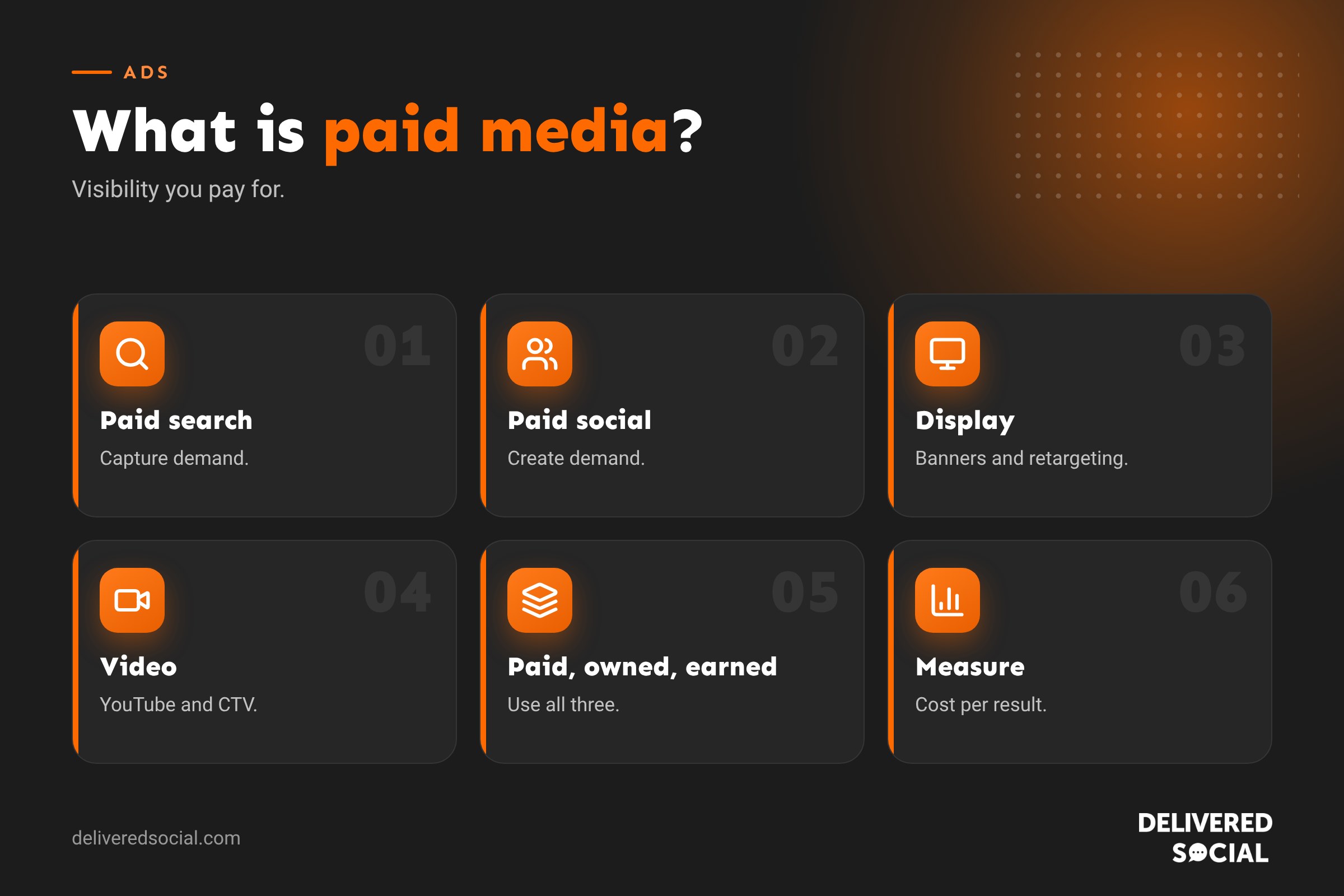
Paid media is any channel where you pay for visibility. Instead of waiting for people to find you, you buy space or attention, whether that is a top position on Google, an advert in someone’s Instagram feed or a sponsored article on a news site. The big advantages are speed and control: you choose who sees your message, when, and how much you spend.
Paid, owned and earned media
Paid media is usually explained alongside two other types:
- Paid media: visibility you pay for, such as ads, sponsored posts and paid partnerships.
- Owned media: channels you control, such as your website, blog, email list and organic social media profiles.
- Earned media: attention you earn rather than buy, such as press coverage, reviews, word of mouth, shares and backlinks.
The best marketing plans use all three together. Paid media brings people in quickly, owned media gives them somewhere useful to land and keeps them coming back, and earned media builds trust and long term reach.
The main paid media channels
Paid search
Ads on Google and Microsoft Bing that appear when people search for specific terms. Paid search captures existing demand from people already looking for what you sell. Our guide to what PPC is explains how it works.
Paid social
Ads on Facebook, Instagram, TikTok, LinkedIn, Pinterest, Snapchat and X. Paid social is excellent for creating demand, targeting by interests and demographics, and reaching people who are not yet searching. Our paid social team runs these campaigns.
Display advertising
Banner and image ads shown across websites and apps, often through the Google Display Network. Useful for awareness and retargeting.
Video advertising
Ads on YouTube, connected TV and video platforms, from short bumper ads to longer stories.
Shopping ads
Product ads with images and prices in Google and other shopping surfaces, essential for many online shops.
Audio advertising
Ads on Spotify, podcasts and digital radio, which reach people away from screens.
Influencer and sponsored content
Paying creators, publications or partners to feature your brand.
Programmatic advertising
Automated buying of ad space across many websites, usually used by larger advertisers.
Why use paid media?
- Speed: campaigns can bring traffic and enquiries within days.
- Targeting: reach people by location, age, interests, job title, behaviour and search intent.
- Control: set budgets, schedules and audiences precisely.
- Measurement: track clicks, enquiries and sales back to individual ads.
- Testing: try new offers, messages and audiences quickly.
- Scale: increase spend on what works.
The downsides
- It stops when you stop paying. Unlike SEO, paid traffic ends when the budget does.
- Costs can rise as competition increases.
- Ad fatigue: audiences tire of seeing the same ads.
- It needs skill to avoid wasting budget on the wrong people.
How to build a paid media strategy
1. Set clear goals
Decide what you want: leads, sales, bookings, app installs or awareness. Attach numbers, such as cost per enquiry targets.
2. Know your numbers
Understand your average order value, profit margin, conversion rate and how much a customer is worth over time. This tells you how much you can afford to pay for each result.
3. Choose channels based on intent
Use paid search to capture people already looking, and paid social or video to create demand and reach new audiences. Retarget website visitors across both.
4. Plan the funnel
Different messages for different stages: awareness ads for new audiences, consideration ads with proof and benefits, and conversion ads with offers for people who already know you.
5. Create strong creative
Great targeting cannot save weak ads. Clear headlines, scroll stopping visuals and a simple call to action matter most.
6. Send people somewhere useful
Landing pages should match the ad and make the next step obvious.
7. Track everything
Set up conversion tracking on every platform and in Google Analytics 4 before launching.
8. Test, learn and adjust
Review results weekly, pause what does not work and put more budget behind what does.
How much should you spend on paid media?
There is no single right figure. Start with what you can afford to test for at least a couple of months, based on the cost per result you need. A local business might start with a few hundred pounds a month on one channel, while an online shop may spend far more across several. Our guide to how much PPC costs and our Facebook ads cost guide give typical UK figures.
How to measure paid media
- Cost per click (CPC) and click through rate.
- Conversion rate from click to enquiry or sale.
- Cost per acquisition (CPA): what each enquiry or sale costs.
- Return on ad spend (ROAS): revenue generated for every pound spent.
- Reach and frequency for awareness campaigns.
Focus on the numbers closest to revenue. Lots of cheap clicks are worthless if none of them buy.
Paid media and SEO together
Paid media and SEO work best as a team. Paid search can test which keywords convert before you invest in ranking for them. SEO reduces your reliance on paid clicks over time. Retargeting turns blog readers into customers. Our article on SEO vs PPC explains how to balance them.
A simple paid media plan for a small business
If you are starting from scratch, keep it simple. First, run a small Google search campaign targeting the services or products people search for in your area, sending clicks to a focused landing page with clear contact options. Second, run a retargeting campaign on Meta to show helpful reminders, reviews and offers to people who visited your website but did not get in touch. Third, once those are profitable, test a prospecting campaign on Instagram, Facebook or TikTok to reach new people who match your best customers. Review results every week, keep what works and move budget away from what does not. This three step approach gives you quick wins from people already looking, while building a pipeline of future customers.
Paid media mistakes to avoid
- Launching without conversion tracking, so you cannot tell what works.
- Sending all traffic to your home page instead of a relevant landing page.
- Spreading a small budget across too many channels at once.
- Judging success on clicks and likes rather than enquiries and sales.
- Running the same ads for months until people stop noticing them.
Key takeaways
- Paid media is any marketing where you pay for visibility, such as ads and sponsored content.
- It works best alongside owned and earned media.
- Paid search captures demand; paid social and video create it.
- Know your numbers so you know what you can afford per result.
- Track conversions and focus on cost per enquiry or sale, not just clicks.
Frequently asked questions
What is an example of paid media?
Google search ads, Instagram ads, YouTube video ads, sponsored articles and paid influencer posts.
What is the difference between paid and earned media?
Paid media is visibility you buy. Earned media is attention you earn, such as press coverage, reviews and shares.
Is paid media the same as PPC?
PPC is one type of paid media. Paid media also includes display, video, audio, sponsored content and more.
Is paid media worth it for small businesses?
Yes, when campaigns are well targeted, tracked properly and focused on profitable results.
How quickly does paid media work?
Ads can bring traffic straight away, but campaigns usually improve over several weeks of testing.
Do I need an agency for paid media?
Not always, but an experienced team can save wasted spend and get results faster.
What is the difference between paid media and paid social?
Paid social is one type of paid media, covering ads on social platforms such as Instagram, Facebook, TikTok and LinkedIn.
Which paid media channel is best?
It depends on your goal. Search is usually best for capturing demand, social and video for creating it, and retargeting for converting interested visitors.
Can paid media help SEO?
Indirectly. Paid campaigns show which keywords convert, bring awareness that increases branded searches and can drive people to content that earns links.
How long should I test a paid media campaign?
Give most campaigns at least four to eight weeks, with enough budget to gather meaningful data, before judging results.
Is influencer marketing paid media?
When you pay a creator to feature your brand, yes. Unpaid mentions and genuine recommendations count as earned media.
Want paid media that pays its way?
We run Google, Meta, TikTok and LinkedIn campaigns for businesses across Surrey, Hampshire and the UK. Call us on 01483 608 303.
































