



Keep reading
Rather we just did it for you?
Let's get your business seen.
Social media, websites, SEO and ads from a team you can actually meet.
Everyone wants to rank for the big keywords: “plumber”, “wedding venue”, “accountant”. But those terms are fiercely competitive, and the people searching them are often just starting to look. Long tail keywords are the longer, more specific phrases people type when they know what they want, such as “emergency plumber in Fareham open Sunday” or “barn wedding venue Surrey for 80 guests”. They are easier to rank for and bring visitors far more likely to become customers. This guide explains long tail keywords: what they are, why they matter for SEO, how to find them and how to use them on your website.
What are long tail keywords?
Long tail keywords are specific search phrases with lower individual search volume but clearer intent. They usually contain three or more words, but length is not the real point. What makes a keyword “long tail” is that it is specific and less competitive than broad “head” terms.
The name comes from a search demand curve. A small number of head terms get huge volumes, while a very long tail of specific phrases each get smaller volumes. Together, the long tail makes up a large share of all searches.
Examples
- Head term: “running shoes”. Long tail: “best running shoes for flat feet women”.
- Head term: “SEO”. Long tail: “how long does SEO take for a new website”.
- Head term: “cake”. Long tail: “vegan birthday cake delivery Guildford”.
- Head term: “accountant”. Long tail: “accountant for self employed electricians Hampshire”.
Why long tail keywords matter
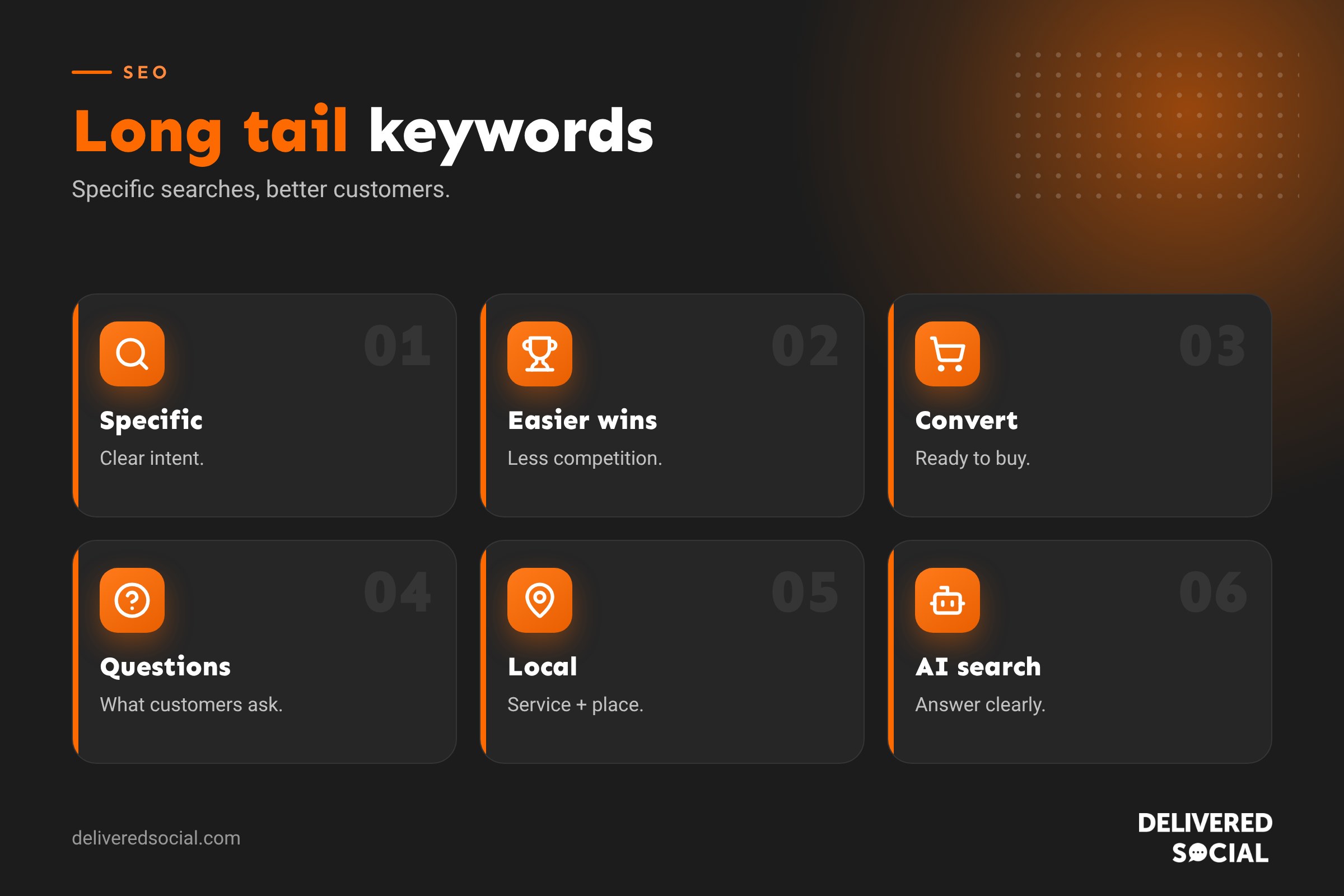
- Less competition: fewer websites target specific phrases, so smaller sites can rank.
- Higher conversion rates: specific searches signal clear intent and readiness to buy or book.
- Better match to content: it is easier to write a page that perfectly answers a specific question.
- Voice search and AI: people speak to assistants and type questions to AI tools in long, natural phrases.
- Cumulative traffic: ranking for hundreds of long tail phrases can bring more total traffic than one head term.
- Lower ad costs: in Google Ads, long tail terms often cost less per click and convert better.
Types of long tail keyword
- Question keywords: “how much does a loft conversion cost in Surrey”.
- Location keywords: “dog groomer in Petersfield”.
- Product detail keywords: “waterproof walking boots wide fit men”.
- Comparison keywords: “WordPress vs Shopify for small business”.
- Problem keywords: “boiler losing pressure no leak”.
- Buying keywords: “book bathroom fitter quote online”.
How to find long tail keywords
Google autocomplete
Start typing a topic into Google and note the suggestions. They reflect real searches.
People also ask
The question boxes in Google results reveal what people want to know about a topic.
Related searches
Scroll to the bottom of the results page for more ideas.
Google Search Console
Your own Search Console data shows long phrases you already appear for. Look for queries with impressions but low clicks, which are opportunities to improve.
Keyword research tools
Tools such as Ubersuggest, Semrush, Ahrefs and Google Keyword Planner show search volumes, difficulty and related phrases. Our guide to keyword research for small businesses explains how to use them.
Customer questions
The questions customers ask by phone, email and in person are some of the best long tail keywords you can target.
Forums and social media
Reddit, Facebook groups and Quora show the exact language people use.
AI tools
Ask ChatGPT or Gemini to list questions people ask about your service. Check them against real data before using them.
How to use long tail keywords
Create focused pages
Write pages or articles that answer one specific query really well. A blog post on “how long does a kitchen fitting take” will rank more easily than a general kitchens page trying to cover everything.
Optimise service and location pages
Include specific services and areas naturally in headings and text, such as “emergency boiler repair in Portsmouth”.
Use them in headings and FAQs
Question style headings and FAQ sections are ideal for long tail phrases and help you appear in featured snippets and AI answers.
Group related phrases
Many long tail keywords share the same intent. Target a group of closely related phrases on one strong page rather than creating thin pages for each variation.
Write naturally
Do not force awkward phrases into sentences. Google understands meaning and variations, so write for people first.
Link pages together
Link long tail articles to your main service pages, building topic clusters that show your expertise.
Long tail keywords for local businesses
Local businesses benefit enormously from long tail SEO. Combining services, problems and locations creates countless specific searches where competition is low and intent is high. Think about the towns you serve, the specific jobs you do and the questions customers ask before booking. Our guide to local SEO for small businesses explains how to make the most of them.
Long tail keywords and AI search
People increasingly ask AI tools long, conversational questions. Content that answers specific questions clearly, with direct answers near the top of sections, is more likely to be cited by Google AI Overviews and tools such as ChatGPT. Long tail content and AI visibility go hand in hand. Our guide to ranking in ChatGPT covers this in more detail.
Common mistakes
- Only chasing high volume head terms you cannot realistically rank for.
- Creating separate thin pages for tiny keyword variations.
- Stuffing awkward phrases into text.
- Ignoring search intent: answering a buying query with an informational article, or the reverse.
- Dismissing keywords with low reported volume, which can still bring valuable customers.
A simple long tail content plan
List your five main services. For each, brainstorm ten questions customers ask and five locations you serve. Check which phrases have search demand using autocomplete and a keyword tool. Group related phrases, then plan one in depth article or page per group. Publish one or two a month, link them to your service pages and track the phrases they rank for in Search Console. Within a year, you will have a library of helpful content bringing steady, high intent traffic.
Measuring long tail success
Long tail results show up differently from head terms. Rather than watching one big ranking, look at the total number of search queries your site appears for in Google Search Console, which should grow steadily as you publish. Track clicks and impressions for each article, and note how many enquiries come from those pages in Google Analytics 4. Many businesses find that long tail pages bring fewer visitors individually but a much higher share of enquiries, which is exactly the point.
Refreshing older content
Your existing pages often rank for long tail phrases you never targeted. Search Console will show them. Update those pages with sections that answer the phrases directly, add FAQs, improve titles and refresh outdated information. This is often the quickest way to win more long tail traffic without writing anything new.
Key takeaways
- Long tail keywords are specific, lower competition phrases with clear intent.
- They are easier to rank for and usually convert better.
- Find them through Google suggestions, Search Console, tools and customer questions.
- Answer each group of related phrases with one focused, helpful page.
- Long tail content also helps you appear in voice search and AI answers.
Frequently asked questions
What is a long tail keyword in SEO?
A specific search phrase with lower volume and competition but clearer intent than a broad head term.
How long is a long tail keyword?
Often three words or more, but specificity matters more than word count.
Are long tail keywords worth targeting?
Yes. They are easier to rank for and often bring visitors more likely to buy or enquire.
How do I find long tail keywords for free?
Use Google autocomplete, People also ask, related searches and your Search Console data.
Should I create a page for every long tail keyword?
No. Group closely related phrases and cover them on one strong page.
Do long tail keywords help local SEO?
Yes. Combining services, problems and locations creates specific searches with high intent.
Do long tail keywords work for paid ads?
Yes. Long tail keywords often have lower costs per click and higher conversion rates in Google Ads.
How many long tail keywords should one page target?
One main phrase plus closely related variations with the same intent. Different intents deserve different pages.
Are long tail keywords good for new websites?
Yes. They are often the quickest way for a new site to start ranking and attracting visitors.
Do long tail keywords change over time?
Yes. Language and trends change, so review your Search Console data regularly for new phrases.
What is the opposite of a long tail keyword?
A head term: a short, broad, high volume phrase such as “shoes” or “marketing”.
Want more of the right visitors?
We help businesses across Surrey, Hampshire and the UK find and rank for the searches that bring customers. Find out more about our SEO services. Call us on 01483 608 303.
































