



Keep reading
Rather we just did it for you?
Let's get your business seen.
Social media, websites, SEO and ads from a team you can actually meet.
“Is Google Ads worth it?” is one of the most common questions small business owners ask us, usually after hearing two completely different stories: one friend who gets most of their work from Google Ads, and another who spent hundreds of pounds and got nothing. Both can be true. Google Ads can be one of the most profitable marketing channels there is, or a quick way to waste money. The difference comes down to your business, your numbers and how the campaigns are run. This guide helps you decide whether Google Ads is worth it for you, and how to give it the best chance of paying off.
How Google Ads works in brief
Google Ads lets you show adverts when people search for particular words on Google, and across Google’s other properties such as YouTube, Maps and partner websites. With search ads, you choose keywords, write ads and set a budget. You usually pay only when someone clicks. The cost per click is set by an auction, influenced by competition and the quality of your ads and landing pages. Our guide to what PPC is explains the basics.
Why Google Ads can be worth it
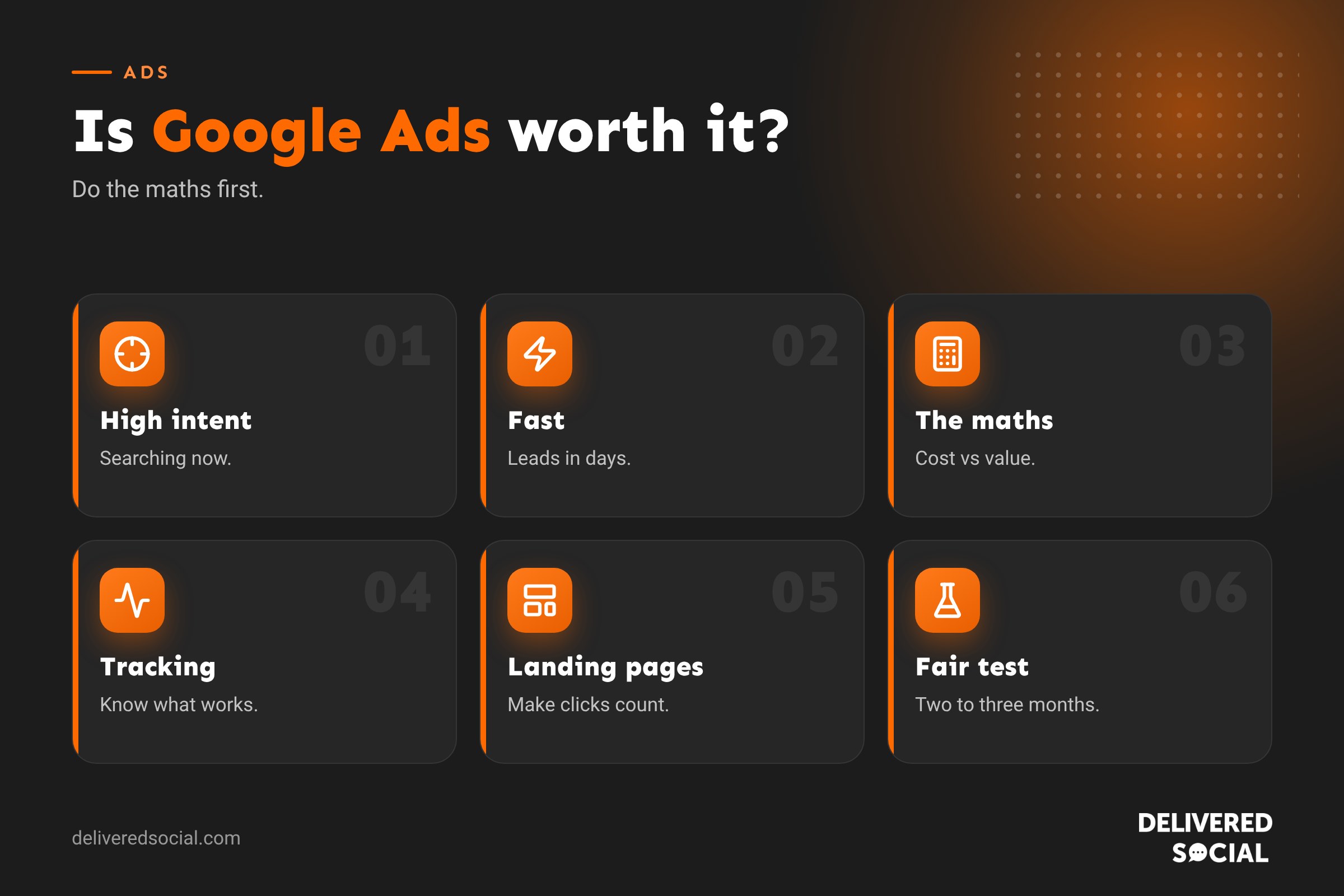
- High intent: people searching “emergency electrician near me” need help now. You reach them at the exact moment they are looking.
- Fast results: ads can bring calls and enquiries within days, unlike SEO, which takes months.
- Control: set your budget, locations, schedule and the searches you want to appear for.
- Measurable: with proper tracking, you can see exactly which keywords bring enquiries and sales.
- Scalable: if a campaign is profitable, you can increase spend to win more work.
- Test ideas: try new services, offers and messages quickly.
Why it sometimes is not worth it
- High click costs: in competitive industries such as legal, finance and some trades, clicks can be expensive.
- Poor setup: broad targeting, no negative keywords and weak ads waste budget quickly.
- Weak landing pages: clicks do not convert if the page is slow, confusing or irrelevant.
- No tracking: without conversion tracking, you cannot tell what works.
- Low margins: if each sale earns very little, paying for clicks may not add up.
- Too small a budget: a tiny budget in a competitive market may never gather enough data to improve.
The maths: how to tell if it is worth it
The simplest way to decide is to work through your own numbers.
- Average cost per click for your keywords (Google’s Keyword Planner gives estimates).
- Conversion rate: the percentage of visitors who enquire or buy.
- Close rate: the percentage of enquiries that become customers.
- Average value of a customer, ideally over their lifetime, and your profit margin.
For example, if clicks cost £3, 5% of visitors enquire and you win half of those enquiries, each new customer costs about £120 in clicks. If a customer is worth £1,000 in profit over time, Google Ads is clearly worth it. If a customer is worth £80, it is not, unless you can improve conversion rates or lower click costs. Our guide to how much PPC costs gives typical figures.
Which businesses benefit most?
- Local services with urgent or high value jobs: trades, repairs, legal, healthcare, home improvements.
- Ecommerce shops using Shopping ads for products people search for.
- B2B services where one client is worth thousands.
- Businesses launching something new and needing quick visibility.
- Seasonal businesses wanting to capture demand at peak times.
It is harder to make work for very low value products, services nobody searches for, or businesses without capacity to handle more enquiries.
How to make Google Ads worth it
Set up conversion tracking first
Track calls, forms, bookings and sales in Google Ads and Google Analytics 4 before spending your budget.
Target the right searches
Focus on keywords with clear buying intent, and add negative keywords to block irrelevant searches such as “jobs”, “free” or “DIY”.
Target the right locations and times
Only show ads where you work and when you can respond.
Write relevant ads
Match the ad to the search, highlight what makes you different and include a clear call to action.
Send people to the right page
Use specific landing pages, not your home page, with clear information and an easy way to get in touch.
Use ad assets
Add call buttons, location details, sitelinks and reviews to make ads more useful and visible.
Review and optimise regularly
Check search terms weekly, pause what wastes money and move budget to what works. Our guide to low cost PPC campaigns explains how to stretch a small budget.
Google Ads vs SEO
SEO brings free traffic over time but takes months to build. Google Ads brings traffic immediately but stops when you stop paying. Many businesses use both: ads for immediate leads and testing, SEO for long term growth. Our article on SEO vs PPC explains how to balance them.
Google Ads vs social media ads
Google Ads captures demand from people already searching. Social media ads on Meta, TikTok and LinkedIn create demand by reaching people who are not yet looking. For urgent and high intent services, Google usually comes first. For visual products and awareness, social ads often work better. Our guide to Meta ads vs Google Ads compares them.
How to run a fair test
- Set a budget you are comfortable spending for at least two to three months.
- Start with your most profitable service and best locations.
- Set up tracking and a focused landing page.
- Review results weekly and make improvements.
- Judge success on cost per enquiry and cost per customer, not clicks.
Signs your current campaigns are not working
- Lots of clicks but few calls or forms.
- Search terms full of irrelevant phrases.
- No idea which keywords bring customers.
- All clicks going to your home page.
- Nobody has changed anything in the account for months.
If these sound familiar, an account review can often find quick savings and improvements.
Real world example
Consider a local roofing company. Its average job is worth around £2,500, with a healthy margin. Clicks for “roofer near me” style searches cost several pounds each. With a focused landing page showing reviews, photos and a click to call button, around one in ten visitors gets in touch, and the company wins roughly a third of quotes. That means each new job costs a fraction of its value in advertising. For this business, Google Ads is clearly worth it. Now compare a shop selling £15 phone cases with thin margins: the same click costs would wipe out the profit. The channel is the same; the maths is completely different.
Key takeaways
- Google Ads is worth it when the value of a customer comfortably exceeds the cost of winning them.
- It works best for high intent, high value services and products people search for.
- Tracking, tight targeting, relevant ads and good landing pages make the difference.
- Run a fair test over a few months and judge on cost per customer.
- Combine Google Ads with SEO and social ads for the best long term results.
Frequently asked questions
Is Google Ads worth it for small businesses?
Often, yes, especially for local services and products people actively search for, when campaigns are well set up and tracked.
How much should a small business spend on Google Ads?
Enough to gather meaningful data in your market. Start with what you can afford to test for a few months and scale what works.
How quickly does Google Ads work?
Ads can bring clicks within days, but campaigns usually take several weeks to optimise.
Why am I getting clicks but no enquiries?
Common causes include irrelevant search terms, weak landing pages, poor mobile experience and broken tracking.
Is SEO better than Google Ads?
Neither is better in every case. SEO builds long term free traffic; Google Ads brings immediate, controllable results.
Should I hire an agency to run Google Ads?
If you lack time or experience, an agency can save wasted spend. Make sure you own your account.
Do Google Ads affect my SEO?
No. Paying for ads does not improve or harm your organic rankings directly.
What is a good conversion rate for Google Ads?
It varies by industry and offer. Compare against your own history and focus on steady improvement.
Can I run Google Ads only at certain times?
Yes. Ad scheduling lets you show ads only during hours when you can answer calls or respond to enquiries.
Should I bid on my own business name?
Often, yes. It is usually cheap and protects you from competitors appearing above you.
What is a negative keyword?
A word or phrase that stops your ads showing for irrelevant searches, such as “jobs” or “free”.
Can Google Ads work for charities?
Yes. Eligible charities can apply for Google Ad Grants, which provide free search advertising.
Want your ad budget to work harder?
We run Google Ads for businesses across Surrey, Hampshire and the UK. Find out more about our Google Ads management. Call us on 01483 608 303.
































