



Keep reading
Rather we just did it for you?
Let's get your business seen.
Social media, websites, SEO and ads from a team you can actually meet.
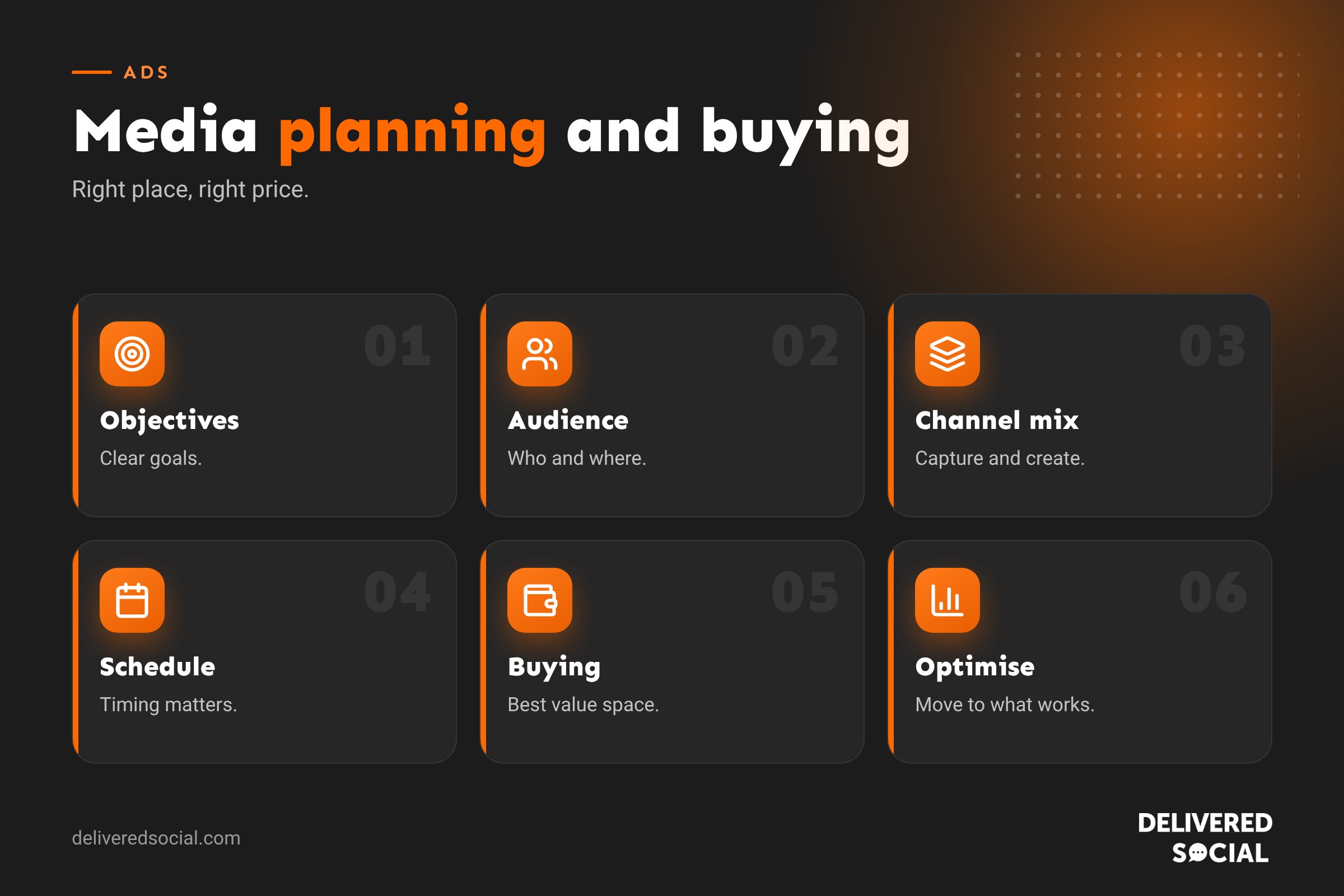
Every advertising campaign starts with two big questions: where should our ads appear, and how much should we pay for that space? Answering them is the job of media planning and buying. Get them right and your budget reaches the right people at the right time for a sensible price. Get them wrong and even brilliant adverts disappear without trace. This guide explains media planning and buying in plain English: what each one involves, the step by step process, digital vs traditional media, key metrics, budgeting and how small businesses can apply the same thinking without a big agency.
What is media planning?
Media planning is deciding where, when and how often your adverts should appear to reach your target audience and achieve your goals. A media planner researches the audience, chooses the right mix of channels, sets the schedule and divides the budget. The result is a media plan: a roadmap for the campaign.
What is media buying?
Media buying is the process of purchasing the advertising space set out in the plan, and getting the best possible value. Buyers negotiate rates, book placements, set up digital campaigns, manage bids and monitor delivery to make sure ads run as planned. In digital advertising, buying is increasingly done through self serve platforms and automated auctions rather than phone calls and contracts.
How planning and buying work together
Planning is strategy; buying is execution. Planners decide that a campaign should reach parents aged 30 to 45 in Hampshire through Instagram, YouTube and local radio over six weeks. Buyers secure that space at the best price and make sure it runs correctly. In smaller teams and agencies, the same people often do both.
The media planning process
1. Set clear objectives
Awareness, website visits, leads, sales, footfall or app installs? Objectives decide which channels and metrics matter. Give each objective a number and a deadline.
2. Understand your audience
Who are they, where do they live, what media do they use, when are they most receptive and what influences their decisions? Use customer data, analytics, surveys and platform insights.
3. Research the market
Look at where competitors advertise, seasonal patterns in demand, and costs on different channels.
4. Choose the channel mix
Select channels that reach your audience efficiently and suit your message. A mix often works best: search to capture demand, social and video to build it, and retargeting to convert.
5. Set budget and schedule
Divide the budget across channels and time. Decide whether to run continuously, in bursts around key dates, or a mix of both.
6. Define reach and frequency
Reach is how many different people see your ads. Frequency is how often each person sees them. Too little frequency and people forget; too much and they get annoyed.
7. Plan measurement
Agree how success will be measured and set up tracking before launch.
The media buying process
- Negotiate and book traditional placements such as radio, print and outdoor.
- Set up digital campaigns on platforms such as Google Ads, Meta, TikTok, LinkedIn and Spotify.
- Choose buying methods: auctions, fixed price placements or programmatic buying.
- Prepare and supply creative in the right formats and sizes.
- Launch and monitor delivery, spend and performance.
- Optimise by moving budget towards the best performing placements.
- Report on results and lessons learned.
Digital vs traditional media
Digital media includes search, social, display, video, audio streaming and connected TV. It offers precise targeting, flexible budgets, real time data and the ability to change campaigns quickly.
Traditional media includes TV, radio, print, outdoor and direct mail. It can deliver mass reach and credibility, and still works well locally, but is usually harder to measure and less flexible.
Many campaigns combine both. A local radio campaign can drive people to search for your business, where search ads and a strong website capture them. Our guide to what paid media is covers the digital channels in more detail.
Buying methods explained
- Auction based: you bid for impressions or clicks, as on Google and Meta. Prices vary with competition.
- Direct buys: you agree a fixed price for specific placements with a publisher or broadcaster.
- Programmatic: automated buying of ad space across many websites and apps using data and algorithms.
- Sponsorships and partnerships: paying to be associated with content, events or creators.
Key metrics
- CPM: cost per thousand impressions, common for awareness.
- CPC: cost per click.
- CPA: cost per acquisition, such as a lead or sale.
- ROAS: return on ad spend.
- Reach and frequency.
- Viewability and completion rates for display and video.
How to budget for media
Start from your goal and work backwards. If you need 20 new customers a month and know roughly what each enquiry costs and how many convert, you can estimate the budget required. Leave room for testing new channels, and hold back some budget to scale whatever performs best. Our guides on PPC costs and Facebook ads costs give typical UK figures.
Media planning for small businesses
You do not need a big agency to plan well. Small businesses can follow the same logic:
- Pick one clear goal per campaign.
- Choose one or two channels where your customers actually spend time.
- Set a realistic test budget and timescale.
- Plan around your busy and quiet seasons.
- Track enquiries and sales, not just clicks.
- Review results and move money to what works.
Common mistakes
- Choosing channels because they are fashionable rather than where your audience is.
- Spreading budget too thinly across too many channels.
- Ignoring frequency, so people either never notice or get sick of your ads.
- Launching without tracking.
- Setting and forgetting campaigns instead of optimising.
- Judging awareness campaigns only on immediate sales.
Should you use an agency?
Agencies bring experience, tools, platform knowledge and sometimes better rates. They are particularly valuable when campaigns span several channels or budgets are significant. For smaller, single channel campaigns, many businesses manage in house with some training. Our article on in house marketing vs an agency helps you decide.
A simple media plan example
A garden centre wants to boost spring sales. Its plan might run for eight weeks from early March: Google search ads for terms like “garden centre near me” and seasonal plants, Facebook and Instagram ads to local homeowners showing new stock, a short burst of local radio around Easter weekend, and retargeting ads with a weekend offer for people who visited the website. The budget is weighted towards the Easter weekend, when demand peaks. Each week the team checks which channel brings the most visits and voucher redemptions, and moves money accordingly. That is media planning and buying in action, at a local scale.
Timing and seasonality
When your ads run can matter as much as where. Look at your own sales data, Google Trends and industry calendars to find when demand peaks and dips. Many businesses get better value by building awareness before peak season, when costs are lower, then increasing spend to capture demand at the peak. Day of week and time of day matter too. A restaurant might focus on Thursday and Friday afternoons, while a B2B service might target working hours. Build these patterns into your plan rather than spreading budget evenly.
Key takeaways
- Media planning decides where, when and how often ads appear; buying secures that space at the best value.
- Start with clear objectives and a deep understanding of your audience.
- Use a channel mix that captures and creates demand.
- Balance reach and frequency, and track the metrics closest to revenue.
- Optimise continuously by moving budget to what performs.
Frequently asked questions
What is the difference between media planning and media buying?
Planning decides where and when ads should run; buying purchases that space and manages delivery.
What does a media buyer do?
Negotiates and books advertising space, sets up campaigns, manages bids and budgets, and monitors performance.
Is media buying only for big brands?
No. Self serve digital platforms let small businesses buy media with modest budgets.
What is programmatic media buying?
Automated buying of ad space across many websites and apps using data and algorithms.
How do I choose the right advertising channels?
Start with where your audience spends time, what you want to achieve and what you can afford to test.
How is success measured?
With metrics matched to your goal, such as reach, cost per lead, cost per sale and return on ad spend.
What is a media plan?
A document setting out a campaign’s objectives, audience, channels, schedule, budget and measurement.
How far ahead should I plan media?
For most small businesses, plan key campaigns a few months ahead and review monthly. Traditional media often needs longer lead times.
Can I buy media without an agency?
Yes. Platforms such as Google Ads, Meta and Spotify are self serve, so you can plan and buy media yourself.
What is reach and frequency?
Reach is how many different people see your ads; frequency is how many times each person sees them on average.
Want help planning your advertising?
We plan and run paid campaigns for businesses across Surrey, Hampshire and the UK. Call us on 01483 608 303.
































