

Keep reading
Rather we just did it for you?
Let's get your business seen.
Social media, websites, SEO and ads from a team you can actually meet.
Should your business advertise online? For most businesses today, the answer is yes, but online advertising isn’t right for every goal or budget, and it comes with real downsides as well as benefits. This guide explains the advantages and disadvantages of internet advertising, the main types of online ads, how they compare with traditional advertising, how much they cost, and how to decide whether online ads are right for you.
What is internet advertising?
Internet advertising, also called online or digital advertising, means paying to show your message to people on websites, search engines, social media, apps and video platforms. Unlike a newspaper ad or billboard, online ads can be targeted, measured and changed in real time.
Types of online advertising
| Type | Where it appears | Best for |
|---|---|---|
| Search ads (PPC) | Google and Bing results | Capturing people actively looking for your service |
| Social media ads | Facebook, Instagram, TikTok, LinkedIn | Targeting by interests, location and demographics |
| Display ads | Banners on websites and apps | Brand awareness and remarketing |
| Video ads | YouTube, social video, streaming | Storytelling and awareness |
| Shopping ads | Google Shopping and marketplaces | Selling products online |
| Local ads | Google Maps and local search | Driving calls and visits |
| Remarketing | Across sites and apps | Reminding past visitors to come back |
Advantages of internet advertising
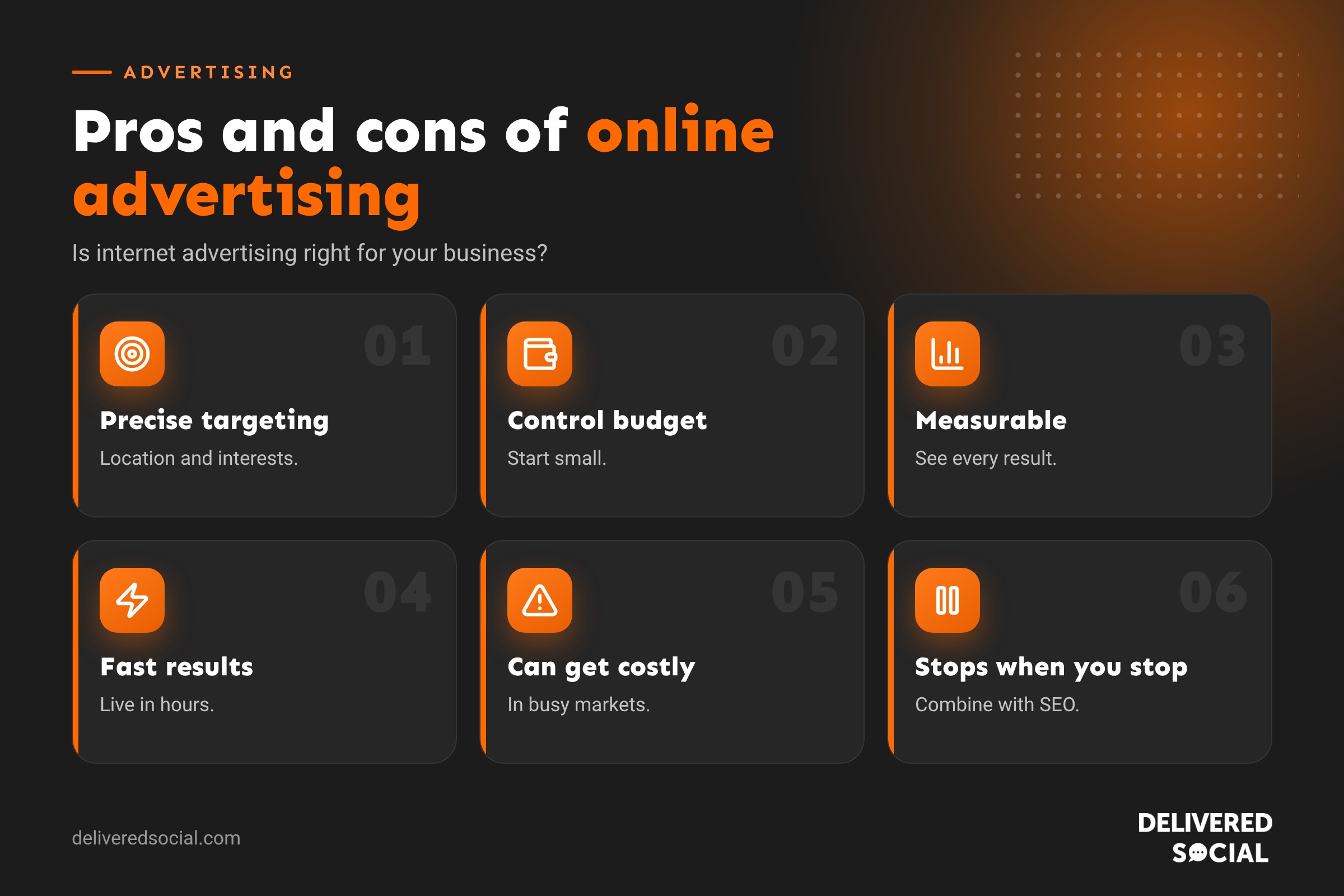
1. Precise targeting
You can show ads to people by location, age, interests, behaviour, job title or what they’re searching for. A plumber in Guildford can target homeowners within ten miles searching for “emergency plumber”, rather than paying to reach everyone.
2. You control the budget
There’s no minimum spend on most platforms. You can start with a few pounds a day, set daily and total limits, and pause at any time.
3. Measurable results
Online ads show exactly how many people saw them, clicked, called, filled in a form or bought. You know what you’re getting for your money, which is much harder with print or radio.
4. Fast results
Search and social ads can start bringing visitors and enquiries within hours, unlike SEO, which takes months.
5. Flexibility
You can change your message, images, offer or targeting at any time, test different versions and quickly switch budget to what works.
6. Reaching people at the right moment
Search ads reach people at the exact moment they’re looking for what you offer. That’s incredibly powerful for services people need urgently.
7. Remarketing
Most people don’t buy on their first visit. Remarketing shows ads to people who’ve already visited your website, reminding them to come back.
8. Levels the playing field
Small businesses can compete with much larger companies by targeting tightly, writing better ads and focusing on local customers.
9. Global or local reach
You can target a single postcode or the whole world, depending on your business.
10. Rich formats
Video, carousels, lead forms and shoppable ads let you show more than a static print ad ever could.
Disadvantages of internet advertising
1. It can get expensive in competitive markets
In industries like law, insurance and finance, clicks can cost several pounds or more each. Without careful management, budgets disappear quickly.
2. Ad blindness and ad blockers
Many people ignore banner ads or use ad blockers, and some platforms now offer paid ad-free subscriptions.
3. Complexity
Each platform has its own tools, settings and jargon. Getting it wrong, for example with broad targeting or poor tracking, wastes money.
4. Results stop when spending stops
Unlike SEO or content, paid ads only work while you pay. Switch them off and the traffic stops.
5. Privacy changes
Privacy rules and cookie changes make tracking and targeting less precise than they used to be. Consent banners mean some activity can’t be measured.
6. Ad fatigue
People get tired of seeing the same ad. Creative needs refreshing regularly.
7. Click fraud and low-quality traffic
Some clicks come from bots or accidental taps. Platforms filter much of this, but it’s worth monitoring.
8. Rules and approvals
Ads must follow platform policies and UK advertising rules. Some industries, such as health, finance and alcohol, face extra restrictions.
Online vs traditional advertising
| Online advertising | Traditional advertising | |
|---|---|---|
| Targeting | Very precise | Broad |
| Minimum budget | Very low | Often high |
| Measurement | Detailed and real-time | Hard to measure |
| Speed | Live in hours | Weeks of planning |
| Flexibility | Change anytime | Fixed once printed or aired |
| Trust and permanence | Fleeting | Can feel more established |
Traditional advertising still has its place, for example local magazines, radio or sponsorship for community visibility. Many businesses combine both.
How much does online advertising cost?
Costs depend on the platform, industry, competition and targeting. Most platforms use one of these models:
- Cost per click (CPC): you pay when someone clicks.
- Cost per thousand impressions (CPM): you pay per 1,000 times your ad is shown.
- Cost per lead or action: some campaigns optimise for enquiries or sales.
Our guides to PPC costs and Facebook ads costs in the UK go into detail.
How to get the most from internet advertising
- Set a clear goal: calls, bookings, sales or awareness.
- Know your numbers: what’s a customer worth to you, and what can you afford to pay for one?
- Start small and test two or three ad versions.
- Send people to a relevant landing page that matches the ad.
- Set up tracking for calls, forms and sales before you start.
- Target tightly, especially if you’re a local business.
- Review weekly, cut what doesn’t work and invest in what does.
- Combine paid and organic: ads for quick wins, SEO and content for long-term growth.
Is internet advertising right for your business?
Online advertising is likely to work well if:
- People search for what you offer.
- You can serve customers quickly when they enquire.
- You have a website or landing page that converts visitors.
- You can track results.
- Each customer is worth more than it costs to win them.
It may be less effective if your product is very new and nobody is searching for it yet, or if your profit per sale is very small. In those cases, content, social media and SEO may be better starting points.
Common online advertising mistakes
- No clear goal: running ads without knowing what success looks like.
- Sending traffic to the home page instead of a page that matches the ad.
- Targeting too broadly, especially for local businesses.
- Not tracking conversions, so you can’t tell what’s working.
- Setting and forgetting campaigns instead of reviewing them weekly.
- Giving up too soon, before the platform has had time to learn.
Combining paid and organic marketing
The most effective businesses rarely rely on ads alone. Paid ads bring quick visibility and leads, while SEO, social media content, reviews and email build long-term trust and free traffic. Ads can also boost your best organic content, so a post that’s already working reaches more of the right people. Over time, a strong organic presence makes your ads perform better too, because people who see your ad will find good reviews, helpful content and an active social media presence when they look you up.
Online advertising rules in the UK
Online ads in the UK must follow the CAP Code, overseen by the Advertising Standards Authority. Ads must be honest, not misleading, and clearly identifiable as advertising. Claims such as “best in Surrey” or “cheapest prices” need evidence, and influencer posts must be labelled as ads. Special rules apply to industries such as health, finance, alcohol and gambling. Following the rules protects your reputation and avoids ads being removed.
Key takeaways
- Online ads offer precise targeting, flexible budgets and measurable results.
- Costs can climb in competitive industries, and results stop when spending stops.
- Choose the right type of ad for your goal: search for demand, social for discovery.
- Track results and review campaigns weekly.
- Combine paid ads with SEO and social media for the best long-term results.
Quick glossary
- PPC: pay per click, where you pay each time someone clicks your ad.
- CPM: the cost of showing your ad 1,000 times.
- Remarketing: showing ads to people who have already visited your website.
- Conversion: the action you want, such as a call, form or sale.
- Landing page: the page people arrive on after clicking your ad.
Frequently asked questions
What are the advantages of internet advertising?
Precise targeting, control over budget, measurable results, fast results and the flexibility to change ads at any time.
What are the disadvantages of online advertising?
Costs in competitive markets, ad blindness, complexity, results stopping when you stop paying, and privacy changes affecting tracking.
Is online advertising better than traditional advertising?
For most small businesses it’s more targeted and measurable, but the best results often come from combining channels.
How much should a small business spend on online ads?
Start with a budget you can afford to test for a month, then increase spending on what brings profitable customers.
Want online advertising that pays for itself?
We plan and manage Google, Facebook, Instagram and TikTok ads for businesses across Surrey, Hampshire and the UK. See our social media and advertising services or call us on 01483 608 303.