



Keep reading
Rather we just did it for you?
Let's get your business seen.
Social media, websites, SEO and ads from a team you can actually meet.
When did Facebook start, and how did a university website become one of the biggest companies in the world? Facebook’s story is also the story of social media marketing: almost every tool businesses use today, from pages to targeted ads, started or grew up on Facebook. This guide walks through the history of Facebook, with a clear timeline from 2004 to today, the key moments that changed how businesses market themselves, and what Facebook’s past tells us about where it’s heading.
When did Facebook start?
Facebook launched on 4 February 2004 as “TheFacebook”, created by Mark Zuckerberg with fellow Harvard students Eduardo Saverin, Andrew McCollum, Dustin Moskovitz and Chris Hughes. At first it was only open to Harvard students, before spreading to other universities and, eventually, anyone aged 13 or over with an email address.
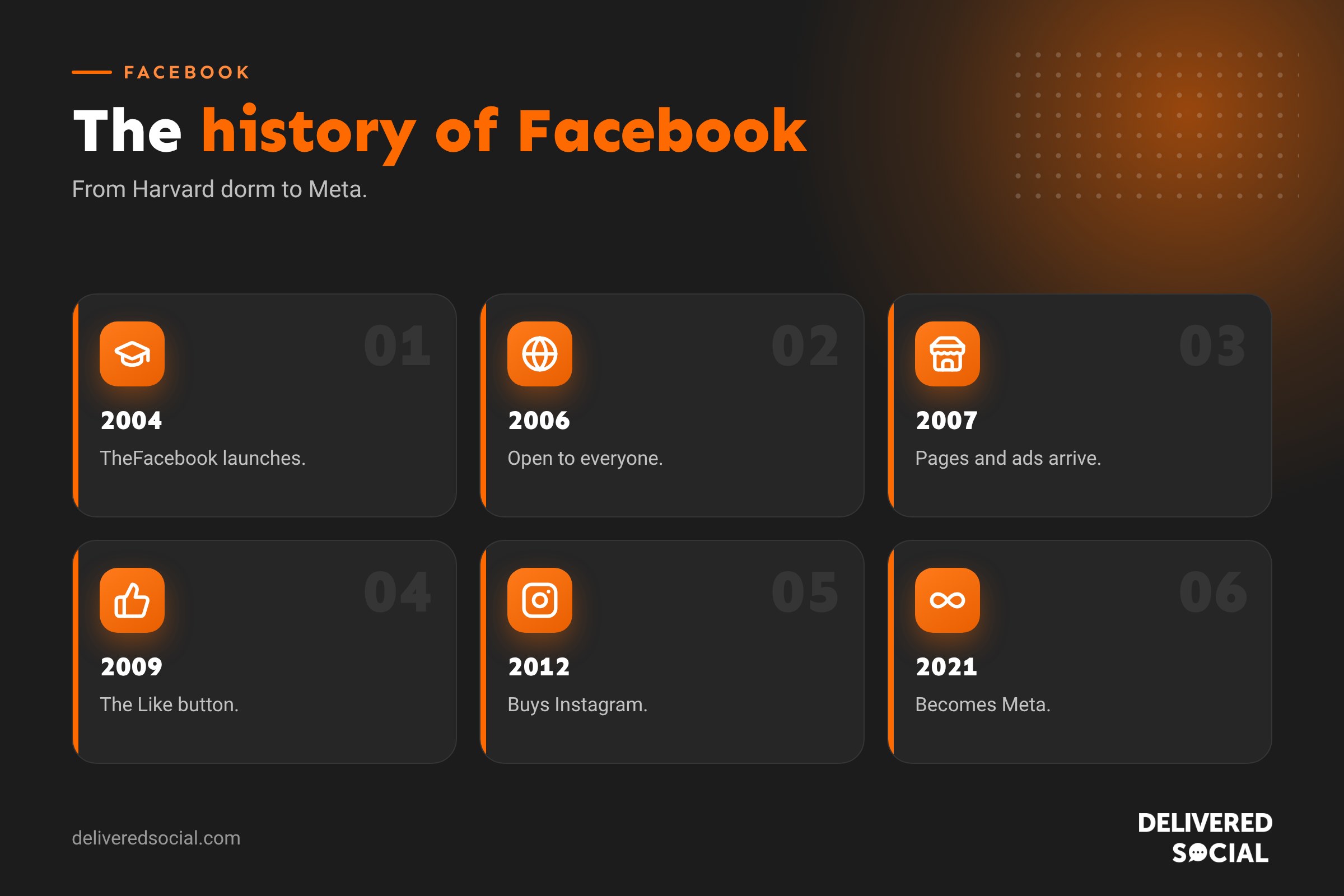
Timeline of Facebook
| Year | Milestone |
|---|---|
| 2004 | TheFacebook launches at Harvard, then expands to other universities. The Wall appears. |
| 2005 | Drops “The” to become Facebook. Opens to high schools. Photos launch. |
| 2006 | Opens to everyone aged 13 and over. The News Feed launches. |
| 2007 | Facebook Pages for businesses and the first Facebook Ads platform arrive. |
| 2008 | Facebook Chat launches. Facebook overtakes Myspace in worldwide visitors. |
| 2009 | The Like button arrives. |
| 2010 | Groups are redesigned; The Social Network film is released. |
| 2011 | Timeline profile design is announced; Messenger becomes a standalone app. |
| 2012 | Facebook buys Instagram, floats on the stock market and passes one billion monthly users. |
| 2014 | Facebook buys WhatsApp and Oculus. |
| 2015 | Facebook Live begins rolling out. |
| 2016 | Reactions (Love, Haha, Wow, Sad, Angry) join the Like button. Marketplace launches. |
| 2017 | Facebook Stories launches. Monthly users pass two billion. |
| 2018 | The Cambridge Analytica scandal leads to tighter data rules and privacy changes. The News Feed is changed to favour friends and family. |
| 2020 | Facebook Shops launches as businesses move online during the pandemic. |
| 2021 | The parent company renames itself Meta. Apple’s iOS 14.5 tracking changes affect ad targeting. Reels launches on Facebook. |
| 2023 | Meta launches Threads. Meta Verified subscriptions arrive. Ad-free subscriptions are introduced in Europe. |
| 2024 onwards | Meta AI is built into Facebook, Instagram and WhatsApp. The feed leans further into recommended content and video. |
The early years: from campus to the world (2004 to 2008)
Facebook grew by being exclusive. Starting at one university and opening up gradually made it feel desirable, and using real names made it feel safer than rivals. The launch of the News Feed in 2006 was controversial at first, as people disliked their updates being broadcast, but it became the heart of the platform and the model for every social feed since.
For businesses, the big moment was 2007, when Facebook launched Pages and its first advertising tools. For the first time, a local café could have a presence on the same network as its customers’ friends.
The growth years: likes, mobile and Instagram (2009 to 2014)
The Like button, introduced in 2009, gave businesses a simple way to build an audience. In the early 2010s, organic reach was high, and many brands built huge followings for free. At the same time, Facebook shifted to mobile, and its 2012 purchase of Instagram for around a billion dollars turned out to be one of the smartest deals in tech history. WhatsApp followed in 2014.
The video and pay-to-play years (2015 to 2020)
As more businesses joined, organic reach for pages fell sharply. Facebook increasingly became a “pay to play” platform, where advertising was the reliable way to reach people. Video took centre stage with Facebook Live, then Stories. Marketplace turned Facebook into a place to buy and sell locally.
In 2018, the Cambridge Analytica scandal revealed that data from millions of users had been harvested for political advertising. It led to stricter rules, fewer targeting options and much more scrutiny of how Facebook handles data. Around the same time, the News Feed was changed to show more posts from friends and family, reducing business reach further.
Meta and the modern era (2021 onwards)
In 2021, Facebook’s parent company became Meta, reflecting its ambitions beyond one app, including virtual reality. The same year, Apple’s App Tracking Transparency changes made it harder for advertisers to track people across apps, pushing Meta to rebuild its ad systems around automation and AI.
Today, Facebook’s feed is more like TikTok’s than it used to be: recommended content from accounts you don’t follow, especially Reels, sits alongside posts from friends. Meta’s AI tools now help businesses create ads, write replies and target audiences automatically.
What Facebook’s history means for businesses
- Platforms change the rules. Organic reach that was free in 2012 isn’t today. Never rely on one platform for all your customers.
- Own your audience. Build an email list and a strong website alongside social media.
- Video keeps winning. From Live to Stories to Reels, video has been Facebook’s priority for a decade.
- Privacy matters. Rules about data are getting stricter, so first-party data and good tracking matter.
- Automation is the future. Meta’s AI ad tools reward good creative and clear goals over manual tinkering.
Facebook today in numbers
Facebook is still the world’s biggest social network, with around three billion monthly users, and it remains widely used in the UK, especially among people aged 25 and over. For the latest figures, see our guide to Facebook statistics.
Is Facebook still worth it for businesses?
For most UK businesses, yes. Facebook remains one of the best places to reach adults locally, run targeted ads, sell through Marketplace and community groups, and keep customers updated. It works best when you:
- Post a mix of video, photos and helpful updates.
- Take part in local groups as your business page, where allowed.
- Use Facebook ads to reach new customers.
- Reply quickly to messages and comments.
- Manage everything properly through Meta Business Suite.
Lessons for today’s marketers
Facebook’s history offers a few lessons that apply to every platform. First, early adopters win: businesses that joined Facebook early built big audiences cheaply, and the same is true of newer platforms today. Second, nothing stays free forever: as platforms mature, they reward advertisers. Third, the format always shifts towards what keeps people watching, from text to photos to video to short-form video. Finally, trust matters. The businesses that do best are those that treat their audience well, answer messages and share genuinely useful content, whatever the algorithm is doing that year.
Key takeaways
- Facebook launched on 4 February 2004 at Harvard.
- Pages and ads arrived in 2007, starting social media marketing as we know it.
- Facebook bought Instagram in 2012 and WhatsApp in 2014.
- The company renamed itself Meta in 2021.
- Its history shows platforms change, so businesses should own their audience too.
How Facebook marketing has changed
| Era | What worked for businesses |
|---|---|
| 2007 to 2011 | Building page likes and posting regularly; organic reach was high |
| 2012 to 2015 | Photos, competitions and early mobile ads; organic reach began to fall |
| 2016 to 2020 | Video, Live, Stories, Messenger and targeted ads with detailed interests |
| 2021 to today | Reels, community groups, automated ads, strong creative and first-party data |
The pattern is clear. Every few years, what worked stops working as well, and businesses that adapt quickly win. That’s why it pays to keep testing new formats rather than repeating what worked five years ago.
Facebook features that came and went
- Pokes: an early, slightly mysterious way to get someone’s attention. Still technically around, but rarely used.
- Facebook Places: a check-in service, later merged into other features.
- Graph Search: an ambitious search tool that was scaled back.
- Facebook Gaming app: a separate app for game streaming, later closed.
- Facebook Dating: launched in 2019 and still available in some countries, including the UK.
Facebook in the UK
Facebook arrived in UK universities in 2005 and opened to everyone in 2006. For years it was the place where families shared photos and friends organised nights out. Today it remains one of the most widely used platforms among UK adults, particularly for community groups, Marketplace and local news, which is why it’s still so valuable for local businesses.
Quick glossary
- News Feed: the main scrolling feed, now usually just called Feed.
- Organic reach: how many people see your posts without paying.
- Meta: the parent company of Facebook, Instagram, WhatsApp and Threads.
- Marketplace: Facebook’s buying and selling feature.
Frequently asked questions
When did Facebook start?
4 February 2004, as TheFacebook at Harvard University.
Who created Facebook?
Mark Zuckerberg, with Eduardo Saverin, Andrew McCollum, Dustin Moskovitz and Chris Hughes.
When did Facebook open to everyone?
In September 2006, to anyone aged 13 or over with an email address.
When did Facebook become Meta?
The parent company changed its name to Meta in October 2021. The Facebook app kept its name.
When did Facebook buy Instagram?
In 2012.
Want Facebook working for your business?
We manage Facebook pages and ads for businesses across Surrey, Hampshire and the UK. Read our guide to Facebook Business Manager, see our social media management services or call us on 01483 608 303.
































