



Keep reading
Rather we just did it for you?
Let's get your business seen.
Social media, websites, SEO and ads from a team you can actually meet.
WhatsApp is on almost every phone in the UK. Families use it for group chats, friends use it to plan nights out and more and more businesses use it to talk to customers. But is WhatsApp actually social media, or just a messaging app? The answer matters for businesses deciding where to spend their marketing time, for parents setting rules for children and for anyone writing a social media policy. This guide explains whether WhatsApp counts as social media, how it differs from platforms like Facebook and Instagram, and how businesses can use it well.
The short answer
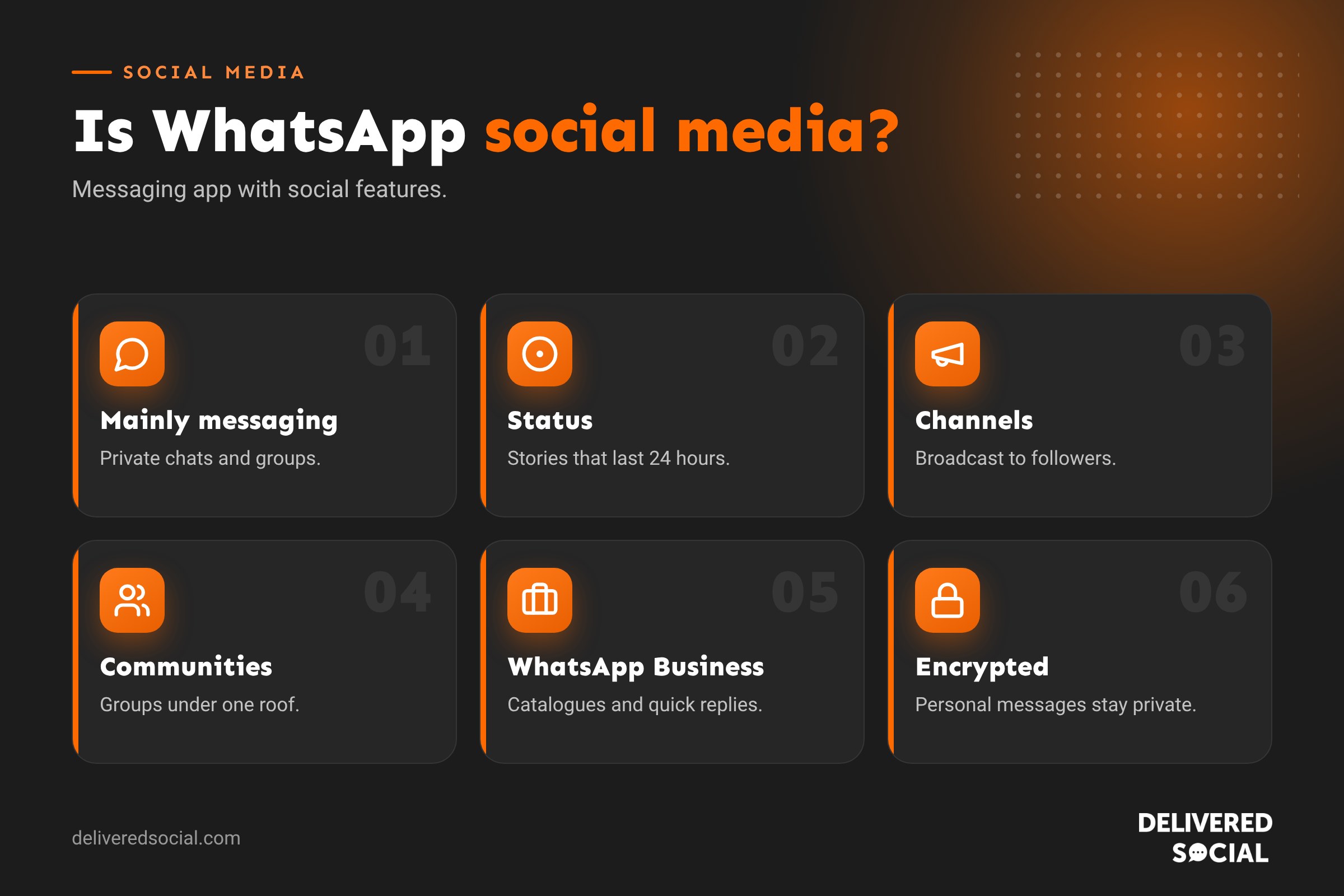
WhatsApp is usually described as a messaging app, but it has many features of social media and is included in most social media statistics and research. Organisations such as DataReportal and Ofcom count it among the most used social and messaging platforms. In everyday terms, it sits in a grey area: it is mainly private messaging, with growing public and broadcast features that make it more social.
What makes something social media?
Social media platforms generally let people:
- Create a profile.
- Share content such as text, photos and videos.
- Connect with others.
- Interact through likes, comments, shares or replies.
- Discover content from people they do not know personally.
WhatsApp ticks most of these boxes. You have a profile, share photos, videos and updates, connect with contacts, react to messages and follow public Channels. The main difference is discovery: traditional social media is built around public feeds, while WhatsApp is built around private conversations.
WhatsApp features that make it social
Status
WhatsApp Status works like Instagram Stories. You share photos, videos and text that disappear after 24 hours, visible to your contacts based on your privacy settings.
Channels
Channels are one way broadcast feeds that anyone can follow. Brands, publishers, sports teams and celebrities use them to share updates with large audiences. Followers can react but not reply publicly. Channels appear in the Updates tab alongside Status, which is a clear move towards social media.
Communities
Communities bring several related group chats together under one umbrella, for example a school with separate groups for each year, or a business with groups for different customer types.
Groups
Group chats can have hundreds of members and behave like small social networks, with shared photos, polls, events and conversations.
How WhatsApp differs from Facebook and Instagram
- Private by default: most conversations are one to one or in groups, not public.
- End to end encryption: personal messages and calls are encrypted, so even WhatsApp cannot read them.
- No main public feed: there is no endless scroll of recommended posts from strangers, although Channels and the Updates tab are changing this.
- Phone number based: accounts are tied to phone numbers, and you usually connect with people you already know.
- Less algorithm driven: messages arrive in order rather than being ranked.
Who owns WhatsApp?
WhatsApp is owned by Meta, the company behind Facebook, Instagram, Messenger and Threads. It was bought in 2014. That puts it firmly in the same family as the biggest social media platforms, and Meta increasingly links them, for example through shared business tools.
How popular is WhatsApp?
WhatsApp has well over two billion monthly users worldwide and is the most used messaging app in the UK. Many people check it more often than any other app. That reach is a big reason businesses are paying attention to it. Our guide to how many people use social media puts it in context.
Why the answer matters
For businesses
If you think of WhatsApp only as private messaging, you might miss its value as a customer service and marketing channel. If you treat it like Instagram, you might annoy customers with unwanted messages. Seeing it as a private, permission based channel helps you use it properly.
For workplace policies
Social media policies should cover WhatsApp, especially work group chats, sharing company information and how staff talk about customers. Many workplace disputes now involve messages in WhatsApp groups.
For parents
WhatsApp’s minimum age is 13 in the UK. Group chats can expose children to bullying, inappropriate content and messages from strangers, so parents should treat it with the same care as other social media and review privacy settings together.
How businesses use WhatsApp
WhatsApp Business app
A free app for small businesses with a business profile, catalogue, quick replies, labels, greeting messages and away messages.
WhatsApp Business Platform
For larger businesses, connecting WhatsApp to customer service systems, chatbots and CRMs, often through approved providers. Business initiated messages are paid and use approved templates.
Common uses
- Answering customer questions quickly.
- Appointment reminders and booking confirmations.
- Order updates and delivery notifications.
- Sharing product catalogues.
- Sending offers to customers who have opted in.
- Running a Channel for updates and news.
Our guide to WhatsApp marketing for small business covers set up and best practice.
WhatsApp marketing dos and don’ts
- Do get clear permission before messaging customers.
- Do reply quickly; people expect fast answers on messaging apps.
- Do keep messages short, helpful and personal.
- Do add a WhatsApp button to your website and social profiles.
- Don’t add customers to group chats without asking.
- Don’t send frequent promotional messages; people will block you.
- Don’t forget data protection rules when storing customer numbers.
WhatsApp and UK data protection
If you use WhatsApp for business, you are handling personal data, so UK GDPR applies. Use the WhatsApp Business app or platform rather than personal accounts, keep customer data secure, only message people who have agreed to hear from you and include WhatsApp in your privacy policy. Avoid sharing sensitive customer information in staff group chats.
Is WhatsApp safe?
Personal messages are end to end encrypted, which makes WhatsApp more private than many platforms. However, scams are common, including fake messages from “family members” asking for money and fraudsters impersonating businesses. Turn on two step verification, be cautious with links and never share the six digit code WhatsApp sends you.
WhatsApp alongside your other social channels
For most businesses, WhatsApp works best as the place where conversations continue after someone has found you elsewhere. A customer might see your Instagram Reel, visit your website and then tap a WhatsApp button to ask a question. Make that journey easy by adding WhatsApp links to your social profiles and website, and keep your replies as friendly and professional as everything else people see from you.
WhatsApp Channels for businesses
WhatsApp Channels give businesses a way to broadcast updates to anyone who chooses to follow them, without needing their phone numbers. Followers see your updates in the Updates tab, can react with emojis and vote in polls, but cannot reply publicly, which keeps things tidy. Channels suit news, offers, event reminders and behind the scenes updates. Promote your Channel link on your website, social profiles and in store, and post regularly but not too often, as followers can mute or leave easily.
Click to WhatsApp adverts
Meta lets businesses run Facebook and Instagram ads with a button that opens a WhatsApp chat. This is useful for service businesses and local shops, because a conversation often converts better than a form. Make sure someone is ready to reply quickly when the ads are running, and set up a greeting message so people get an instant response.
Key takeaways
- WhatsApp is mainly a messaging app but has many social media features.
- Status, Channels, Communities and Groups make it increasingly social.
- It is included in most social media research and owned by Meta.
- Businesses can use it for customer service, updates and opted in marketing.
- Include it in social media policies and follow data protection rules.
Frequently asked questions
Is WhatsApp considered social media?
It is usually called a messaging app, but it has social features and is counted in most social media statistics.
Is WhatsApp a social networking site?
Not in the traditional sense, as it lacks a main public feed, but Channels and Status are social features.
Who owns WhatsApp?
Meta, which also owns Facebook and Instagram.
Can businesses advertise on WhatsApp?
Businesses can message opted in customers, run Channels and use click to WhatsApp ads on Facebook and Instagram.
What is the age limit for WhatsApp in the UK?
13.
Are WhatsApp messages private?
Personal messages are end to end encrypted.
Is WhatsApp safer than other social media?
Personal messages are end to end encrypted, but scams still happen, so stay alert.
Can I use my personal WhatsApp for business?
It is better to use WhatsApp Business so your work and personal chats stay separate and you get business tools.
Do WhatsApp Channels show my phone number?
No. Channel followers cannot see the admin’s phone number, and admins cannot see followers’ numbers.
Should WhatsApp be in my social media policy?
Yes. Cover work group chats, sharing company information and how staff contact customers.
Want customers to talk to you?
We help businesses across Surrey, Hampshire and the UK use social media and messaging to win customers. Find out more about our social media management services. Call us on 01483 608 303.
































