



Keep reading
Rather we just did it for you?
Let's get your business seen.
Social media, websites, SEO and ads from a team you can actually meet.
Branding is not just for big companies with big budgets. For a small business, a strong brand is often the difference between being remembered and being forgotten, between competing on price and being chosen because people trust you. The good news is that great small business branding is more about clarity and consistency than expensive design. This guide explains what small business branding really is, why it matters, the key elements, a step by step process to build your brand, budget options and common mistakes to avoid.
What is branding?
Branding is the process of shaping how people think and feel about your business. It includes the visible parts, like your logo, colours and website, but also your values, personality, tone of voice, the promises you make and the experience customers have. Your brand is ultimately the reputation people carry in their heads about you.
A logo is part of a brand, but it is not the brand. Think of the brand as your business’s personality, and the logo as its signature.
Why branding matters for small businesses
- Recognition: a consistent look and voice helps people remember and recognise you.
- Trust: a professional, consistent brand signals that you are reliable and established.
- Differentiation: branding shows why you are different from competitors offering similar services.
- Pricing power: strong brands can charge more because customers value them.
- Loyalty: people stay with brands they like and feel connected to.
- Easier marketing: when you know who you are and who you serve, every post, advert and web page becomes easier to create.
- Business value: a recognised brand adds value if you ever sell the business.
The key elements of a small business brand
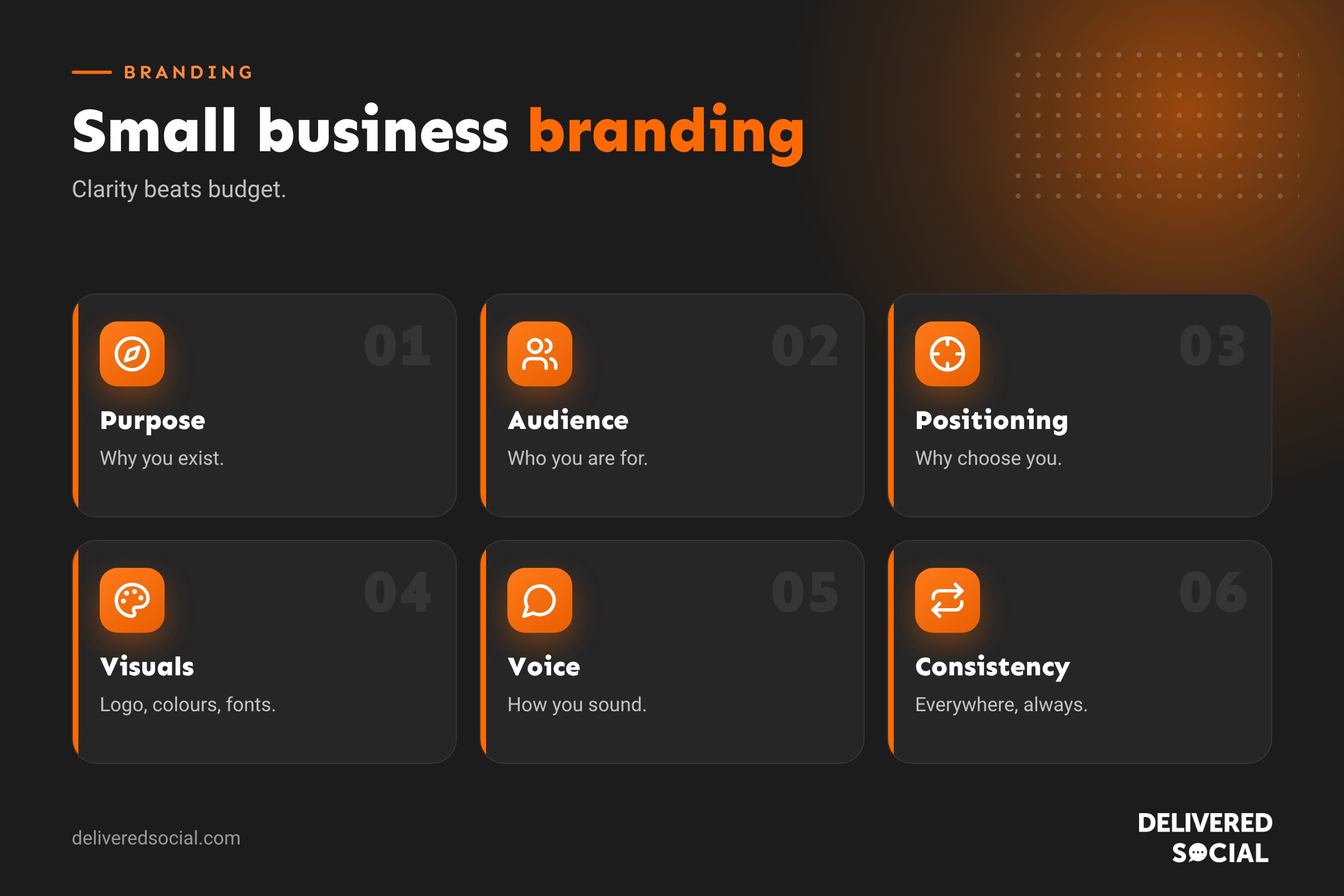
Purpose and values
Why does your business exist beyond making money? What do you believe in? Values guide decisions and give customers a reason to connect with you.
Target audience
Who are you for? A brand that tries to appeal to everyone ends up connecting with no one. Be specific about your ideal customer.
Positioning
Where do you sit in the market? Premium, affordable, specialist, local, fast, friendly? Positioning explains why someone should choose you.
Brand name and tagline
Your name should be memorable, easy to spell and available as a domain and on social media. A short tagline can explain what you do or what makes you different.
Logo
Simple, distinctive and readable at small sizes, such as on a phone screen or social media profile. Our guide to writing a logo brief helps you get the design right.
Colours
Choose a small palette, usually one or two main colours and a couple of supporting ones. Colours carry meaning, so think about the feelings you want to create. Our article on colour psychology in marketing explains more.
Typography
One or two fonts used consistently across your website, documents and social media.
Imagery
Photography and graphics style. Real photos of your team, premises and work usually build more trust than stock images.
Tone of voice
How you sound in writing and conversation: friendly, expert, playful, calm or straight talking. Keep it consistent across emails, posts and your website.
Customer experience
Everything from how you answer the phone to how you package an order. The experience is where your brand promises are kept or broken.
How to build your small business brand step by step
1. Research your customers and competitors
Talk to customers about why they chose you. Look at competitors’ websites and social media and note what everyone says, so you can find space to stand out.
2. Define your purpose, values and personality
Write down your purpose in one sentence, three to five values and three words that describe your personality.
3. Write your positioning statement
A simple formula: “We help [audience] to [benefit] by [what you do], unlike [alternatives] because [your difference].”
4. Create your visual identity
Design or refresh your logo, choose colours and fonts, and decide on a photography style. Working with a designer at this stage is often worthwhile.
5. Create simple brand guidelines
Even a two page document with your logo versions, colours, fonts and tone of voice examples keeps everyone consistent.
6. Apply your brand everywhere
Website, social media profiles, email signatures, invoices, signage, vehicles, uniforms, packaging and your Google Business Profile.
7. Live your brand
Train your team, deliver on your promises and keep checking that the experience matches the message.
Branding on a budget
- Start with strategy: clarity about who you are and who you serve costs nothing but time.
- Keep the logo simple: simple logos are cheaper to design and more versatile.
- Use templates: brand templates in tools like Canva keep social posts consistent.
- Take your own photos: modern phones produce great images with good light.
- Prioritise: start with your website, Google profile and main social channel, then roll out further.
Investing in professional branding usually pays off once you are established, especially before a website redesign. Our graphic design services cover logos, brand kits and templates.
Signs your brand needs a refresh
- Your logo looks dated or does not work on social media.
- Your website, socials and printed materials all look different.
- Customers misunderstand what you do.
- Your business has changed but your brand has not.
- You are attracting the wrong customers or competing only on price.
Common small business branding mistakes
- Thinking a logo is the whole brand.
- Copying a competitor’s look.
- Using too many colours and fonts.
- Being inconsistent across channels.
- Trying to appeal to everyone.
- Making promises the business cannot keep.
- Changing the brand too often, before people have had chance to recognise it.
Branding and marketing: what is the difference?
Branding defines who you are; marketing tells people about it. Branding is long term and shapes perception; marketing is the activity that drives awareness and sales. Strong branding makes marketing more effective because every campaign builds on a clear identity. Our article on branding vs marketing explains the difference in more detail.
How to tell if your branding is working
Good branding shows up in everyday signs. More people mention you by name when they get in touch. Customers describe you in the way you hoped. You see more branded searches in Google Search Console, more direct traffic to your website and more people tagging you on social media. Enquiries come from the right kind of customer, and price becomes less of a sticking point. Check these signs every few months to see whether your brand is building the reputation you want.
Bringing your brand to life on social media
Social media is often where customers meet your brand first, so it is worth getting right. Use your logo as your profile picture, write a clear bio that explains what you do and who you help, and use consistent colours and fonts in your graphics. Create a few branded templates for common posts such as tips, testimonials and offers. Most importantly, let your personality show through your captions, videos and replies. A consistent, recognisable feed helps people remember you and builds trust long before they visit your website.
Branding for service businesses
For trades and service businesses, branding often lives on vans, uniforms, quotes and invoices as much as online. A well branded van is a moving advert, uniforms make your team look professional and trustworthy on a customer’s doorstep, and a branded quote template shows care in every detail. These small touches add up to a business people remember and recommend.
Key takeaways
- Branding is how people think and feel about your business, not just your logo.
- Strong branding builds recognition, trust, loyalty and pricing power.
- Start with purpose, audience and positioning, then create your visual identity.
- Simple brand guidelines keep everything consistent.
- Your customer experience must match the brand promise.
Frequently asked questions
Why is branding important for a small business?
It helps customers recognise, remember and trust you, and gives them a reason to choose you over competitors.
How much does small business branding cost?
It ranges from a few hundred pounds for a simple logo and colour palette to several thousand for a full brand identity and guidelines.
What comes first, branding or a website?
Ideally branding, so your website reflects a clear, consistent identity from day one.
Can I do my own branding?
You can define your purpose, audience and tone yourself. A professional designer helps with the visual identity.
How often should I rebrand?
Only when your business has changed significantly or your brand no longer works. Small refreshes every few years are common.
What are brand guidelines?
A short document explaining how to use your logo, colours, fonts and tone of voice consistently.
Do I need a logo before I start trading?
A simple, clean logo helps, but you can start with a clear name and refine your branding as you learn more about your customers.
Want a brand that stands out?
We help small businesses across Surrey, Hampshire and the UK with branding, websites and social media. Find out more about our branding services. Call us on 01483 608 303.
































