

Keep reading
Rather we just did it for you?
Let's get your business seen.
Social media, websites, SEO and ads from a team you can actually meet.
Every booking that comes through an online travel agent costs a hotel a slice of the room rate. Every booking that comes direct keeps that money, and the guest’s details, in the business. A good hotel marketing strategy is mostly about shifting that balance: being easy to find, giving people a reason to book with you rather than through a booking site, and staying in touch so they come back.
This guide is written for independent hotels, inns, B&Bs and small groups rather than global chains. It covers the channels that matter, how to win more direct bookings, where AI genuinely helps, and a 90-day plan you can follow.
What is a hotel marketing strategy?
It’s a plan for how you attract guests, turn interest into bookings and bring people back. A useful one answers five questions:
- Who are your guests? Business travellers, couples on a break, families, wedding parties, walkers, event-goers.
- Why do they choose you? Location, character, food, value, parking, dog-friendly rooms.
- Where do they look? Google, Google Maps, booking sites, Instagram, TikTok, wedding directories.
- How do they book? Your website, phone, email or an online travel agent.
- What brings them back? A great stay, a reason to return and a reminder at the right time.
Why direct bookings matter
Online travel agents such as Booking.com and Expedia are useful for being seen, but they charge commission on every booking, typically somewhere around 15% to 25% of the room rate depending on the platform and your agreement. They also own the relationship: the guest’s email address and future bookings tend to stay with the platform.
| Booking site | Direct booking | |
|---|---|---|
| Cost | Commission on every stay | Your marketing and booking engine costs |
| Guest data | Mostly held by the platform | Yours, with consent, for future marketing |
| Upsells | Limited | Breakfast, dinner, late checkout, packages |
| Repeat bookings | Often go back through the platform | Come straight to you |
| Best use | Reaching new guests and filling gaps | Your core, most profitable business |
The aim isn’t to leave booking sites altogether. It’s to use them for reach while making direct booking the easier, better-value choice.
1. Get found on Google first
Most stays start with a search. For a small hotel, these are the foundations:
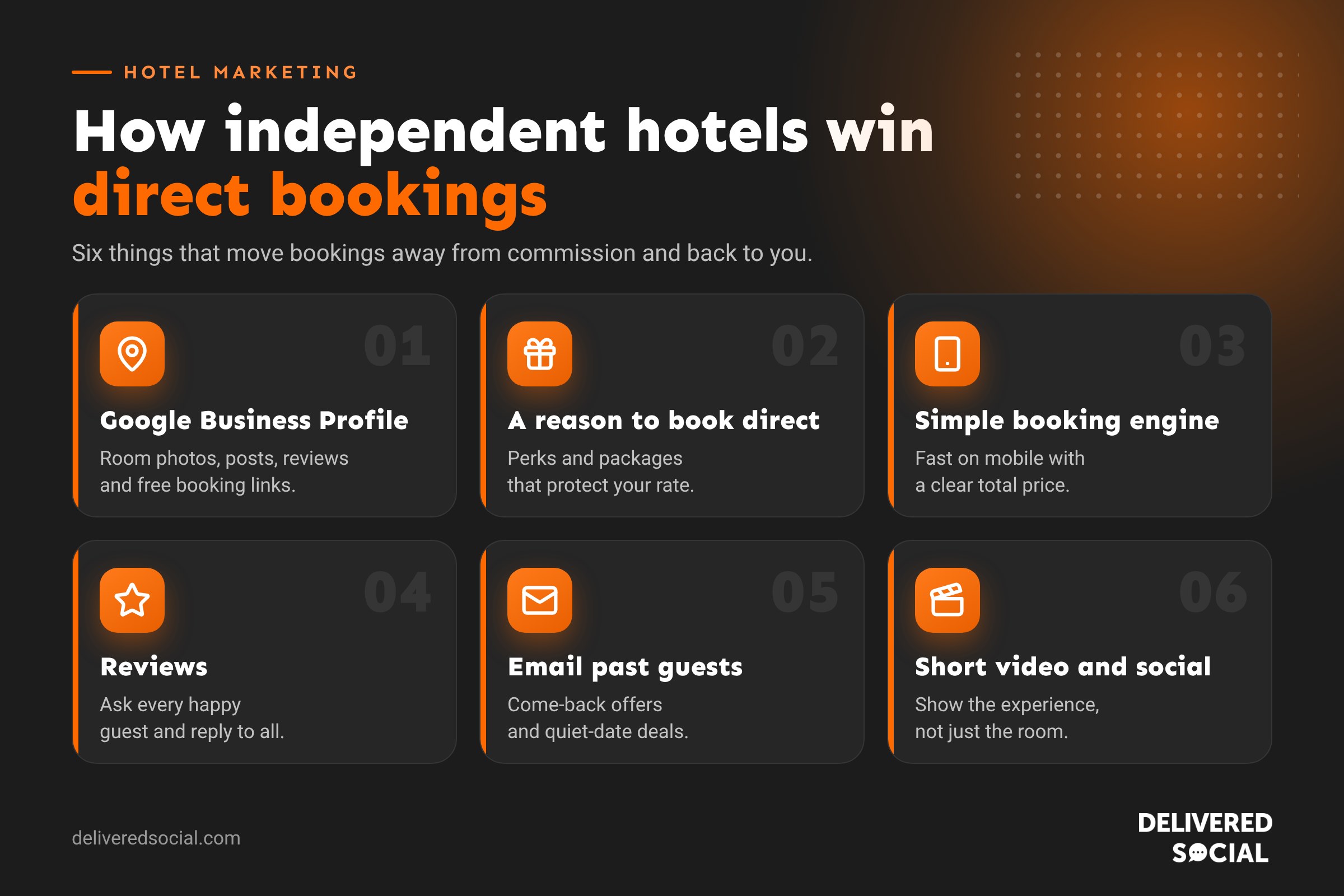
- Google Business Profile: correct category, photos of every room type, amenities, check-in times, and regular posts. Answer every review.
- Free booking links: connect your booking engine so your own website shows as a booking option alongside the travel agents in Google’s hotel results. Most modern booking engines support this.
- Local SEO on your website: pages for the things people search, such as “hotel near [venue]”, “dog-friendly hotel in [town]” and “wedding venue with rooms”. See our guide to hotel SEO.
- Fast mobile pages: most travel searches happen on phones, often on the move.
2. Give people a reason to book direct
If the price and the process are the same, guests will book wherever is easiest. Make your website the better deal:
- A direct-booking perk: free breakfast, a welcome drink, free parking, early check-in or a flexible cancellation policy. Perks protect your rate better than discounts.
- Packages you can’t get elsewhere: dinner, bed and breakfast; spa breaks; walking weekends; event packages.
- A clear “best rate when you book direct” message on every page, near the booking button.
- A simple booking engine: few steps, works perfectly on a phone, shows the total price clearly, and takes Apple Pay or Google Pay if possible.
3. Let your website do the selling
Your website should answer every question a guest has before they leave to check a booking site:
- Real photos of every room type, the bathrooms, the view and the breakfast.
- Clear prices or a visible “check availability” button on every page.
- Reviews near the top, ideally pulled from Google or TripAdvisor.
- Practical details: parking, accessibility, dogs, check-in times, distances to local attractions.
- Abandoned booking emails, if your booking engine supports them, to remind people who started but didn’t finish.
4. Reviews are your most powerful marketing
Guests trust other guests. Ask happy guests for a Google review at checkout or in a thank-you email, make it easy with a direct link or QR code, and reply to every review, good or bad, politely and personally. Future guests read your replies as closely as the reviews.
5. Stay in touch with past guests
Your past guests are your cheapest source of future bookings. With consent, build an email list and send:
- A thank-you email after their stay, with a review link.
- A “come back” offer around the anniversary of their stay.
- Seasonal emails about events, menus and special breaks.
- Last-minute availability to fill quiet dates.
6. Show the experience on social media
People book a feeling as much as a room. Short videos of the room reveal, breakfast being served, the view from the window, the bar on a Friday night and the team behind the desk build trust faster than any brochure. Our guide to social media for hotels covers what to post.
7. Use paid ads to fill the gaps
- Google Ads on your own hotel name to stop booking sites taking guests who are already searching for you.
- Google Hotel Ads or meta-search to show your direct price alongside the travel agents.
- Meta and Instagram retargeting for people who visited your rooms page but didn’t book.
- Campaigns for quiet periods, such as midweek winter breaks, rather than spending evenly all year.
Where AI helps hotels
AI is most useful for smaller hotels when it saves staff time, not when it replaces the welcome:
| Use | What it does | Keep in mind |
|---|---|---|
| Website chat assistant | Answers common questions on parking, dogs and check-in at any hour | Make handing over to a person easy |
| Review replies | Drafts replies for staff to personalise | Always edit before posting |
| Dynamic pricing | Adjusts rates to demand and local events | Set minimum rates you’re happy with |
| Translation | Helps with emails and messages from overseas guests | Check important details carefully |
| Content help | Drafts blog posts, social captions and emails | Add your own local knowledge and photos |
| Personalised emails | Sends offers based on past stays | Follow UK GDPR and get consent |
A 90-day hotel marketing plan
| When | Focus | Actions |
|---|---|---|
| Weeks 1 to 2 | Know your numbers | Bookings by channel, commission paid, occupancy by month, direct share |
| Weeks 3 to 4 | Fix the foundations | Google Business Profile, free booking links, website photos and booking engine |
| Weeks 5 to 8 | Build habits | Review requests, a monthly guest email, weekly short videos, Google posts |
| Weeks 9 to 12 | Fill the gaps | Packages and paid campaigns for your quietest dates, then measure |
How to measure your hotel marketing
- Share of bookings that come direct, month by month.
- Commission paid to booking sites.
- Website booking conversion rate.
- Occupancy and average room rate in quiet periods.
- Repeat guest rate and review score.
Common hotel marketing mistakes
- A cheaper price on booking sites than on your own website.
- A booking engine that’s slow or confusing on a phone.
- Out-of-date photos that don’t match the rooms.
- Never contacting past guests again.
- Spending the same on marketing every month instead of focusing on quiet periods.
Frequently asked questions
What is the best marketing strategy for a hotel?
For most independent hotels: a strong Google Business Profile, a website that makes direct booking easy and better value, plenty of reviews, and regular contact with past guests.
How can a small hotel get more direct bookings?
Offer a direct-booking perk, connect free booking links on Google, keep your rates the same or better on your own site, and make the booking process quick on mobile.
Should hotels stop using Booking.com?
Usually not. Booking sites help new guests find you. Use them for reach and fill quiet dates, while encouraging repeat guests to book direct.
Do I need a hotel marketing agency?
Not always. Many small hotels manage the basics themselves and bring in help for websites, ads and social media. See our list of hotel marketing agencies in the UK.
How is AI used in hotels?
For chat assistants, review reply drafts, dynamic pricing, translation and personalised emails. It works best when it frees up staff to look after guests.
Want more direct bookings?
We help hotels, inns and hospitality businesses across Surrey, Hampshire and the UK with websites, SEO, social media and ads that bring guests straight to you. See our social media services or call us on 01483 608 303 for a friendly chat.