

Keep reading
Rather we just did it for you?
Let's get your business seen.
Social media, websites, SEO and ads from a team you can actually meet.
“Only pay when you rank” sounds like the safest deal in marketing. No results, no fee. But pay on results SEO isn’t always what it seems, and the cheapest-looking option can end up costing far more. This guide explains how pay on results SEO works, its pros and cons, the warning signs to look for, and how SEO and paid search can work together to get faster results without the risk.
What is pay on results SEO?
Pay on results (or pay for performance) SEO is a pricing model where you pay the agency only when agreed targets are hit. Common models include:
| Model | How you pay |
|---|---|
| Pay per ranking | A fee for each keyword in the top 10 or top 3 each month |
| Pay per lead | A fee for each enquiry or call from organic search |
| Revenue share | A percentage of sales from organic traffic |
| Hybrid | A lower monthly retainer plus a bonus for hitting targets |
The pros
- Less upfront risk: you’re not paying a full retainer before you see anything.
- Clear targets: both sides know what success looks like.
- Motivated agency: the agency only earns when it delivers.
The cons and the catches
- Easy keywords: agencies may pick low-competition phrases that rank quickly but nobody searches for, so you pay for rankings that bring no customers.
- Short-term tactics: the pressure to rank fast can lead to risky link building that breaks Google’s spam policies and can harm your site later.
- Higher total cost: pay on results fees are often set high to cover the agency’s risk, so you can end up paying more than a normal retainer once results arrive.
- Rankings aren’t results: a top-three ranking is only valuable if it brings enquiries or sales.
- Locked-in work: some contracts keep the content or links the agency created, or remove them if you leave.
Warning signs to look for
- Guaranteed first-page rankings. Google itself says no one can guarantee a ranking.
- Vague answers about how links will be built.
- Keyword lists chosen by the agency with no search volume shown.
- No access to your Google Search Console and Analytics data.
- Contracts where content or links are removed if you stop paying.
Questions to ask any pay on results SEO agency
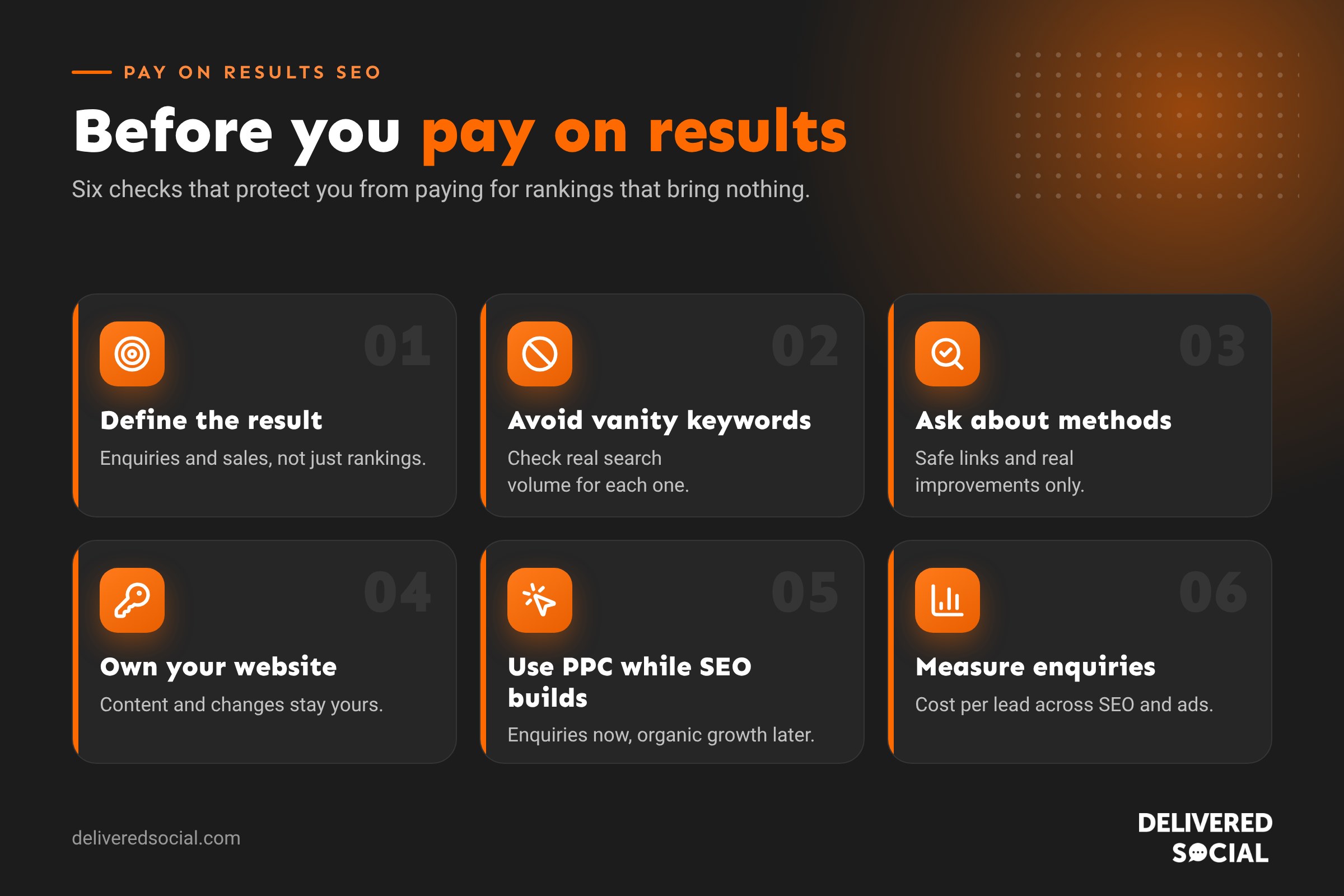
- Exactly what counts as a result, and how is it measured?
- Can I choose or approve the keywords, and how many people search for each?
- How will you build links and improve my site?
- Who owns the content and changes you make?
- What happens if rankings drop because of a Google update?
- Can I see examples and speak to current clients?
A better approach: SEO and paid search together
SEO takes months to build momentum. Paid search (PPC) brings visitors from day one. Used together, they cover each other’s weaknesses:
| How they help each other | What it means for you |
|---|---|
| Test keywords with PPC first | Find which searches bring enquiries before investing months of SEO in them |
| Fill the gap while SEO grows | Get enquiries now while organic rankings build |
| Take up more of the results page | Appearing in both ads and organic results builds trust and clicks |
| Share data | Search terms from ads guide new content; Search Console shows what to bid on |
| Remarketing | Bring back people who found you through SEO but didn’t get in touch |
| Cut ad spend as SEO grows | Reduce bids on keywords where you rank strongly |
Our guides to how much PPC costs and building an SEO strategy go into more detail.
What to measure instead of rankings
- Enquiries, calls and sales from organic search.
- Organic clicks for searches that matter to your business, from Google Search Console.
- Cost per enquiry across SEO and PPC combined.
- Rankings for a small set of high-value, agreed keywords.
Frequently asked questions
Is pay on results SEO worth it?
It can be, if results are defined as enquiries or sales, the keywords genuinely matter, and the methods are safe. Paying for rankings alone is rarely good value.
Can anyone guarantee a first-page ranking?
No. Google warns against anyone who guarantees rankings, because no one controls its results.
Should I use SEO or PPC?
Most businesses benefit from both: PPC for immediate enquiries and testing, SEO for long-term, lower-cost traffic.
How long does SEO take to work?
Usually three to six months to see meaningful movement, longer in competitive markets.
Want SEO you can measure?
We help small businesses across Surrey, Hampshire and the UK grow with SEO and Google Ads, reporting on enquiries, not just rankings. See our SEO services or call us on 01483 608 303 for a friendly chat.