

Keep reading
Rather we just did it for you?
Let's get your business seen.
Social media, websites, SEO and ads from a team you can actually meet.
Can you really make money on Instagram? Yes, but probably not in the way most “get rich” posts suggest. For most people and small businesses, the money comes from selling products and services, brand partnerships and a loyal audience, not from Instagram paying you directly. This guide explains how to make money on Instagram, the different ways to earn, what you need to qualify, and how to get started.
Ways to make money on Instagram
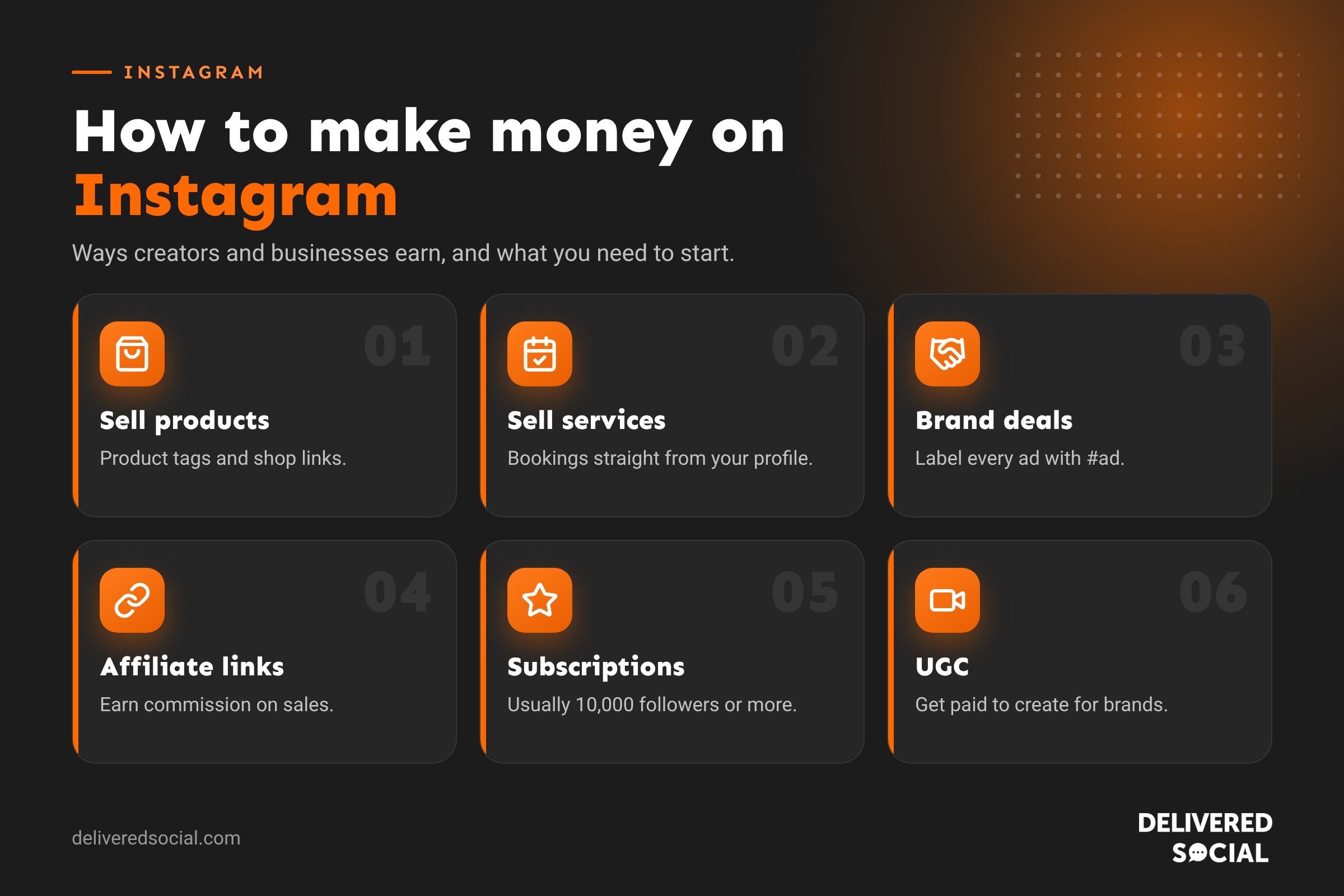
| Method | Best for | Followers needed |
|---|---|---|
| Selling your own products | Shops, makers, brands | Any |
| Selling services | Trades, salons, coaches, freelancers | Any |
| Brand partnerships | Creators with an engaged niche audience | Usually a few thousand or more |
| Affiliate links | Creators who recommend products | Any, but more helps |
| Subscriptions | Creators with loyal fans | 10,000 or more |
| Gifts on Reels and badges on Lives | Entertaining creators | Eligibility varies by country |
| User-generated content (UGC) | People good at filming | None, you’re paid to create |
| Social media management | People with marketing skills | None |
1. Sell your own products
For businesses, this is the most reliable way to make money on Instagram. Show your products in real use, explain what makes them different and make buying easy:
- Tag products in posts and Reels if you’ve set up an Instagram Shop through Commerce Manager. Shoppers can tap through to your website to buy.
- Use a clear link in your bio to your online shop, best-sellers or latest offer.
- Share Stories with link stickers to new arrivals and limited stock.
- Go Live to demonstrate products and answer questions in real time.
- Take orders by DM for made-to-order or local products, with a secure payment link.
2. Sell your services
Hairdressers, photographers, builders, personal trainers, cafés and consultants all win customers through Instagram. The trick is to show your work and make it easy to book:
- Post before and after photos, project videos and customer reviews.
- Add a Book now or Contact button to your profile.
- Use your town or area in your name field and bio so local people find you.
- Reply quickly to DMs and comments, as that’s where many enquiries start.
3. Brand partnerships and sponsored posts
Brands pay creators to feature their products. You don’t need a huge following: many brands prefer smaller creators with an engaged, specific audience, such as local foodies or parents in one area. To get started:
- Switch to a creator or business account to see your Insights.
- Build a media kit: your audience, engagement rates, examples of your best content and your prices.
- Join Instagram’s creator marketplace where available, or pitch brands you already love.
- Agree clear terms: what you’ll post, when, how many revisions, usage rights and payment.
In the UK, sponsored content must be clearly labelled. The Advertising Standards Authority and the Competition and Markets Authority expect posts to be marked as ads, for example with “#ad” at the start of the caption, and Instagram’s Paid partnership label. Gifted products count too.
4. Affiliate marketing
With affiliate links, you earn a commission when people buy through your link. Amazon Associates, Awin, Rakuten and many individual brands run affiliate programmes. Share links in your bio, Stories and Broadcast channel, and always disclose them clearly as affiliate links. Recommend only products you’d genuinely use, as trust is your most valuable asset.
5. Instagram Subscriptions
Subscriptions let your followers pay a monthly fee for exclusive content, such as subscriber-only Stories, Reels, Lives and group chats, plus a purple badge next to their name. Meta’s requirements include being at least 18, having a professional account, being in an eligible country, meeting its monetisation policies, and typically having at least 10,000 followers. The UK is among the countries where it has been available.
6. Gifts, badges and bonuses
Instagram has tested several ways for fans to tip creators directly:
- Gifts on Reels, where viewers buy “stars” and send them to creators.
- Badges on Live videos, where viewers pay to support a creator during a broadcast.
- Bonuses, invitation-only payments for creating certain types of content.
Availability changes by country and over time. To see which tools you’re eligible for, go to your Professional dashboard and look for monetisation options.
7. UGC creation
User-generated content creators make photos and videos for brands to use in their own adverts and social media. You’re paid for the content itself, so your follower count doesn’t matter. You need a good phone, decent lighting, clear audio and the ability to show products naturally. Build a portfolio of example videos and share it with brands.
8. Offer your Instagram skills
If you’re good at Instagram, other businesses may pay you to run theirs. Social media management, content creation, photography and Reels editing are all in demand from small businesses that don’t have the time.
What you need to monetise Instagram
- A professional account (business or creator) to access Insights, monetisation tools and contact buttons.
- Original content that follows Instagram’s Community Guidelines and Partner Monetisation Policies.
- An engaged audience: comments, saves and shares matter more than follower count.
- A clear niche, so followers and brands know what you’re about.
- Consistency: regular posting over months, not weeks.
How much can you earn on Instagram?
It varies hugely. Some creators earn a few pounds a month from affiliate links, while well-known creators earn thousands per sponsored post. A small business might make most of its revenue through Instagram enquiries without ever being paid by Instagram itself. Rather than chasing a number, focus on the method that suits you and track it: enquiries, sales, partnership fees or subscriber numbers.
Mistakes to avoid
- Buying followers. It ruins your engagement rate, and brands can spot it.
- Not labelling ads. It breaks UK advertising rules and damages trust.
- Posting only sales content. Mix in helpful, entertaining and behind-the-scenes posts.
- Relying on one platform. Build an email list and website too, so you own your audience.
- Falling for scams promising paid “ambassador” roles if you buy products first.
A step-by-step plan to start earning
- Choose your main route. For a business, it’s usually selling products or services. For a creator, it might be partnerships or affiliate links.
- Switch to a professional account and fill in your bio, contact buttons and links.
- Pick three to five content themes that suit your audience, such as tips, behind the scenes, customer stories and product spotlights.
- Post consistently, with a mix of Reels, carousels and Stories each week.
- Make one clear offer people can act on: book, buy, subscribe or click a link.
- Check your Insights monthly to see which posts bring in followers, clicks and enquiries.
- Do more of what works and drop what doesn’t.
How to price sponsored posts
There’s no fixed rate. Brands look at your engagement, audience and content quality, not just your follower count. When setting prices, consider:
- Time: planning, filming, editing and revisions.
- Format: a Reel usually costs more than a Story because it takes longer and lasts.
- Usage rights: if a brand wants to use your content in its own adverts, charge extra.
- Exclusivity: if you can’t work with competitors for a time, that has value.
- Results: share past examples of reach, clicks or sales from similar posts.
Start with a simple rate card and adjust as you build experience and confidence.
Turning followers into customers
Followers don’t pay the bills; customers do. To turn one into the other, make sure every profile visitor can see in seconds what you sell, where you are and how to buy. Use Highlights for reviews, prices and FAQs. Reply to every comment and DM. Share customer stories so people can picture themselves using your product or service. And give a reason to act now, such as limited stock, booking slots or a seasonal offer.
Build an audience you own
Instagram can change its features, algorithm and rules at any time. Protect your income by moving followers onto channels you control. Offer a useful freebie, such as a guide, discount or checklist, in exchange for an email address, and send a regular newsletter. Drive followers to your website, where you can sell without relying on Instagram’s tools. If Instagram ever has a problem, your business keeps going.
Frequently asked questions
Does Instagram pay you for views?
Not directly for most people. Instagram pays through specific tools such as Gifts, Subscriptions and invitation-only bonuses, where available.
How many followers do you need to make money on Instagram?
None to sell your own products or services. Brand partnerships usually start at a few thousand engaged followers, and Subscriptions usually need 10,000.
Do I have to pay tax on Instagram income?
Yes. In the UK, income from Instagram, including gifted products in some cases, may need to be declared to HMRC. Speak to an accountant if you’re unsure.
Can a small business make money on Instagram?
Yes. Most do it by winning customers rather than being paid by Instagram: showing their work, building trust and making it easy to buy or book.
Want Instagram to bring in more customers?
We help small businesses across Surrey, Hampshire and the UK turn Instagram into a steady source of enquiries and sales. See our social media services or call us on 01483 608 303.