

Keep reading
Rather we just did it for you?
Let's get your business seen.
Social media, websites, SEO and ads from a team you can actually meet.
In many small businesses, marketing and sales are done by the same person, or blur together until nobody is quite sure who’s responsible for what. In larger organisations, the two teams sometimes work in silos and blame each other when targets are missed. Understanding the difference, and how the two fit together, helps you win more customers with less wasted effort. This guide explains marketing vs sales: what each does, how they differ, where they overlap, the metrics for each, and how to get them working as one team.
What is marketing?
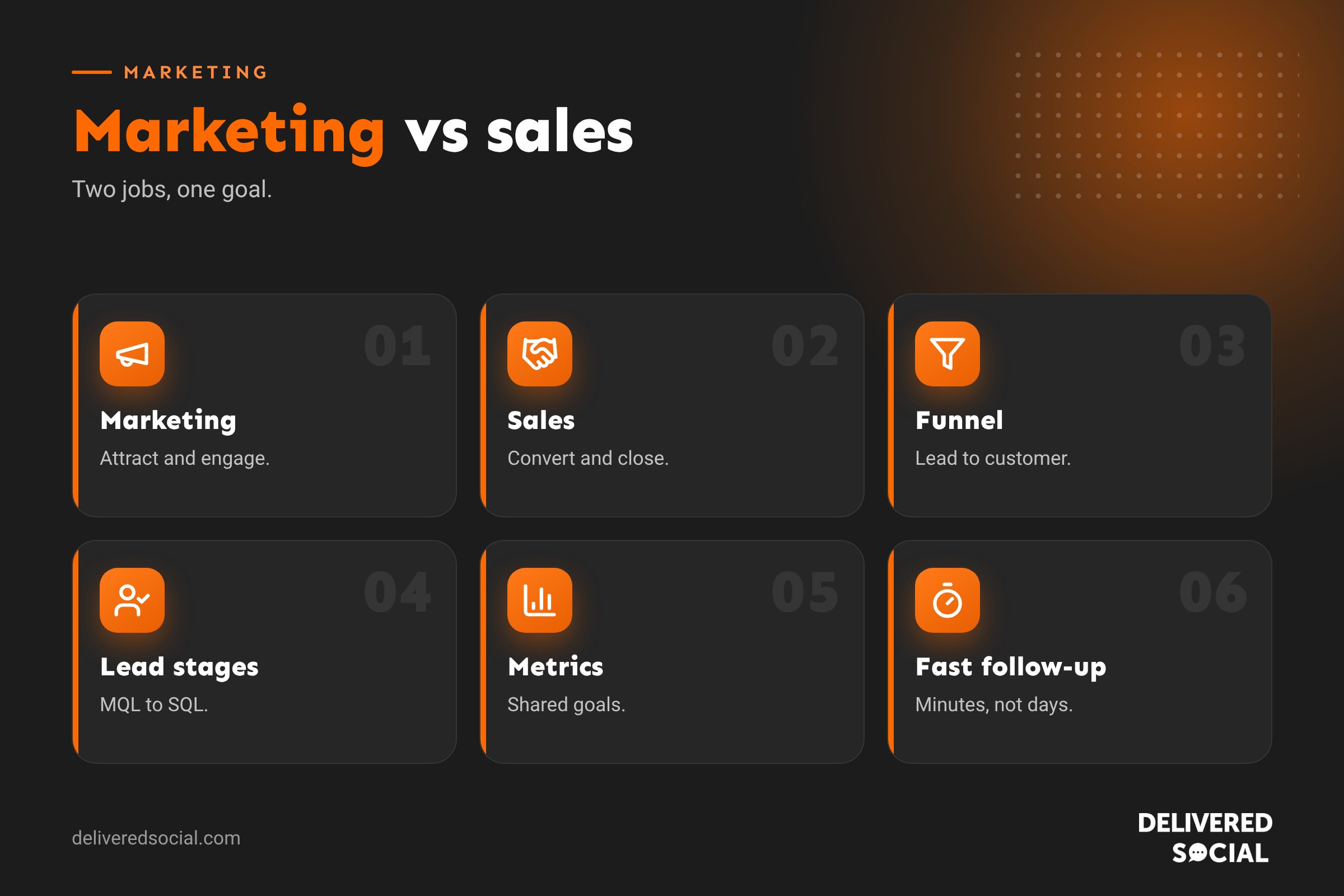
Marketing is everything you do to attract and engage the right people, build awareness and trust, and create demand for what you offer. It includes understanding your customers, positioning your brand, creating content, running social media and advertising, SEO, email, events and PR. Marketing typically speaks to many people at once and works over a longer timeframe.
What is sales?
Sales is the process of turning interested prospects into paying customers. It includes responding to enquiries, qualifying leads, understanding needs, presenting solutions, handling objections, sending proposals, negotiating and closing deals. Sales usually works one-to-one or with a small group, and focuses on specific opportunities in the near term.
Marketing vs sales at a glance
| Marketing | Sales | |
|---|---|---|
| Main goal | Attract, engage and generate leads | Convert leads into customers |
| Audience | Many people at once | Individuals or small groups |
| Timescale | Medium to long term | Short term |
| Activities | Content, social, SEO, ads, email, PR, events | Calls, meetings, demos, proposals, negotiation |
| Focus | The market and the message | The individual and their needs |
| Typical metrics | Reach, engagement, leads, cost per lead | Conversion rate, revenue, deal size, sales cycle |
Where marketing and sales overlap
The line between them has blurred. Today’s buyers research online long before speaking to anyone, so marketing content does much of the early selling. Meanwhile, salespeople use social media, content and personal branding to build relationships. Both share the same aim: profitable customers.
Areas of overlap include:
- Defining the ideal customer.
- Messaging and value propositions.
- Case studies and testimonials.
- Follow-up email sequences.
- Social selling on LinkedIn.
- Customer feedback and insights.
Marketing vs advertising vs sales
Advertising is one part of marketing: paid placements to reach people. Marketing is the wider strategy. Sales is converting interest into revenue. See our guide to marketing vs advertising for more.
The marketing and sales funnel
- Awareness: marketing reaches new people.
- Interest: marketing educates and engages.
- Lead: someone shares their details or enquires.
- Qualification: marketing or sales checks fit, budget and timing.
- Proposal: sales presents a solution.
- Close: sales wins the deal.
- Retention and referral: both help keep customers happy and win referrals.
For online shops, the funnel is often fully automated. See our ecommerce marketing funnel guide.
Leads: MQL and SQL
- Marketing qualified lead (MQL): someone who has shown interest, such as downloading a guide, but isn’t ready to buy yet.
- Sales qualified lead (SQL): someone ready for a sales conversation, such as requesting a quote.
Agreeing what counts as each, and when a lead passes from marketing to sales, prevents a lot of frustration.
Metrics for each
| Marketing metrics | Sales metrics |
|---|---|
| Website traffic and sources | Lead to customer conversion rate |
| Engagement and reach | Revenue won |
| Number of leads | Average deal size |
| Cost per lead | Sales cycle length |
| Lead quality | Win rate on proposals |
Shared metrics, such as cost per customer and revenue by lead source, encourage both sides to work together.
Why marketing and sales fall out
- Sales says leads are poor quality; marketing says sales doesn’t follow up.
- Messages in marketing don’t match what sales actually offers.
- No agreement on what a good lead looks like.
- Feedback from sales never reaches marketing.
- Different targets pulling in different directions.
How to align marketing and sales
- Agree the ideal customer together.
- Define lead stages and the handover point.
- Set shared goals based on revenue and customers, not just leads.
- Meet regularly to review leads, wins and losses.
- Create content sales can use: case studies, FAQs, comparison guides.
- Use one CRM so everyone sees the full customer journey.
- Feed sales insights into marketing: common objections become content.
- Follow up fast: responding within minutes rather than days lifts conversion dramatically.
Marketing and sales for small businesses
If you’re doing both yourself, separate them in your diary. Set time for marketing (posting, content, networking) and time for sales (follow-ups, quotes, calls). Track where every enquiry comes from and what happens to it. A simple spreadsheet or free CRM is enough to start. Our guide to marketing for freelancers has a useful weekly routine.
Which should you invest in first?
If you get plenty of enquiries but convert few, improve sales: faster responses, better proposals, follow-up and handling objections. If you convert well but don’t get enough enquiries, invest in marketing. Most growing businesses need both, in balance.
The role of your website
Your website sits between marketing and sales. It attracts visitors through search and social (marketing) and turns them into enquiries through clear offers, proof and easy contact options (sales). A strong website makes both teams’ jobs easier.
Example: a training company
A training company’s marketing team runs LinkedIn content and webinars, generating plenty of sign-ups, but sales complains that few become clients. They meet and agree that a qualified lead is an HR or operations manager at a company with 50 or more staff who has asked for pricing. Marketing changes its webinar topics and forms to attract and identify these people, and sales commits to calling every qualified lead within one working day. Within a quarter, fewer leads come through, but more of them buy.
Content that helps sales close deals
Some of the most valuable marketing content is created specifically to help sales conversations. Ask your sales team (or yourself) which questions come up before people buy, then create content to answer them:
- Case studies of similar customers with real results.
- Pricing guides or “what affects the cost” articles.
- Comparison pages explaining your options.
- FAQ pages covering common objections.
- Short videos explaining your process.
- Testimonials and reviews organised by service.
Sales can share these before and after calls, which builds trust and shortens the time it takes to decide.
Speed of response matters
Marketing can generate a great lead, but if nobody replies for three days, the prospect has often chosen someone else. Set a target to respond to new enquiries within an hour during working hours, use auto-replies that explain what happens next, and track response times. It’s one of the cheapest ways to improve sales results.
Marketing and sales after the sale
The relationship doesn’t end at the purchase. Marketing keeps customers engaged with newsletters, tips and offers; sales or account managers check in, spot new needs and ask for referrals and reviews. Happy customers become your best source of new leads, so both teams share responsibility for keeping them happy.
A simple shared dashboard
Even a small business benefits from one simple view of marketing and sales together: leads by source each month, how many became customers, revenue won and average time to close. Reviewing it monthly shows which marketing channels bring buyers, not just enquiries, so you can invest where it counts.
Quick glossary
- Lead: a potential customer who has shown interest.
- MQL: marketing qualified lead.
- SQL: sales qualified lead.
- CRM: customer relationship management system.
- Sales cycle: the time from first contact to purchase.
Key takeaways
- Marketing attracts and engages; sales converts and closes.
- Marketing works one-to-many over time; sales works one-to-one now.
- Agree lead definitions and handover points.
- Share goals, data and feedback.
- Invest where the bigger bottleneck is.
Frequently asked questions
What is the main difference between marketing and sales?
Marketing creates interest and leads; sales turns leads into customers.
Which comes first, marketing or sales?
Marketing usually comes first, generating the interest sales converts.
Can one person do both?
Yes, in many small businesses, with separate time set for each.
What is sales and marketing alignment?
Both teams working to shared goals, definitions and data.
Is advertising part of sales?
No, advertising is part of marketing.
What is a qualified lead?
Someone who fits your ideal customer and is likely to buy.
How do I measure marketing success?
Track leads, cost per lead and, most importantly, customers and revenue generated.
Do I need a CRM?
It helps once you have more than a handful of leads to track.
What is a sales funnel?
The stages a prospect moves through from first awareness to becoming a customer.
Should marketing and sales report to the same person?
In small businesses they often do, which can make alignment easier.
How do I know if leads are good quality?
Track how many become customers and how much they spend, by source.
Is customer service part of sales?
It’s separate, but great service drives repeat sales and referrals, so it supports both.
Want more of the right leads?
We help businesses across Surrey, Hampshire and the UK generate leads through websites, social media, SEO and ads. Call us on 01483 608 303.