



Keep reading
Rather we just did it for you?
Let's get your business seen.
Social media, websites, SEO and ads from a team you can actually meet.
Selling online is no longer just for big retailers. From independent shops and makers to cafés, salons and local service businesses, more UK businesses are adding ecommerce to how they trade. Some sell everything online; others use it alongside a shop or showroom. If you are wondering whether it is worth it, this guide sets out the benefits of ecommerce for businesses and customers, the challenges to plan for and the practical first steps to selling online.
What is ecommerce?
Ecommerce, short for electronic commerce, means buying and selling goods or services online. It includes online shops on your own website, sales through marketplaces such as Amazon and Etsy, social commerce through Instagram and TikTok, subscriptions, digital downloads and online bookings for services.
The main benefits of ecommerce for businesses
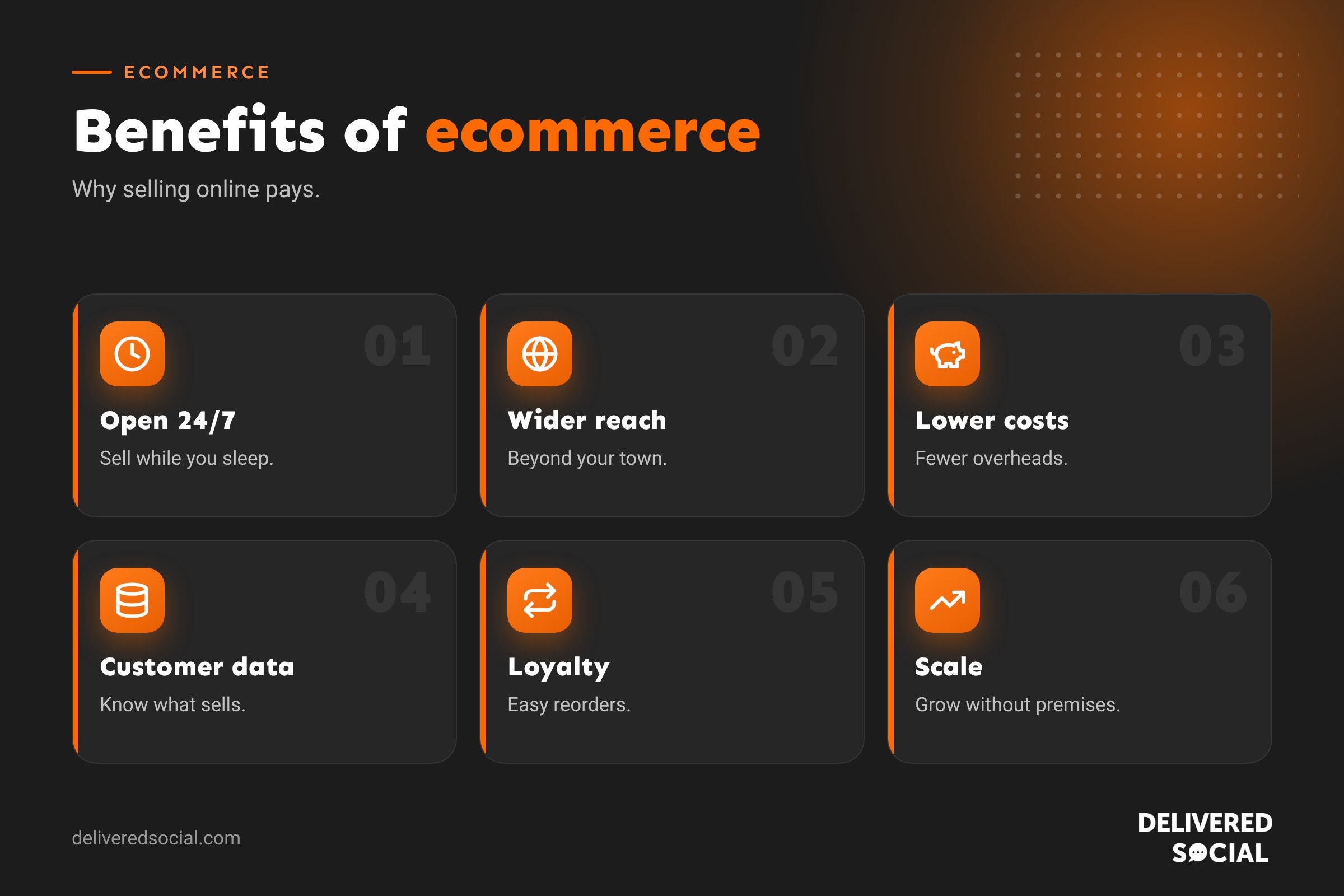
1. Open 24 hours a day
An online shop never closes. Customers can browse and buy at midnight, on Sundays and during bank holidays, which means you make sales while you sleep.
2. Reach far more customers
A physical shop serves people who can visit. An online shop can serve the whole of the UK, and overseas if you choose. Even a small local business can find customers far beyond its town.
3. Lower running costs
Selling online can avoid or reduce some costs of a physical shop, such as rent, business rates, staffing for long opening hours and fit out. There are new costs, like the website, platform fees and delivery, but many businesses find the overall cost per sale lower.
4. Start small and test ideas
You can test new products, bundles or prices online quickly, without filling shelves or printing signs. If something does not sell, you change it.
5. Valuable customer data
Ecommerce shows you what people look at, what they buy, where they come from and what they abandon. That data helps you stock smarter, market better and improve your shop.
6. Build customer loyalty
Customers who buy online can join your email list, receive personalised offers, join a loyalty scheme and reorder in a couple of clicks, all of which encourages repeat business.
7. Easier to scale
Growing an online shop is usually easier than opening new branches. You can increase stock, add products, expand delivery areas or advertise more without new premises.
8. More ways to market
SEO, Google Shopping, social media, influencers and email all lead directly to your products, so marketing can turn into sales quickly and measurably.
9. Personalisation
Online, you can show relevant products, remember preferences and tailor emails to each customer in a way that is hard to do in a shop.
10. Resilience
Businesses with an online channel are better able to keep trading through events that close high streets, such as bad weather, roadworks or lockdowns.
The benefits for customers
- Convenience: shop any time, from anywhere.
- Choice: more products and sizes than any single shop could stock.
- Easy comparison: compare prices, read reviews and research before buying.
- Home delivery or click and collect.
- Easy reordering of regular purchases.
Understanding what customers value helps you design a better shop. Our guide to ecommerce website features covers what shoppers expect.
Benefits of ecommerce for local retail
Ecommerce is not just for online only brands. For local shops, it can:
- Let regular customers order between visits.
- Offer click and collect, bringing people into the shop where they often buy more.
- Reach visitors and tourists after they have gone home.
- Show what is in stock so people visit with confidence.
- Make the shop visible in Google searches for products nearby.
Combining a website with a strong Google local presence helps local shoppers find you online and in person.
The challenges to plan for
Ecommerce has real benefits, but it is not effortless. Plan for:
- Competition: online, you compete with national brands and marketplaces.
- Marketing: a shop without traffic will not sell. Budget time and money to bring people in.
- Delivery and returns: costs, packaging and customer expectations around speed and free returns.
- Trust: new shoppers need reviews, clear policies and secure checkout before they buy.
- Photography and content: customers cannot touch the product, so images and descriptions do the selling.
- Admin: stock, orders, customer service and website maintenance take time.
How to start selling online
- Decide what to sell online first. Start with best sellers that ship easily.
- Choose where to sell: your own website, a marketplace, social commerce or a mix. Our guide to ecommerce websites vs marketplaces helps you choose.
- Choose a platform such as WooCommerce or Shopify.
- Get great product photos and descriptions.
- Set up payments, delivery and returns clearly.
- Plan your marketing before launch, including SEO, social media and email.
- Measure and improve using your analytics.
Is ecommerce right for every business?
Most businesses benefit from some form of online selling, but the right model varies. A café might sell gift cards and coffee beans online rather than meals. A service business might take online bookings and deposits. A maker might start on Etsy before building their own site. Think about what your customers would genuinely like to buy online, and start there.
How much does it cost to start?
Costs range widely. A simple shop on a hosted platform can be launched for a modest monthly fee plus your time, while a professionally designed online shop with custom features is a bigger investment. Our guide to UK ecommerce website costs gives typical price ranges, and our Shopify pricing guide breaks down platform fees.
A quick example
Picture a small independent gift shop on a busy high street. Most sales happen on Saturdays and in the run up to Christmas. By adding a simple online shop with its best selling products, click and collect and local delivery, it starts taking orders in the evenings and from tourists who visited in the summer. Its email list grows with every online order, and it sends a monthly newsletter with new arrivals. Within a year, online sales cover the quiet weekday months, and more people visit the shop because they found it on Google first. That is the real benefit of ecommerce for many small businesses: not replacing the shop, but making it busier and more resilient.
Ecommerce for service businesses
Ecommerce is not only about physical products. Service businesses can benefit too. A salon can take bookings and deposits online, reducing no shows. A personal trainer can sell class passes and online programmes. A garden centre can sell workshop tickets. An accountant can sell fixed price packages. A café or restaurant can sell gift vouchers, merchandise and pre orders for busy dates. Each of these turns your website from a brochure into something that earns money around the clock.
How to measure the benefits
Once you are selling online, keep an eye on a few simple numbers. Track online revenue each month, your conversion rate (the share of visitors who buy), average order value and how many customers come back to buy again. Look at which marketing channels bring buyers rather than just visitors, and how much it costs to win each new customer. Comparing these numbers over time shows whether ecommerce is delivering the benefits you expected and where to focus next, whether that is more traffic, a better checkout or a stronger email programme.
Common myths about selling online
- “If I build it, they will come.” An online shop needs marketing, just like a physical one needs a good location.
- “Ecommerce is only for young customers.” People of every age now buy online, and many older customers are among the most loyal.
- “It will replace my shop.” For most local businesses, online and in person sales support each other.
- “It is too expensive to start.” You can start small with a few products and grow as sales come in.
Key takeaways
- Ecommerce lets you sell around the clock to customers far beyond your local area.
- It can lower costs, provide valuable data and make growth easier.
- Local shops benefit through click and collect and better Google visibility.
- Plan for marketing, delivery, trust and competition.
- Start small with products that sell and ship well, then grow.
Frequently asked questions
What are the main advantages of ecommerce?
Selling 24/7, reaching more customers, lower running costs, customer data, easier scaling and more ways to market.
What are the disadvantages of ecommerce?
Strong competition, delivery and returns costs, the need for marketing and the challenge of building trust online.
Is ecommerce good for small businesses?
Yes. It lets small businesses reach new customers and sell without the costs of extra premises.
Can a local shop benefit from ecommerce?
Yes. Click and collect, local delivery and Google visibility can increase both online and in store sales.
What do I need to start selling online?
Products, a platform or marketplace, good photos and descriptions, payments, delivery, and a plan to attract customers.
Which ecommerce platform is best?
It depends on your needs. WooCommerce offers flexibility and ownership, while Shopify offers simplicity.
Ready to sell online?
We design, build and market online shops for businesses across Surrey, Hampshire and the UK. Call us on 01483 608 303.
































