



Keep reading
Rather we just did it for you?
Let's get your business seen.
Social media, websites, SEO and ads from a team you can actually meet.
For years, people have asked how to get their business mentioned in ChatGPT’s answers. Now there is a paid route too. OpenAI has started showing adverts in ChatGPT, and in August 2026 it confirmed that ChatGPT ads had launched in the United Kingdom. For marketers, it is a brand new channel that reaches people while they are researching, planning and deciding what to buy. This guide explains ChatGPT ads: how they work, who sees them, the rules OpenAI has set, how they differ from search ads, and how UK businesses should prepare.
What are ChatGPT ads?
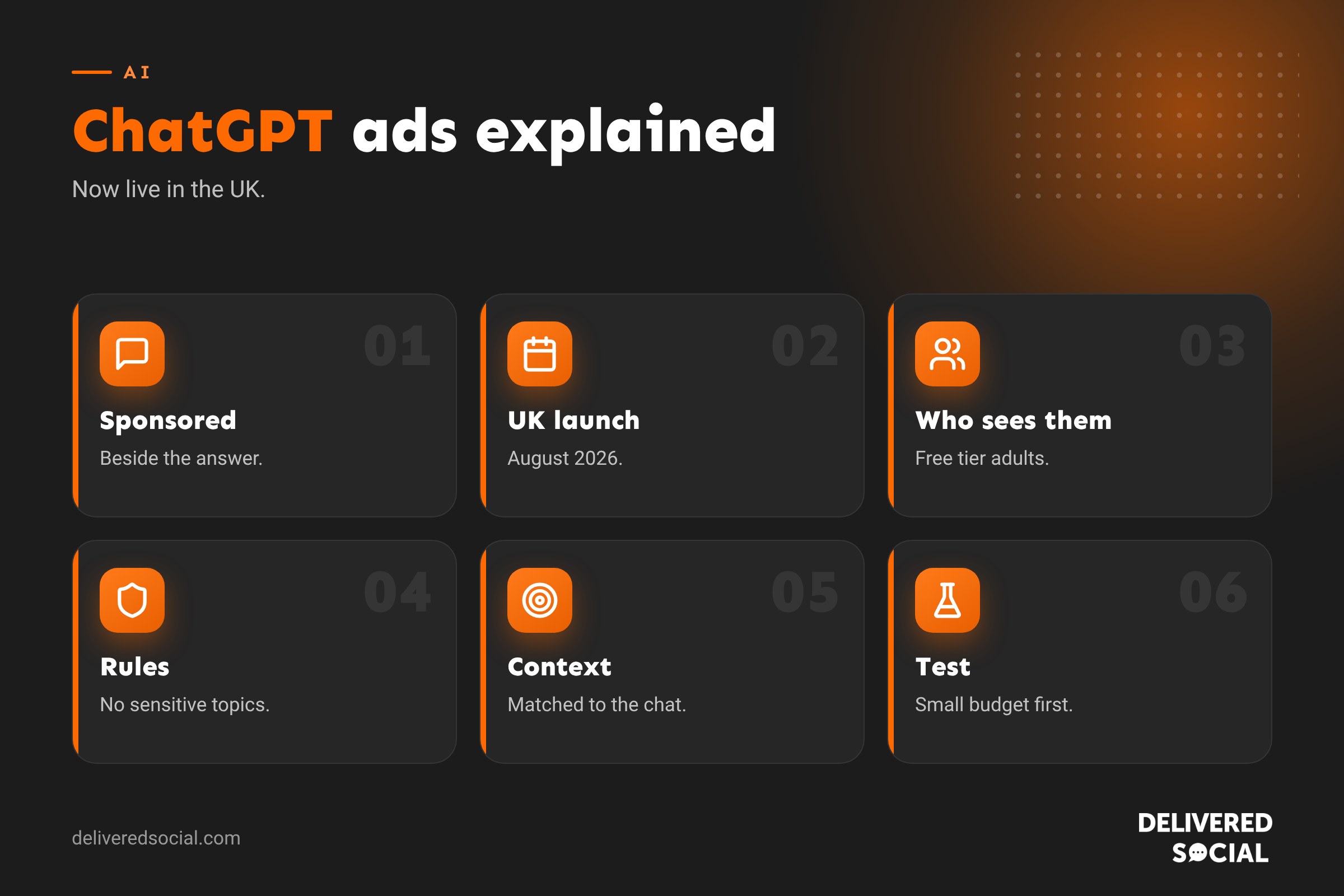
ChatGPT ads are sponsored placements shown within ChatGPT conversations. According to OpenAI, ads are clearly labelled as sponsored and visually separated from ChatGPT’s normal answer. They are matched to the topic of the conversation, so someone asking for help planning a weekend away might see an ad from a relevant travel brand.
When did ChatGPT ads launch?
OpenAI began testing ads in ChatGPT in the United States in early 2026. It later expanded the test, and in an update dated 11 August 2026 it confirmed that ChatGPT ads had launched in the United Kingdom, Mexico, Brazil, Japan and South Korea. OpenAI has also announced expansion across Europe. Availability, formats and buying options are still developing, so check OpenAI’s latest announcements for current details.
Who sees ChatGPT ads?
When OpenAI introduced ads, it said they would be shown to logged in adult users on its free and lower cost tiers. Paid tiers such as Plus, Pro, Business, Enterprise and Education were described as ad free. OpenAI also said ads would not be shown to users it believes are under 18.
The rules OpenAI has set
OpenAI has published several principles for ads in ChatGPT:
- Ads do not influence answers. OpenAI says ChatGPT’s responses are not changed by advertising.
- Clear labelling. Ads are marked as sponsored and kept separate from the answer.
- No ads near sensitive topics. OpenAI says ads are not shown alongside conversations about sensitive or regulated topics such as health, mental health or politics.
- Privacy. Advertisers receive aggregate performance data such as views and clicks, not people’s conversations.
- No ads for under 18s.
How are ChatGPT ads targeted?
OpenAI has said ads are matched using the topic of the current conversation, and may also take into account past chats and past interactions with ads. This is different from traditional search ads, where you bid on specific keywords. Here, the context of a whole conversation can determine relevance, which means intent can be very strong. Someone who has spent ten minutes comparing family cars is a valuable person to reach.
ChatGPT ads vs Google Ads
- Intent: both reach people actively looking for information, but ChatGPT conversations are often longer and more detailed.
- Targeting: Google relies heavily on keywords; ChatGPT ads are matched to conversation context.
- Maturity: Google Ads has decades of tools, data and best practice. ChatGPT ads are new and still evolving.
- Measurement: Google offers detailed conversion tracking. ChatGPT reporting is currently more limited.
- Scale: Google still handles far more searches, but ChatGPT has a very large and growing user base.
For most UK businesses, Google Ads will remain the core paid search channel for now, with ChatGPT ads worth watching and testing as access widens. Our guide to where to spend your ad budget explains how to split spend across channels.
Which businesses could benefit?
ChatGPT ads are likely to suit businesses where customers research before buying, such as:
- Travel, holidays and hospitality.
- Retail and ecommerce, especially considered purchases.
- Software and online tools.
- Home improvement and trades.
- Education, courses and training.
- Professional services, where allowed under the sensitive topic rules.
How to prepare your business
1. Get your organic AI visibility right first
Ads appear next to the answer, not in it. Being recommended in the answer itself is still hugely valuable. Our guides on how to rank in ChatGPT and generative engine optimisation strategies explain how.
2. Know your customers’ questions
Write down the questions people ask before they buy from you. These are the conversations where your ads, and your organic content, need to appear.
3. Prepare strong landing pages
Someone arriving from a detailed AI conversation expects a page that continues it. Clear information, prices where possible and a simple next step.
4. Set up tracking
Make sure Google Analytics 4 and your conversion tracking are working so you can measure traffic from ChatGPT, both paid and organic.
5. Start with a test budget
When access is available to you, treat ChatGPT ads as a test. Compare cost per enquiry or sale against Google and social ads before scaling.
Will ChatGPT ads change SEO?
They add another reason to think about AI visibility. As more people use ChatGPT to research, businesses will compete both for organic mentions in answers and for paid placements beside them. That makes clear, factual content, strong reviews and a well structured website even more important. Our AI SEO guide covers the essentials.
Concerns to keep in mind
- Trust: users may be wary of ads in an assistant they rely on for advice. Honest, helpful ads will perform best.
- Limited data: early reporting may be basic compared with established platforms.
- Changing rules: formats, availability and policies may change as OpenAI develops the product.
- Restricted categories: some industries may find their topics excluded from ads.
A practical checklist for the next six months
While ChatGPT ads mature, there is plenty you can do now so you are ready when you want to test them:
- List the twenty questions customers ask before they buy from you.
- Ask ChatGPT those questions each month and note who gets mentioned.
- Improve your website content so it answers those questions clearly.
- Gather more detailed reviews on Google and other platforms.
- Check your analytics for visits from chatgpt.com and set up a report for them.
- Create a landing page that suits visitors arriving from AI conversations.
- Set aside a small test budget for when ChatGPT ads are available to you.
How ChatGPT ads could look for a local business
Imagine a family planning a short break on the south coast. They ask ChatGPT to suggest dog friendly places to stay, things to do on a rainy day and good places to eat. Over a few messages, the conversation becomes very specific about dates, budget and location. A relevant hotel, attraction or restaurant appearing as a clearly labelled sponsored suggestion at that moment could be extremely valuable, because the family is close to making a decision. The same logic applies to someone researching a new kitchen, comparing accountants or choosing a course. The businesses that do best will be those whose ads and landing pages genuinely help people take the next step.
Key takeaways
- ChatGPT ads are sponsored placements shown alongside, not inside, ChatGPT’s answers.
- OpenAI confirmed ChatGPT ads had launched in the UK in August 2026.
- Ads are matched to conversation context and are not shown to under 18s or near sensitive topics.
- Organic AI visibility still matters as much as paid placements.
- Treat ChatGPT ads as a test channel alongside Google and social ads.
Frequently asked questions
Are there ads in ChatGPT?
Yes. OpenAI shows clearly labelled sponsored placements to some users, separate from ChatGPT’s answers.
Are ChatGPT ads available in the UK?
OpenAI confirmed in August 2026 that ChatGPT ads had launched in the UK. Check OpenAI for current access and buying options.
Do ads change ChatGPT’s answers?
OpenAI says ads do not influence the answers ChatGPT gives.
Do paid ChatGPT users see ads?
OpenAI described its higher paid tiers, such as Plus and Pro, as ad free.
Can advertisers see my conversations?
OpenAI says advertisers receive only aggregate performance data, not conversations.
Should my business advertise on ChatGPT?
If your customers research before buying, it is worth testing alongside Google and social ads once you have access.
How are ChatGPT ads different from AI Overviews?
AI Overviews are Google’s AI summaries in search results. ChatGPT ads are sponsored placements within ChatGPT conversations. Both reward businesses with clear, trustworthy content.
Will ChatGPT ads replace Google Ads?
Unlikely in the short term. Google still handles a huge volume of searches, so most businesses will use both.
What should I put on my landing page for ChatGPT visitors?
Clear answers to common questions, prices or price ranges where possible, reviews, and one simple next step such as booking or getting a quote.
Can I track traffic from ChatGPT?
Yes. In Google Analytics 4, look for referral traffic from chatgpt.com, and use tracked links in any ads you run.
Are ChatGPT ads expensive?
Pricing and buying options are still developing, so check OpenAI’s latest information. Start with a small test budget and compare results with your other channels.
Want to get ahead in AI search?
We help businesses across Surrey, Hampshire and the UK get found in Google and AI tools. Find out more about our generative engine optimisation services. Call us on 01483 608 303.
































