



Keep reading
Rather we just did it for you?
Let's get your business seen.
Social media, websites, SEO and ads from a team you can actually meet.
Rebranding is one of the biggest decisions a business can make. Done well, it can help you attract better customers, charge more and stand out from competitors. Done for the wrong reasons, it can confuse loyal customers and waste money. So why do businesses rebrand, how do you know if it is the right time, and what does the process actually involve? This guide explains why a business would want to rebrand, the difference between a refresh and a full rebrand, the steps involved and how to launch a new brand without losing the customers you already have.
What is a rebrand?
A rebrand is a change to how a business presents itself and is perceived. It can include the name, logo, colours, fonts, tone of voice, messaging, website, signage and even the products or audience the business focuses on. Rebranding is about more than a new logo: it is about changing what people think and feel when they come across your business.
Refresh or full rebrand?
Brand refresh
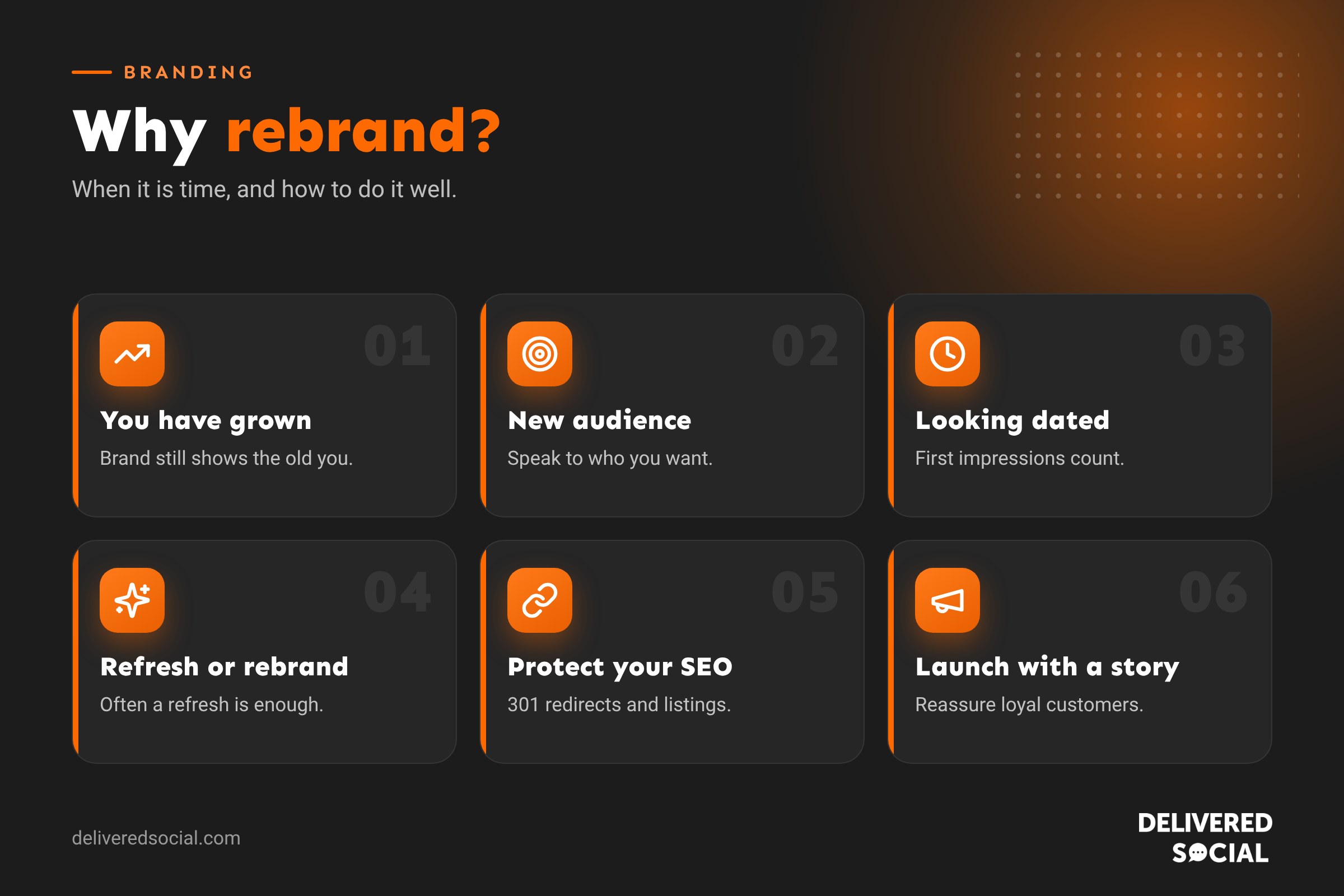
A refresh updates your existing brand without starting again. You might modernise the logo, tweak the colour palette, update fonts, improve photography and refine messaging. Customers still recognise you, but you look current and consistent. Many businesses only need a refresh.
Full rebrand
A full rebrand changes the brand fundamentally, sometimes including the name, positioning and target audience. It is bigger, more expensive and riskier, but sometimes necessary, for example after a merger or a major change in what the business does.
Good reasons to rebrand
Your business has changed
Many businesses outgrow their original brand. You might have added services, moved upmarket, expanded beyond your town or shifted from consumers to businesses. If your brand still reflects what you were rather than what you are, it is holding you back.
You want to reach a different audience
If you want to attract larger clients, younger customers or a new sector, your brand needs to speak to them. A brand designed for one audience rarely appeals to another without change.
You look outdated
Design trends move on. A logo and website from ten years ago can make a business look behind the times, even if the service is excellent. Customers judge quickly, and an old look can suggest an old approach.
You blend in with competitors
If your name, colours and messaging look like everyone else’s, customers struggle to remember you. A distinctive brand helps you stand out and be recommended.
Mergers, acquisitions and new owners
When businesses combine or change hands, a rebrand can bring teams together under one identity and signal a fresh start.
Reputation problems
Sometimes a business needs to move on from a past problem. A rebrand alone will not fix the underlying issue, but combined with real change it can signal a new chapter.
Legal or name issues
Trademark conflicts, confusion with another company or a name that does not work in new markets can all force a change.
Inconsistent branding
If your logo, colours and messages vary across your website, social media, vans and documents, a rebrand can bring everything into line with clear brand guidelines. Our guide to brand guidelines explains why consistency matters.
Bad reasons to rebrand
- Boredom: you have seen your logo every day for years, but customers have not tired of it.
- Following trends: a trendy look can date quickly.
- A new manager wanting to make their mark without a business reason.
- Hiding real problems with service, product or culture.
- Copying a competitor rather than finding your own position.
Signs it might be time to rebrand
- You feel embarrassed to hand out your business card or share your website.
- Customers misunderstand what you do.
- Your prices have gone up but your brand still looks budget.
- Your website and social media look like they belong to different businesses.
- Your best competitors look more professional and established.
- Your name no longer fits your services or locations.
The benefits of rebranding
- Stronger first impressions: a professional brand builds trust before you say a word.
- Higher prices: premium brands can charge premium prices.
- Better recruitment: people want to work for businesses that look successful.
- Clearer marketing: a defined brand makes every campaign easier to create.
- Renewed energy: a rebrand can motivate your team and give you a reason to reconnect with customers.
The risks of rebranding
- Losing recognition with existing customers.
- Confusing search engines if website changes are handled badly.
- Costs running over budget if every item needs replacing at once.
- Internal resistance if the team is not involved.
Most risks can be managed with planning, clear communication and a phased roll out.
The rebranding process step by step
1. Research
Talk to customers, staff and partners about how they see your business. Study competitors. Identify what is working and what needs to change.
2. Strategy
Define your positioning: who you serve, what makes you different, your values and your personality. This is the foundation for every design decision.
3. Name and messaging
Decide whether to keep your name. Write your key messages, tagline and tone of voice. Our guide on how to choose a brand name helps if a new name is needed.
4. Visual identity
Design the logo, colour palette, fonts, imagery style and graphic elements. Test them on real applications: website, social media, signage, uniforms and documents.
5. Brand guidelines
Document how to use the brand so everyone applies it consistently.
6. Roll out
Update your website, social profiles, email signatures, Google Business Profile, documents, signage and vehicles. Prioritise what customers see most.
7. Launch and communicate
Tell customers, staff and partners why you have rebranded and what it means for them.
Protecting your SEO during a rebrand
If the rebrand includes a new domain name or website structure, plan the change carefully. Set up 301 redirects from every old URL to the matching new one, update your Google Business Profile and directory listings, tell Google about the move in Search Console and keep the old domain registered. Handled properly, you keep the search rankings you have worked hard for.
How to launch your new brand
- Announce it with a story: why you changed and what stays the same.
- Reassure existing customers that the people and service they value are not going anywhere.
- Show the new brand on social media with a reveal post and behind the scenes content.
- Email your customer list.
- Update everything on launch day where possible to avoid confusion.
- Brief your team so they can answer questions confidently.
How much does a rebrand cost?
A small business refresh might cost from a few hundred to a few thousand pounds for design work. A full rebrand with strategy, naming, identity, website and roll out costs considerably more. Remember to budget for the roll out itself, including signage, vehicles, printed materials and website updates, which can cost more than the design.
Rebranding on a budget
If funds are tight, focus on the essentials first: logo, colours, fonts, website and social media profiles. Use up old printed stock where it does not cause confusion, and replace signage and vehicles over time. A clear plan lets you spread the cost while keeping the brand consistent where customers see it most.
Measuring the success of a rebrand
Decide before launch how you will judge success. Useful measures include website enquiries, conversion rates, average order or project value, social media engagement and feedback from customers and staff. Compare the six months before and after launch. Brand awareness takes time to build, so give the new brand a fair chance before judging it.
Involving your team in a rebrand
Staff are your brand ambassadors, so involve them early. Ask for their views during research, share the strategy before revealing designs and explain the reasons behind decisions. When the new brand launches, give everyone new email signatures, templates and guidance, and celebrate the change internally first. A team that understands and believes in the new brand will represent it far better.
Key takeaways
- Rebrand when your business, audience or ambitions have changed, not because you are bored.
- A refresh is often enough; a full rebrand suits bigger changes.
- Start with research and strategy before design.
- Protect your SEO with redirects and updated listings.
- Explain the change clearly to customers and staff.
Frequently asked questions
Why do companies rebrand?
To reflect growth, reach new audiences, modernise, stand out or mark a merger or new chapter.
What is the difference between a refresh and a rebrand?
A refresh updates your existing brand; a rebrand changes it more fundamentally.
How long does a rebrand take?
A few weeks for a refresh, several months for a full rebrand.
Will a rebrand hurt my SEO?
Not if you handle domain and page changes carefully with redirects.
Should I change my business name?
Only if it no longer fits or causes problems, as names carry recognition.
How do I tell customers about a rebrand?
Explain why, show what is new, and reassure them about what stays the same.
Thinking about a rebrand?
We help businesses across Surrey, Hampshire and the UK refresh their brand and website. Find out more about our branding services. Call us on 01483 608 303.
































