

Keep reading
Rather we just did it for you?
Let's get your business seen.
Social media, websites, SEO and ads from a team you can actually meet.
Affiliate marketing lets other people sell your products for you, and you only pay when they do. Bloggers, comparison sites, cashback sites and social media creators share your link, and you pay them a commission on each sale. For the right business it’s one of the lowest-risk ways to grow online sales. The hard part is choosing the right affiliate platform and running the programme properly.
This guide compares the main affiliate marketing platforms used in the UK, explains what they cost, shows how brands structure their affiliate programmes, and covers the UK rules you need to follow.
What is an affiliate platform?
An affiliate platform (or network) sits between your business and the people promoting it. It:
- Gives each affiliate a unique tracking link.
- Tracks clicks and sales, and which affiliate sent them.
- Handles commission payments, often in many currencies.
- Introduces you to publishers already on the network.
- Helps spot fraud, such as fake sales or affiliates bidding on your brand name.
The main affiliate platforms in the UK compared
| Platform | Best for | Worth knowing |
|---|---|---|
| Awin | UK retailers of all sizes | One of the biggest networks in the UK and Europe, with a self-serve option aimed at smaller brands. Awin also owns ShareASale |
| Webgains | UK and European retail and fashion brands | Hands-on account management, popular with mid-sized UK retailers |
| Rakuten Advertising | Established retail brands | Strong with large publishers, more suited to bigger budgets |
| CJ (Commission Junction) | Brands selling internationally | Large global network, more set-up effort |
| Impact.com | Brands running creator, partner and affiliate programmes together | Powerful partnership platform, priced for growing brands |
| Partnerize | Large brands with complex partnerships | Enterprise-level tracking and contracts |
| Tradedoubler | European brands | Long-established network with a strong European base |
| Shopify Collabs and affiliate apps | Small Shopify stores working with creators | Low cost and simple, but no big publisher network |
Networks change their pricing and plans often, so always ask for an up-to-date quote before you sign anything.
How much does affiliate marketing cost?
There are usually three costs:
- Commission paid to the affiliate on each sale. Typical rates range from around 5% for low-margin products to 20% or more for digital products, subscriptions and high-margin goods.
- Network fees, often charged as a percentage on top of the commission you pay (commonly in the region of 20% to 30% of the commission).
- Set-up or monthly fees, depending on the network and plan.
Worked example: a £100 sale at 10% commission costs £10 to the affiliate. With a 30% network fee on top, that’s another £3, so the sale costs you £13 in total. Check that your margin can carry that, especially once returns are taken into account.
Brands with affiliate programmes: what they do well
Most well-known UK retailers run affiliate programmes, from fashion and beauty brands to travel, broadband and insurance companies. The successful ones tend to share the same habits:
- Clear, competitive commission with bonuses for top performers.
- Great assets: product feeds, banners, photos and exclusive discount codes.
- Regular communication with affiliates about launches, sales and seasonal campaigns.
- Clear rules, such as no bidding on the brand name in Google Ads and no misleading claims.
- Fair validation: approving or declining sales quickly so affiliates trust the programme.
Types of affiliates to work with
| Affiliate type | What they do | Good for |
|---|---|---|
| Content sites and bloggers | Reviews, guides and “best of” lists | Considered purchases |
| Social media creators | Videos, posts and stories with links or codes | Fashion, beauty, food, lifestyle |
| Voucher and discount sites | Promote codes and offers | Converting people ready to buy |
| Cashback and loyalty sites | Reward shoppers for buying | Repeat purchases |
| Comparison sites | Compare prices and features | Insurance, finance, utilities, tech |
Be careful with voucher and cashback sites: they can take credit for sales that would have happened anyway. Many brands pay them a lower commission.
How to set up an affiliate programme
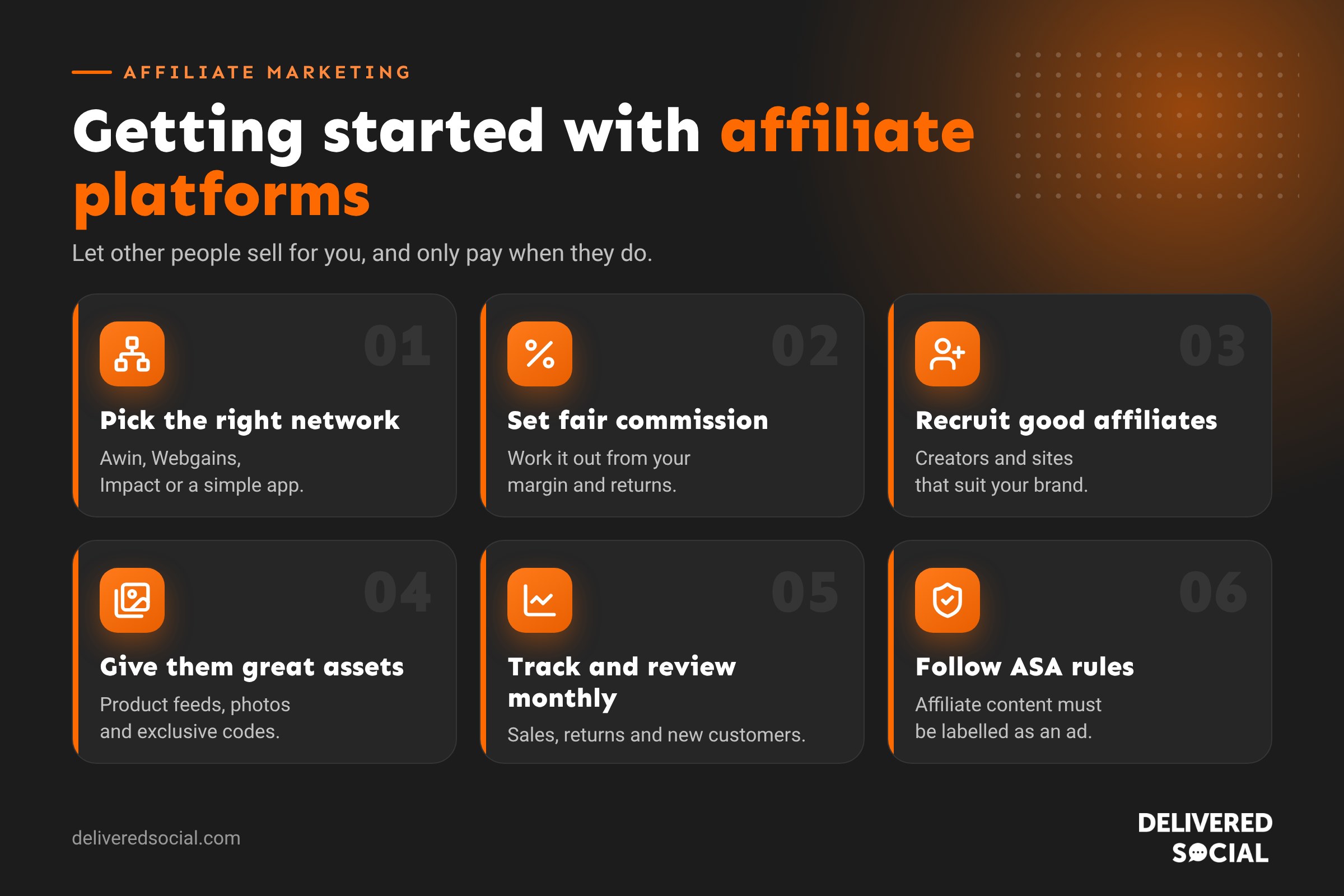
- Check your numbers: margin, average order value and return rate decide what commission you can afford.
- Choose a platform that suits your size and where your customers are.
- Set your terms: commission rates, cookie length, brand-bidding rules and which affiliate types you accept.
- Prepare assets: a product feed, images, banners and exclusive codes.
- Recruit affiliates who suit your brand, rather than accepting everyone.
- Track and review monthly: sales, return rates and which affiliates bring new customers.
UK rules for affiliate marketing
- Affiliate content is advertising. Under the CAP Code, enforced by the Advertising Standards Authority (ASA), affiliates must make it clear when content includes affiliate links, for example by labelling it “Ad” or “#ad”.
- Brands are responsible too. The ASA and the Competition and Markets Authority expect brands to make sure affiliates follow the rules.
- Claims must be accurate. Affiliates can’t make claims about your product that you couldn’t make yourself.
- Cookies need consent. Affiliate tracking cookies fall under PECR, so your cookie banner should cover them.
Is affiliate marketing right for your business?
It works best for businesses that sell online, have healthy margins and products that people research or compare. It’s less suited to local services, very low-margin products or businesses that can’t track online sales. If you’re unsure, start small with a handful of hand-picked affiliates or creators before joining a large network.
Frequently asked questions
What is the best affiliate platform in the UK?
For most UK retailers, Awin and Webgains are the usual starting points. Larger brands often use Rakuten, CJ, Impact or Partnerize. The best choice depends on your size, budget and products.
How much commission should I offer affiliates?
Look at what competitors offer and what your margin allows. Many retailers offer 5% to 15%, while digital products often pay more.
Do affiliates have to say they’re paid?
Yes. UK advertising rules require affiliate content to be clearly labelled as advertising.
Can small businesses use affiliate marketing?
Yes. Self-serve network plans and simple affiliate apps make it affordable to start with a small programme.
Want help growing online sales?
We help small businesses across Surrey, Hampshire and the UK grow with SEO, paid ads, social media and creator partnerships. See our SEO services or call us on 01483 608 303 for a friendly chat.