



Keep reading
Rather we just did it for you?
Let's get your business seen.
Social media, websites, SEO and ads from a team you can actually meet.
Backlinks remain one of the strongest signals Google uses to judge which websites to trust. Earning them takes time, so it is no surprise that many businesses ask whether they can simply buy them. Search for “buy backlinks” and you will find thousands of sellers offering links for a few pounds each. But is buying backlinks a good idea, is it against Google’s rules, and what are the safer ways to build links that actually help your rankings? This guide gives you an honest answer.
What is a backlink?
A backlink is a link from another website to yours. Google treats relevant links from trusted websites as a sign that your content is useful. A link from a respected industry site or local newspaper carries far more weight than one from a random directory. Our guide to building backlinks covers the basics.
What Google says about buying links
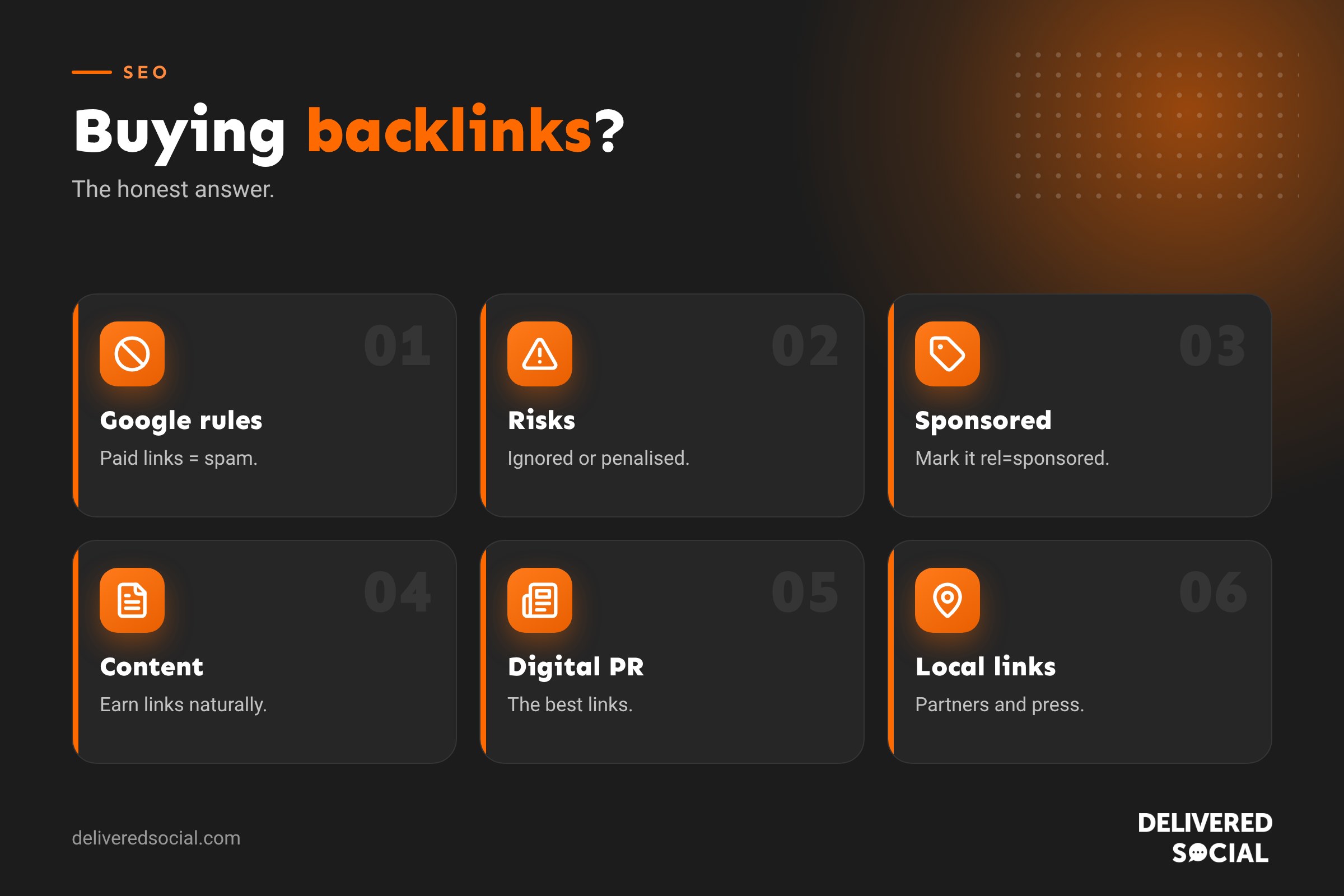
Google’s spam policies say that buying or selling links intended to manipulate search rankings is a link spam violation. That includes paying money for links that pass ranking value, exchanging goods or services for links, and excessive link swaps. Google expects paid or sponsored links to be marked with a rel="sponsored" or rel="nofollow" attribute, which tells it not to pass ranking credit.
In other words, paying for a link is not illegal or automatically wrong. Paying for a link specifically to boost rankings, without marking it as sponsored, breaks Google’s guidelines.
What can happen if you buy links
- Nothing useful. Google is very good at ignoring obvious paid links, so you may simply waste your money.
- Algorithmic devaluation. Google’s systems can discount links from known link selling sites, and sometimes the whole site’s link profile.
- Manual action. In more serious cases, Google can apply a manual penalty, which you will see in Search Console, causing rankings to fall sharply.
- Reputation damage. Links from spammy, irrelevant or adult sites look poor to customers and partners who find them.
Recovering from a link penalty can take months of clean up work. Our guide to cleaning backlink profiles explains what is involved.
Why cheap links are a bad deal
Cheap link packages usually come from private blog networks, hacked sites, link farms or websites that exist only to sell links. They have little real traffic, publish anything for money and link out to hundreds of unrelated businesses. These are exactly the patterns Google’s systems are built to spot. Even if they seem to work for a few weeks, they rarely last.
Sponsored content done properly
There is a legitimate place for paid content. Sponsored articles, advertorials and paid placements on relevant websites can bring real readers, brand awareness and referral traffic. The key is to treat them as advertising and mark the links appropriately. Ask yourself:
- Would this placement be worth paying for even if the link passed no SEO value?
- Is the website genuinely relevant to my customers?
- Does it have real readers and traffic?
- Is the content useful, well written and clearly labelled where required?
If the answer is yes, sponsored content can be a sensible part of your marketing mix.
How to judge the quality of a link
Whether a link is earned or part of a sponsored placement, check:
- Relevance: is the site about your industry, location or audience?
- Real traffic: does the site get genuine visitors from search?
- Editorial standards: does it publish useful content, or anything that pays?
- Outbound links: does it link to hundreds of unrelated sites?
- Placement: is the link within helpful content, or stuffed in a footer or list?
- Anchor text: natural wording, not exact match keywords every time.
Our backlink quality scorecard gives 12 checks to run before you build any link.
Safer ways to build backlinks
Create content worth linking to
Original research, local data, free tools, templates, detailed guides and strong opinions attract links naturally, especially when you promote them.
Digital PR
Pitch stories, data and expert comments to journalists and publications. Coverage in news and trade media brings some of the most valuable links there are. Our digital PR team does this for clients.
Local links
Local newspapers, business groups, chambers of commerce, charities you support, events you sponsor and suppliers you work with are all natural link sources for local businesses.
Guest contributions
Writing genuinely useful articles for relevant industry websites can build authority and links, provided the focus is on value for readers rather than just the link.
Directories and citations
Reputable business directories and industry listings help local SEO. Our list of UK citation sites is a good place to start.
Reclaim unlinked mentions
Find articles that mention your business without linking to you and politely ask for a link.
Partnerships
Testimonials for suppliers, case studies with clients and joint content with partners often come with links.
How many links do you need?
There is no magic number. It depends on your competition. A local business in a small town may rank well with a handful of strong local links, while a national ecommerce site in a competitive market needs far more. Quality and relevance matter much more than volume. Our guide to how many links a new website needs looks at this in more detail.
Signs your link building has gone wrong
If you, or a previous agency, have bought links in the past, watch for these warning signs:
- A sudden drop in rankings or traffic that lines up with a Google spam update.
- A manual action message in Google Search Console.
- Large numbers of links from foreign language, adult or gambling sites with no connection to your business.
- Lots of links using the exact same keyword as anchor text.
- Links from sites that list hundreds of unrelated businesses on a single page.
If you spot these, do not panic. Review your link profile, remove what you can, disavow the worst offenders if there is a manual action and focus your effort on earning better links going forward.
What about buying links from link building agencies?
Some agencies describe paid placements as “outreach” or “guest posts”. Before hiring anyone, ask exactly where links will come from, whether you can see the sites in advance, whether the sites have real traffic and how links will be labelled. Be wary of anyone promising a set number of high authority links for a low monthly fee. Good link building is closer to PR than to shopping.
A simple monthly link building routine
For most small businesses, a steady routine beats one big push. Each month, aim to publish one genuinely useful piece of content, such as a guide, local data or a how to article, and share it with people who might reference it. Reach out to two or three local organisations, suppliers or partners about features, case studies or sponsorships. Check for new unlinked mentions of your business and ask for links. Respond to journalist requests for expert comment in your field. Keep a simple spreadsheet of who you contacted and what happened. Over a year, this steady effort builds a strong, natural link profile that keeps helping your rankings, without the risks of buying links.
Key takeaways
- Buying links to manipulate rankings breaks Google’s spam policies.
- Cheap link packages are usually ignored or risky.
- Sponsored content is fine when it is worth it as advertising and links are marked as sponsored.
- Judge links on relevance, real traffic and editorial standards.
- Content, PR, local links and partnerships are safer and longer lasting.
Frequently asked questions
Is it illegal to buy backlinks?
No, but buying links that pass ranking value breaks Google’s spam policies and can harm your rankings.
Can Google tell if a link is paid?
Often, yes. Google’s systems recognise patterns from link selling sites and networks.
What is a sponsored link?
A paid link marked with rel=”sponsored” so search engines know not to pass ranking credit.
Are guest posts paid links?
If you pay for a guest post with a link, it is a paid placement and the link should be marked as sponsored.
What is the safest way to get backlinks?
Create genuinely useful content, earn press coverage and build relationships with relevant local and industry sites.
How long does link building take to work?
Usually several months, as new links are discovered and trust builds over time.
Should I disavow bad links?
Only if you have a manual action or a clear pattern of paid or spammy links. Google ignores most low quality links on its own.
Are directory links paid links?
Reputable business directories are fine, even with a listing fee, as long as they are genuine directories used by real people.
Do social media links count as backlinks?
Most social links are nofollow and carry little direct ranking value, but sharing content on social media helps it get seen by people who may link to it.
Want help building links the right way?
Our SEO and digital PR team helps businesses across Surrey, Hampshire and the UK earn links that last. Find out more about our SEO services. Call us on 01483 608 303.
































