



Keep reading
Rather we just did it for you?
Let's get your business seen.
Social media, websites, SEO and ads from a team you can actually meet.
“How much will SEO for our online shop cost?” is one of the first questions ecommerce owners ask, and the answers they find online range from a few hundred pounds to many thousands a month. That makes it hard to know what is fair, what you actually get and whether it will pay for itself. This guide explains typical ecommerce SEO cost in the UK, what affects the price, the different ways agencies and freelancers charge, and how to work out whether the investment makes sense for your shop.
Why ecommerce SEO costs more than local SEO
SEO for an online shop is usually more involved than SEO for a local service business. A plumber’s website might have twenty pages. An online shop can have hundreds or thousands of product and category pages, each needing good titles, descriptions, internal links and technical health. Ecommerce sites also face specific issues such as duplicate content from product variants, faceted navigation that creates endless URLs, out of stock products and complex site structures. Competition is national rather than local, often against large retailers and marketplaces. All of that takes more time, which is reflected in the price.
Typical ecommerce SEO prices in the UK
Every provider prices differently, but these ranges give a realistic picture of the UK market:
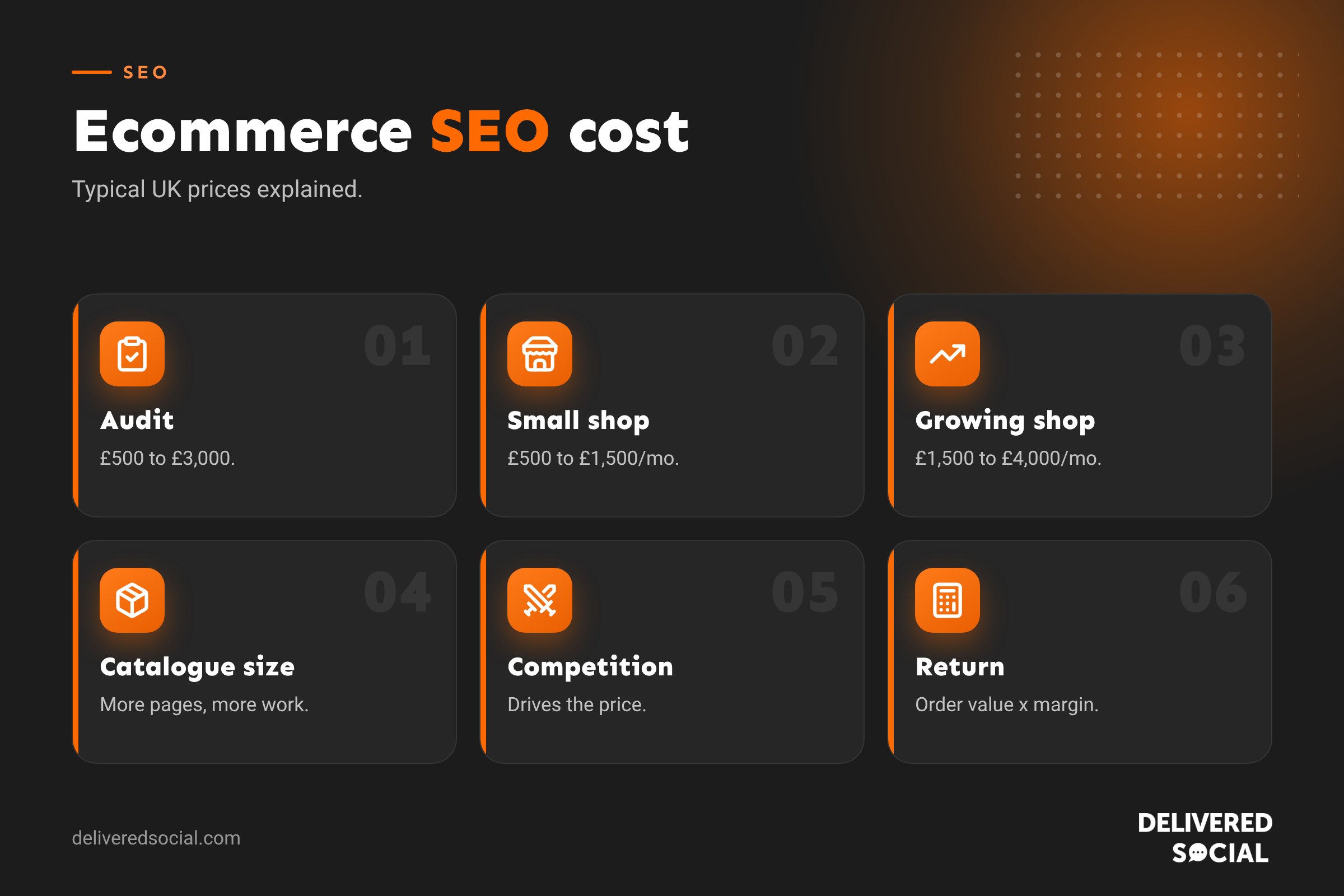
- One off SEO audit: roughly £500 to £3,000 depending on the size of the shop and the depth of the audit.
- Small shop monthly SEO (up to a few hundred products, modest competition): roughly £500 to £1,500 a month.
- Growing shop monthly SEO (hundreds to a few thousand products, competitive markets): roughly £1,500 to £4,000 a month.
- Large or highly competitive ecommerce SEO: £4,000 a month and upwards.
- Freelancers: often charge £30 to £100 an hour, or lower monthly fees for a narrower scope.
- Project work such as a migration, replatform or category restructure: often £1,000 to £10,000 depending on scale.
Be cautious of very cheap packages. If someone offers to rank your shop for £99 a month, it is worth asking exactly what they will do. Low quality link building and automated content can do more harm than good.
What affects the cost
Size of the catalogue
More products and categories mean more pages to optimise, more technical issues to fix and more content to write. A shop with 50 products needs far less work than one with 5,000.
Competition
Selling a niche product with little competition costs less to rank than selling trainers, mattresses or skincare against national brands with big budgets.
Current state of the site
A shop with slow pages, broken links, duplicate content and thin descriptions needs a lot of groundwork before growth work can begin. A well built site can move straight to content and authority building.
Platform
WooCommerce, Shopify, Magento and other platforms each have their own SEO strengths and limits. Some issues take minutes to fix on one platform and require developer time on another.
Scope of work
Does the price include content writing, product description rewrites, digital PR and link building, technical fixes carried out directly, or only recommendations? These differences explain much of the variation between quotes.
Speed of results wanted
If you want to grow quickly, more work each month costs more. A steady approach can be more affordable but takes longer.
What should be included?
A good ecommerce SEO service usually covers these areas, though the balance changes depending on your shop:
- Technical SEO: crawling, indexing, site speed, mobile usability, structured data, canonical tags, faceted navigation and redirects.
- Keyword research: finding the searches that match your categories and products, including buying intent and long tail terms. See our guide to ecommerce SEO keyword research.
- Category page optimisation: often the biggest opportunity, with helpful introductions, FAQs and strong internal links.
- Product page optimisation: unique descriptions, titles, images and schema for priority products.
- Content: buying guides, comparisons and how to articles that attract searches and support categories.
- Authority building: earning links and mentions from relevant, respected websites.
- Reporting: clear monthly reports linking work done to traffic, rankings and revenue.
- AI search visibility: increasingly, making sure products appear in AI answers. Our GEO for ecommerce guide explains how.
Pricing models explained
- Monthly retainer: the most common model. You pay a fixed fee each month for an agreed amount of work. Good for steady, ongoing growth.
- Project fee: a fixed price for a defined piece of work such as an audit, migration or content project.
- Hourly or day rate: common with freelancers and consultants, useful for advice or one off fixes.
- Performance based: fees linked to results such as revenue growth. These can sound attractive, but read the terms carefully, as results can be hard to attribute fairly.
Is ecommerce SEO worth the cost?
The best way to decide is to do some simple maths. Work out:
- Your average order value.
- Your conversion rate from organic traffic.
- Your gross margin.
- How many extra visitors SEO could realistically bring over twelve months.
For example, if your average order is £60, your margin is 50% and organic visitors convert at 2%, each 1,000 extra visitors could bring around 20 orders, £1,200 in revenue and £600 in gross profit. If SEO costs £1,000 a month, you would need several thousand extra organic visitors a month to break even on direct sales alone, before counting repeat purchases and the lasting value of rankings. For many shops that is very achievable within a year; for others, a smaller budget or a more focused scope makes more sense.
Remember that SEO compounds. Unlike paid ads, traffic does not stop the day you stop paying. Rankings and content built this year keep working for years if they are maintained.
How long before you see results?
Technical fixes and quick wins can improve traffic within weeks. Meaningful growth usually takes three to six months, and competitive categories can take a year or more. Be wary of anyone promising first place rankings quickly. A good provider will set realistic expectations and show early progress through improving impressions, rankings and traffic.
How to keep costs down
- Fix obvious issues yourself, such as missing titles or copied product descriptions, using our ecommerce SEO checklist.
- Focus SEO budget on your most profitable categories rather than the whole catalogue.
- Write product descriptions in house with guidance from your SEO provider.
- Combine SEO with email marketing so new visitors become repeat customers.
- Avoid common errors that waste budget. Our guide to ecommerce SEO mistakes covers the big ones.
Questions to ask before you hire
- What exactly will you do each month?
- Will you make changes on the site, or only recommend them?
- How do you build links and authority?
- Which ecommerce platforms have you worked with?
- How will you report on revenue as well as rankings?
- What is the minimum contract length and notice period?
- Can you show examples of ecommerce results?
Red flags to watch for
- Guaranteed number one rankings.
- Vague monthly reports with no detail of work done.
- Large numbers of cheap links from unrelated websites.
- Mass produced content with little value for shoppers.
- Long lock in contracts before any results are shown.
In house, freelancer or agency?
Hiring an in house SEO specialist gives you dedicated time but means a full salary plus tools, usually only worthwhile for larger shops. A freelancer can be cost effective for a defined scope, though capacity and range of skills may be limited. An agency brings a team covering technical work, content and outreach, which suits shops that need all three. Some businesses combine approaches, with an in house marketer supported by an agency for technical and authority work.
Key takeaways
- UK ecommerce SEO typically costs from around £500 a month for small shops to several thousand for large or competitive ones.
- Catalogue size, competition, site condition and scope drive the price.
- Category pages, technical health and content usually bring the biggest gains.
- Do the maths on order value and margin to judge return on investment.
- Choose transparency and realistic expectations over guarantees.
Frequently asked questions
How much does ecommerce SEO cost per month in the UK?
Typically between £500 and £4,000 a month, depending on the size of the shop, the competition and the scope of work.
Is SEO cheaper than Google Ads for ecommerce?
Over the long term, often yes, because organic traffic does not cost per click. Ads deliver faster results, so many shops use both.
How long does ecommerce SEO take to work?
Usually three to six months for clear progress, longer in very competitive markets.
Can I do ecommerce SEO myself?
You can handle the basics, such as product descriptions and titles. Technical work, content strategy and link building usually benefit from specialist help.
What is the most important part of ecommerce SEO?
For most shops, well optimised category pages and a technically healthy site bring the biggest gains.
Should I pay for an SEO audit first?
An audit is a sensible first step, as it shows what needs fixing and helps you budget accurately.
Want a clear quote for your shop?
We provide ecommerce SEO for online shops across Surrey, Hampshire and the UK, with transparent monthly plans. Find out more about our ecommerce SEO services. Call us on 01483 608 303.
































