

Keep reading
Rather we just did it for you?
Let's get your business seen.
Social media, websites, SEO and ads from a team you can actually meet.
Every time someone types a question into Google, they’re using keywords. For a business, understanding those words is the difference between a website that quietly brings in customers and one nobody finds. This guide explains what keywords are in plain English, the different types, why they matter for SEO and content marketing, how to find the right ones for your business and how to use them on your website, blog and social media without sounding robotic.
What are keywords?
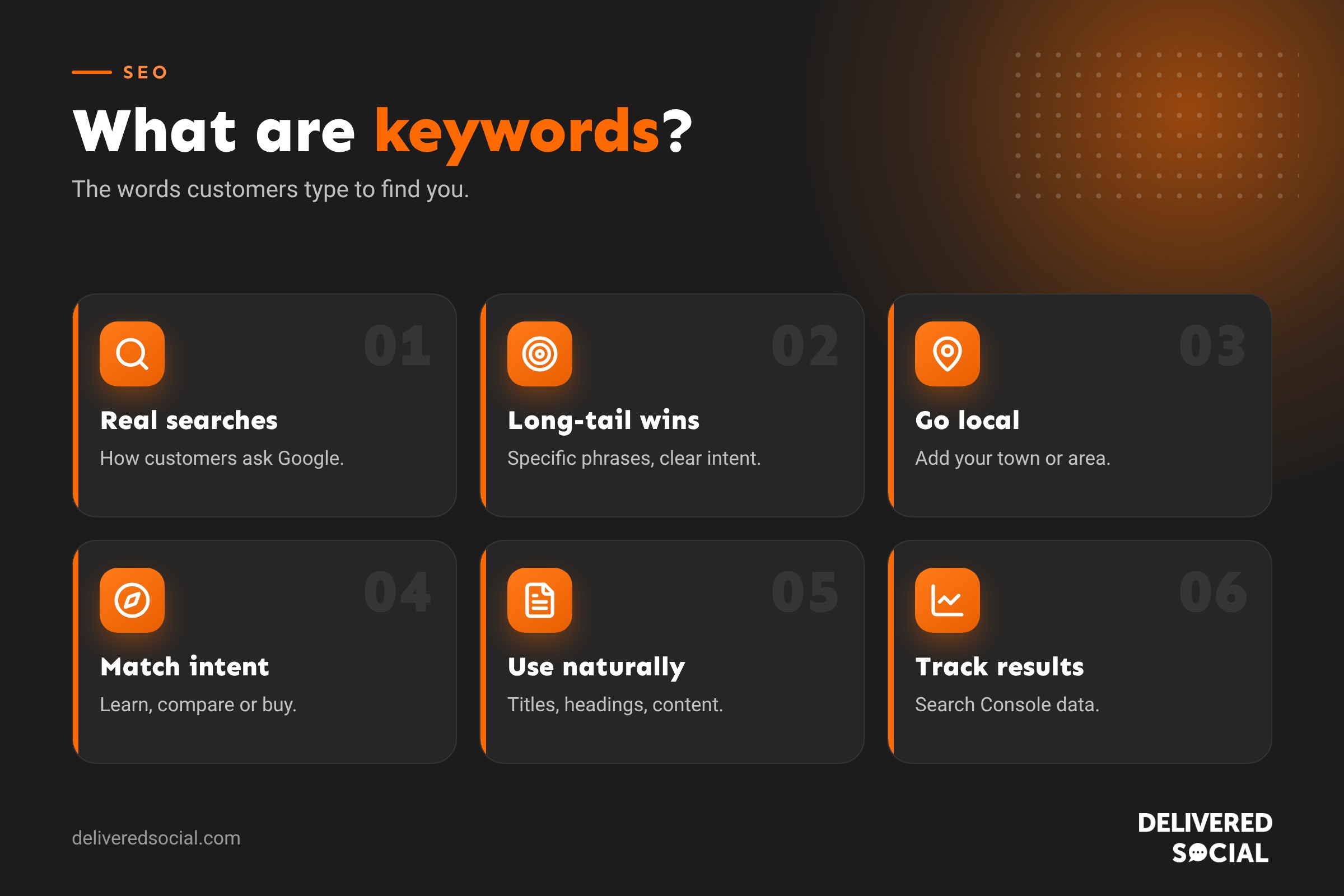
Keywords are the words and phrases people type or speak into search engines when they’re looking for something. “Plumber near me”, “how to clean a suede sofa” and “best wedding venues in Surrey” are all keywords.
In SEO and content marketing, keywords are the bridge between what people search for and the content you create. If your pages use the same language your customers use, search engines can match you with them.
Why keywords are important
- They help Google understand your pages. Clear keywords show what a page is about and who it’s for.
- They reveal what customers want. Search data shows the real questions and problems people have.
- They guide your content plan. Instead of guessing what to write, you answer questions people are already asking.
- They bring the right visitors. Targeting specific phrases attracts people who are more likely to buy, book or enquire.
- They work across channels. The same keywords help on Google, YouTube, TikTok, Pinterest and Instagram search.
Types of keywords
| Type | What it means | Example |
|---|---|---|
| Short-tail | One or two broad words with high volume and heavy competition | keywords, shoes, marketing |
| Long-tail | Longer, more specific phrases with lower volume but clearer intent | waterproof walking boots for wide feet |
| Local | Searches that include a place or “near me” | accountant in Portsmouth |
| Question | Searches phrased as a question | how do I get more Google reviews |
| Branded | Searches that include a brand name | Delivered Social reviews |
| Commercial | Searches comparing options before buying | best CRM for small business |
| Transactional | Searches from people ready to act | book boiler service Guildford |
Understanding search intent
Search intent is the reason behind a search. Getting it right matters as much as the words themselves.
- Informational: they want to learn something. “What are keywords” needs a clear explainer like this one.
- Navigational: they want a specific site. “Instagram login” needs Instagram, not a blog post.
- Commercial: they’re researching options. “Best social media agency Surrey” suits comparison or service pages.
- Transactional: they want to buy or book. “Order birthday cake Woking” needs a product or booking page.
A quick way to check intent is to search the keyword yourself and look at what ranks. If the top results are all guides, a sales page will struggle, and vice versa.
Short-tail vs long-tail keywords
Small businesses usually do best with long-tail keywords. A word like “flowers” is searched constantly, but you’d be competing with national brands, and many of those searchers aren’t ready to buy. A phrase like “same day flower delivery in Farnham” has far fewer searches, but the people searching it know exactly what they want, and there’s less competition. Together, lots of long-tail keywords can bring in more customers than one big keyword ever would.
How to find keywords for your business
- Brainstorm with your customers in mind. List your services, products and the problems you solve, in the words customers use rather than industry jargon.
- Use Google itself. Type a phrase and look at autocomplete suggestions, the “People also ask” box and related searches at the bottom of the page.
- Check Google Search Console. It shows the searches your site already appears for, including ones you didn’t expect.
- Use keyword tools. Free and paid tools show search volume, difficulty and related ideas. See our list of keyword research tools.
- Listen to customers. Questions from phone calls, emails, reviews and social comments are excellent keyword ideas.
- Look at competitors. See which topics and phrases their best pages target.
Our step-by-step guide to keyword research for small businesses goes deeper into this process.
How to choose the right keywords
| Factor | What to look for |
|---|---|
| Relevance | Does it match what you actually offer? |
| Intent | Is the searcher likely to become a customer, or learn something you can help with? |
| Volume | Enough people search for it to make it worthwhile |
| Difficulty | Realistic competition for your site’s strength |
| Location | Does it fit the area you serve? |
Relevance always comes first. A high-volume keyword that doesn’t match your business brings visitors who leave straight away.
Where to use keywords on your website
- Page title (meta title), ideally near the start.
- Main heading (H1) on the page.
- Subheadings where they fit naturally.
- The first paragraph, so readers and search engines know the topic straight away.
- Body text, along with related words and phrases.
- URL, kept short and readable.
- Image alt text, describing images accurately.
- Meta description, to encourage clicks.
- Internal links, using descriptive link text.
Keywords in content marketing
Keywords aren’t just for service pages. In content marketing, they help you plan blogs, guides, videos and social posts that answer real questions. A good approach is to build topic clusters: one main guide on a broad subject, supported by several shorter articles on related long-tail keywords, all linking together. This shows search engines you know a subject well and gives readers an easy path to more help.
For example, a garden designer might write a main guide on “small garden design ideas”, supported by posts on “low maintenance garden ideas”, “small garden seating ideas” and “how much does garden design cost in Hampshire”.
Keywords on social media
Social platforms are search engines too. People search TikTok for recipes, Instagram for local businesses and YouTube for tutorials. Use keywords in:
- Profile names and bios.
- Captions, especially the first line.
- On-screen text and spoken words in videos, which platforms can read and transcribe.
- Video titles and descriptions on YouTube.
- Pin titles and descriptions on Pinterest.
Keyword stuffing: what not to do
Keyword stuffing means cramming the same phrase in again and again, like “Our Guildford plumber is the best Guildford plumber for plumbing in Guildford”. It reads badly, puts visitors off and can harm your rankings. Modern search engines understand synonyms and related phrases, so write naturally, use your main keyword where it fits and support it with related words.
How to track keyword performance
- Google Search Console: impressions, clicks and average position for each search term.
- Google Analytics: what visitors do once they arrive.
- Rank tracking tools: regular position checks for your chosen keywords.
- Enquiries and sales: the measure that matters most.
SEO takes time. Expect to see movement over a few months rather than days, and keep improving pages that are close to page one.
Mapping keywords to pages
Give each important keyword a home: one main page per main topic. If several pages target the same phrase, they compete with each other and none ranks as well as it could. A simple spreadsheet listing each page and its main and supporting keywords keeps things clear. Our guide to keyword mapping explains how.
Keywords and AI search
AI tools and AI answers in search are changing how people look for information, often with longer, conversational questions. The fundamentals still apply: understand the questions your customers ask, answer them clearly and thoroughly, and structure your content with helpful headings, lists and FAQs. Clear, well-organised content written around real questions is more likely to be used and cited.
A simple keyword plan for small businesses
- List your five most important services or products.
- Find two or three keywords for each, including a local version.
- Check each service has its own page optimised for those keywords.
- Collect ten common customer questions and plan a blog or video for each.
- Review Search Console every month and refresh pages that are slipping.
Quick glossary
- Search volume: how many times a keyword is searched each month.
- Keyword difficulty: an estimate of how hard it is to rank.
- Long-tail keyword: a longer, more specific phrase.
- Search intent: the purpose behind a search.
- Keyword cannibalisation: when several of your pages compete for the same keyword.
Key takeaways
- Keywords are the words people use to search, and they connect your content with customers.
- Long-tail and local keywords usually suit small businesses best.
- Match your content to the intent behind each search.
- Use keywords naturally in titles, headings and content, never stuffed.
- Track results in Search Console and keep improving.
Frequently asked questions
What are keywords in simple terms?
The words and phrases people type into search engines to find information, products or services.
Why are keywords important in marketing?
They show what customers are looking for and help your content appear when they search.
How many keywords should a page target?
One main keyword plus a handful of closely related phrases is a good rule.
Are keywords still important for SEO?
Yes, though search engines now understand meaning and context, so natural language matters more than exact repetition.
What is a long-tail keyword?
A longer, specific search phrase with lower volume but clearer intent, such as “vegan birthday cake delivery Woking”.
Want help choosing the right keywords?
We research keywords and create SEO content for businesses across Surrey, Hampshire and the UK. Read our guide to SEO, see our digital marketing services or call us on 01483 608 303.