



Keep reading
Rather we just did it for you?
Let's get your business seen.
Social media, websites, SEO and ads from a team you can actually meet.
Shoppers no longer just type a product into Google and click the first link. More and more of them ask ChatGPT, Google’s AI Overviews, Perplexity or Copilot questions like “what is the best waterproof walking boot for wide feet?” or “which UK coffee subscription is best for beginners?” The AI gives a short answer, often naming a few brands and products. If your shop is not one of them, you are invisible at the exact moment someone is ready to buy. That is what GEO for ecommerce is about: making your products and your brand easy for AI tools to find, understand, trust and recommend.
What is GEO for ecommerce?
GEO stands for generative engine optimisation. It is the practice of shaping your website and your wider online presence so that AI answer engines include you in their responses. For an online shop, that means getting your products, categories and brand mentioned when people ask AI tools for recommendations, comparisons and buying advice.
GEO is not a replacement for SEO. Most AI tools still lean heavily on search results and on well structured, trustworthy web pages. A shop with strong ecommerce SEO already has a head start. GEO builds on that foundation by focusing on the things AI systems look for when they summarise and recommend: clear facts, consistent product data, genuine reviews, helpful comparisons and a brand that other trusted sites talk about.
Why GEO matters for online shops
Ecommerce is one of the areas where AI search is changing behaviour fastest. A few reasons it deserves your attention now:
- AI answers shorten the journey. Instead of opening ten tabs, a shopper reads one AI summary and clicks one or two of the products it names.
- Recommendations are a shortlist. AI tools tend to name three to five options. Being on that shortlist matters far more than being tenth on a results page.
- Shopping features are growing. Google, ChatGPT and other tools increasingly show product cards, prices and merchant links within the answer.
- Smaller brands can compete. AI tools reward clear, specific and well reviewed products, not only the biggest advertisers. A niche shop with excellent product information can beat a giant on specific questions.
How AI tools choose which products to recommend
No AI company publishes a full recipe, but the signals that matter are fairly consistent across tools:
- Relevance: does the product clearly match the need in the question, such as “wide fit”, “vegan”, “under £50” or “for small dogs”?
- Clarity of information: can the AI easily read the product name, price, specifications, sizes, materials and availability?
- Trust and reputation: do reviews, ratings, press coverage and independent sites support the product and the brand?
- Consistency: is the same information shown on your site, your Google Merchant Center feed, marketplaces and other listings?
- Freshness: is the information current, with up to date prices, stock and recent reviews?
Your job is to make each of these signals as strong and as easy to read as possible.
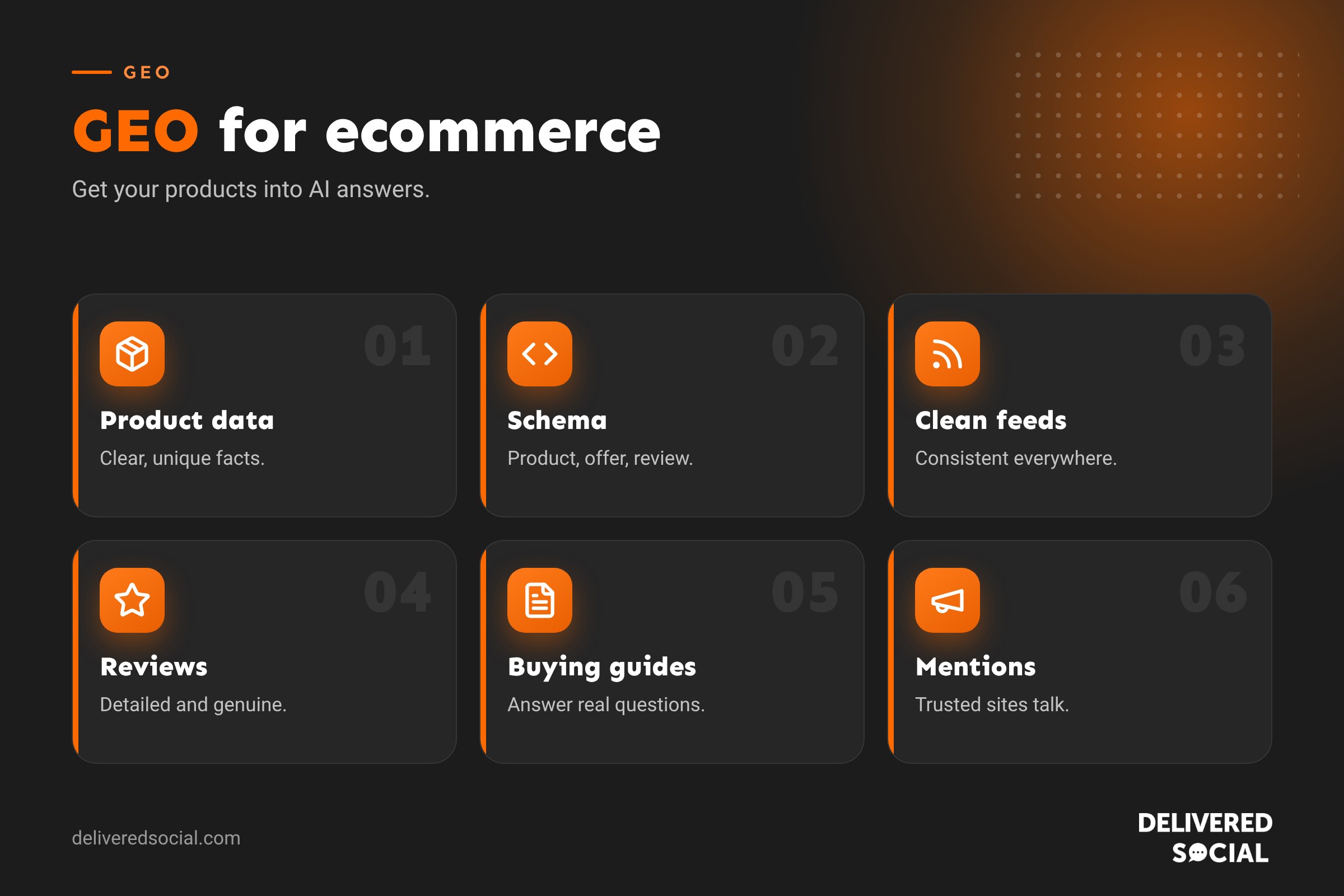
Step 1: get your product data in order
AI tools cannot recommend what they cannot understand. Start with the basics on every product page:
- A clear, descriptive product name that includes the key attributes people search for.
- A unique description written for humans, explaining who the product is for, what problem it solves and how it compares with alternatives.
- Full specifications: dimensions, weight, materials, compatibility, care instructions and anything else a buyer would ask.
- Accurate price, stock status and delivery information.
- Good quality images with descriptive alt text.
Avoid copying manufacturer descriptions word for word. Hundreds of shops use the same text, which gives an AI no reason to choose you. Add your own expertise: how it fits, what customers say, what it pairs well with.
Step 2: add structured data
Structured data (schema markup) labels the key facts on your pages in a format machines can read reliably. For ecommerce, the most useful types are:
- Product with name, image, description, brand, SKU and GTIN where you have them.
- Offer with price, currency, availability and shipping details.
- AggregateRating and Review for genuine customer reviews.
- Organization with your logo, contact details and social profiles.
- FAQPage for genuine question and answer content on category and guide pages.
- BreadcrumbList to show how your categories fit together.
Most platforms, including WooCommerce and Shopify, add some of this automatically. It is worth checking it with Google’s Rich Results Test, because gaps such as missing prices, brands or availability are common.
Step 3: keep your product feed clean
Google Merchant Center feeds power Google Shopping, free product listings and increasingly the product information shown in AI answers. Keep your feed complete and accurate, with matching prices and availability on your site. Fix disapproved products quickly. If you sell on marketplaces such as Amazon, eBay or Etsy, keep the core facts consistent there too. Conflicting information is one of the quickest ways to lose an AI’s confidence.
Step 4: build trust with reviews
Reviews are one of the strongest signals for both shoppers and AI tools. They give an AI real language about what a product is good for, which it can quote or summarise. To build them:
- Ask every customer for a review by email a few days after delivery.
- Use a recognised review platform such as Trustpilot, Feefo, Reviews.io or Google Customer Reviews alongside on-site product reviews.
- Reply to reviews, especially critical ones, politely and helpfully.
- Encourage detail. A review that says “great for wide feet, no rubbing on a 10 mile walk” is far more useful than “love it”.
Step 5: create content that answers buying questions
AI tools love content that directly answers the questions shoppers ask. Product pages alone rarely do this. Add supporting content such as:
- Buying guides: “How to choose a walking boot”, “What size dog bed do I need?”
- Comparisons: “Merino vs synthetic base layers”, “Our two best selling coffee grinders compared”.
- Best for lists: “Best gifts for new gardeners under £30”, using your own products honestly alongside clear criteria.
- How to and care guides: “How to clean leather boots”, “How to brew pour over coffee”.
- Detailed FAQs on category pages covering sizing, delivery, returns, materials and suitability.
Use clear headings, short answers near the top of each section and plain language. Our guide to generative engine optimisation strategies covers how to structure pages so AI tools can lift the answer easily.
Step 6: get your brand talked about elsewhere
AI tools pay a lot of attention to what other sites say about you. Being mentioned in a respected gift guide, a niche blog, a Reddit thread or a local news story can matter as much as anything on your own site. Ways to build those mentions:
- Send samples to relevant bloggers, reviewers and journalists.
- Pitch your products for seasonal gift guides well in advance.
- Take part genuinely in communities where your customers spend time.
- Work with relevant influencers and creators who will review honestly.
- Share your story: founders, sustainability, local manufacturing and expertise all make good stories.
Step 7: make your site fast and easy to crawl
AI crawlers and search engine bots need to access your pages. Check that your robots.txt file does not block important AI and search crawlers you want to be seen by, that product pages are not hidden behind heavy scripts, and that your site loads quickly on mobile. Clean category structures, internal links between related products and guides, and an up to date XML sitemap all help. Our ecommerce SEO checklist covers the technical basics.
How to track your AI visibility
Measuring GEO is less precise than tracking rankings, but you can still see progress:
- Test the questions yourself. Each month, ask ChatGPT, Gemini, Perplexity and Copilot ten to twenty buying questions your customers ask. Note whether you are mentioned, where, and what is said.
- Check referral traffic. In Google Analytics 4, look for visits from chatgpt.com, perplexity.ai, copilot.microsoft.com and similar sources.
- Watch Search Console. Impressions for longer, question style searches often rise as AI Overviews start to cite you.
- Ask customers. Add “AI assistant such as ChatGPT” as an option on your “How did you hear about us?” question.
- Use AI visibility tools. A growing number of tools track brand mentions across AI answers if you want regular reporting.
A simple 90 day GEO plan for online shops
If you are not sure where to begin, this order works well for most small and medium online shops:
- Weeks 1 to 2: run a baseline test of twenty buying questions across the main AI tools and record the results. Audit your top twenty products for missing data, weak descriptions and schema gaps.
- Weeks 3 to 6: rewrite descriptions for your best sellers, fix structured data, clean up your Merchant Center feed and set up an automated review request email.
- Weeks 7 to 10: publish two or three buying guides or comparisons that target the questions you were not appearing for, and add FAQs to your main categories.
- Weeks 11 to 13: start outreach for mentions in gift guides, niche blogs and communities, then repeat your twenty question test and compare.
Keep a simple spreadsheet of each question, which tools mention you and which competitors appear. Over time it becomes a clear picture of where you are winning and where you need more work.
How GEO and SEO work together
Almost everything that helps GEO also helps traditional SEO, and the other way round. Clear product data improves click through rates. Reviews improve conversion. Buying guides attract links and rankings. The main difference is focus: SEO is about ranking pages, while GEO is about being quoted, summarised and recommended. A good ecommerce marketing plan does both. If you are building a wider plan, our ecommerce marketing strategy guide shows where GEO fits alongside ads, email and social.
How much does GEO for ecommerce cost?
Much of the groundwork can be done in house if you have time: rewriting product descriptions, gathering reviews and writing buying guides. Where outside help pays off is the technical side (schema, feeds, crawlability), content at scale and outreach. Costs vary with the size of your catalogue, but our guide to AI SEO cost gives typical UK prices for audits and monthly work.
Key takeaways
- GEO for ecommerce means getting your products recommended inside AI answers.
- Clear, unique product information and structured data are the foundation.
- Consistent feeds, genuine reviews and helpful buying content build trust.
- Mentions on other respected sites carry a lot of weight with AI tools.
- Track progress by testing real buying questions every month.
Frequently asked questions
What does GEO stand for in ecommerce?
Generative engine optimisation: making your shop and products visible in AI generated answers from tools such as ChatGPT, Gemini, Perplexity and Google AI Overviews.
Is GEO different from SEO?
It overlaps heavily. SEO focuses on rankings in search results, while GEO focuses on being cited and recommended by AI tools. Strong SEO is the best starting point for GEO.
Can small online shops compete in AI answers?
Yes. AI tools often favour the clearest, most specific and best reviewed answer to a question, which gives niche shops a real chance.
Does ChatGPT recommend products?
Yes. ChatGPT and other assistants regularly suggest products and brands, and many now show product cards with prices and links to retailers.
How long does GEO take to work?
Expect a few months. Some improvements, such as fixing product data, can show quickly, while reputation and mentions build over time.
How do I know if AI tools mention my shop?
Ask them the questions your customers ask, check your analytics for AI referral traffic and consider an AI visibility tracking tool.
Want your products in AI answers?
We help online shops across Surrey, Hampshire and the UK get found in Google and in AI search, from product data and schema to content and outreach. Find out more about our generative engine optimisation services. Call us on 01483 608 303.
































