



Keep reading
Rather we just did it for you?
Let's get your business seen.
Social media, websites, SEO and ads from a team you can actually meet.
Every day, Google decides which websites appear at the top of its results and which are buried on page five. For a business, that decision can mean the difference between a phone that rings and a website nobody visits. Google does not publish its full formula, but it explains a great deal about how search works, and years of testing show what matters. This guide explains how Google ranks websites in plain English: how it finds pages, how it decides what is relevant and trustworthy, the main ranking factors, and what you can do to rank higher.
Step 1: Crawling
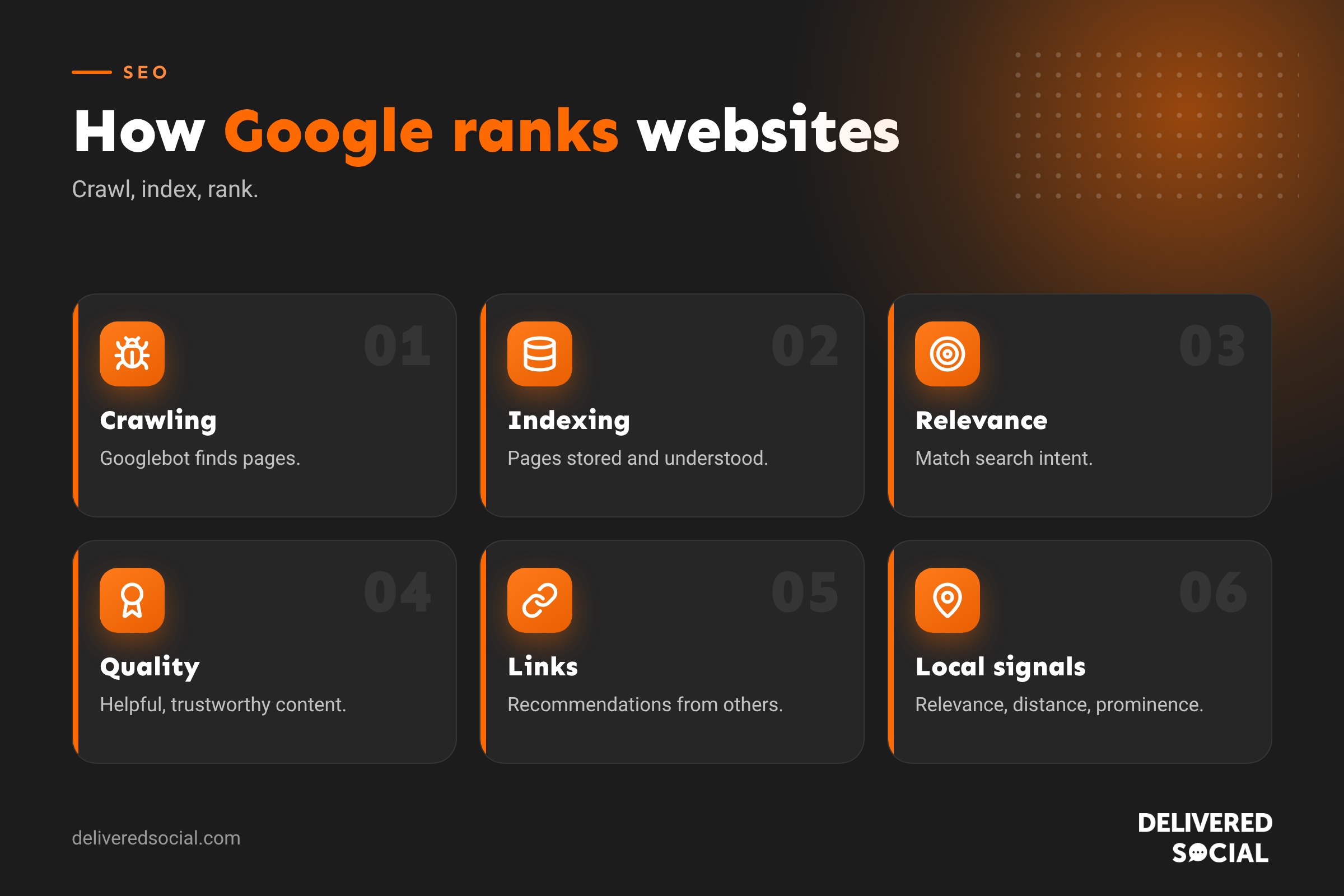
Google uses automated programs, called crawlers or Googlebot, to discover pages on the web. They follow links from page to page and read sitemaps that website owners submit. If Google cannot find or access a page, it cannot rank it. Common blockers include pages hidden behind logins, broken links, robots.txt rules and “noindex” tags.
Step 2: Indexing
After crawling, Google analyses the page’s text, images, video and structure and stores it in its index, a huge database of web pages. Not every crawled page is indexed. Thin, duplicate or low quality pages may be left out. You can check which pages are indexed in Google Search Console. Our guide to what SEO is explains the basics.
Step 3: Ranking
When someone searches, Google looks through its index for the most helpful results and orders them using many signals. Google groups these into a few big areas: the meaning of the query, the relevance of content, the quality of content, the usability of pages and the context of the searcher.
The main ranking factors
1. Relevance to the search
Google works out what the searcher wants, known as search intent, and looks for pages that answer it. Are they looking to learn, compare, buy or find a local business? A page about “emergency plumber Portsmouth” should help someone find and call a plumber quickly, not explain the history of plumbing. Using the words people search for in titles, headings and content helps Google understand relevance. Our guide to long tail keywords explains how to target specific searches.
2. Helpful, high quality content
Google aims to reward content written for people, not search engines. It looks for original information, depth, accuracy and genuine expertise. Its quality guidelines talk about experience, expertise, authoritativeness and trust, often shortened to E E A T. Show who wrote the content, include real examples and keep information up to date.
3. Links and reputation
Links from other reputable websites act like recommendations. Google’s PageRank system was built on this idea, and links remain an important signal. Quality matters far more than quantity, and buying links breaks Google’s rules. Our guide to buying backlinks explains the risks.
4. Page experience
Google prefers pages that load quickly, work well on mobile, are secure (HTTPS) and do not bombard visitors with intrusive pop ups. Core Web Vitals measure loading speed, responsiveness and visual stability.
5. Site structure and technical health
A clear structure, good internal links, tidy URLs and no broken pages help Google crawl and understand your site. Our guide to SEO website architecture covers this in detail.
6. Freshness
For some searches, such as news or “best of” lists, recent content matters. For evergreen topics, accuracy and depth matter more than the date.
7. Location and personal context
Results change based on where the searcher is, their language and their device. Local searches show nearby businesses, which is why local SEO matters for shops and trades.
How Google ranks local businesses
For local searches, Google’s map pack results are based on three main factors: relevance (how well your business matches the search), distance (how close you are) and prominence (how well known and well reviewed you are). A complete Google Business Profile, consistent business details across the web and plenty of genuine reviews all help. Our guide to local SEO ranking factors explains more.
Algorithm updates
Google changes its systems thousands of times a year, with a few big core updates and spam updates that can shift rankings noticeably. Sites with helpful, trustworthy content tend to do well over time; sites relying on shortcuts can drop sharply. Our guide to Google algorithm updates explains what to do if your rankings change.
AI Overviews and AI search
Google now shows AI generated summaries at the top of many results. These draw on pages Google considers helpful and trustworthy, and often link to sources. The same principles apply: clear answers, genuine expertise and a strong reputation increase your chances of being cited. Our guide to getting your business into Google’s AI Overviews covers this.
What does not directly help rankings
- Keyword stuffing: repeating words unnaturally can hurt.
- Meta keywords tag: Google ignores it.
- Paying for Google Ads: ads do not improve organic rankings.
- Word count alone: longer is not automatically better; helpfulness is.
- Social media likes: not a direct ranking factor, though social activity can lead to links and searches.
How to help Google rank your website
- Make sure every important page can be crawled and indexed.
- Submit a sitemap in Google Search Console.
- Create a page for each service and location you want to rank for.
- Write helpful content that answers real customer questions.
- Use clear titles, meta descriptions and headings.
- Improve speed and mobile experience.
- Build genuine links through partnerships, PR and great content.
- Collect reviews and keep your Google Business Profile active.
- Link related pages together.
- Track progress in Search Console and keep improving.
Our guide to improving Google rankings in the UK gives a practical plan.
How long does it take to rank?
New pages can appear within days, but climbing for competitive searches usually takes months. Factors include competition, your site’s existing authority and how much you invest in content and links. Patience and consistency win.
How search intent shapes the results
Look at the first page of Google for any search and you will see Google’s view of what people want. Search “best running shoes” and you see review lists and shops. Search “how to tie running shoes” and you see videos and step by step guides. Search “running shop Guildford” and you see a map and local businesses. Before creating a page, search for your target phrase and study the results. If Google shows guides, a sales page will struggle; if it shows local businesses, a national blog post will struggle. Matching the format and intent of what already ranks is one of the quickest ways to improve your chances.
A real world example
Imagine two electricians in the same town. The first has a single page website with “electrical services” on the home page. The second has a page for each service, such as fuse board upgrades, EV charger installation and electrical testing, each with photos of real jobs, prices from, FAQs and reviews. Their Google Business Profile is complete, they collect reviews after every job and the local paper linked to them after a charity event. When someone searches “EV charger installer near me”, Google has far more reasons to trust and show the second electrician. Neither paid Google a penny; one simply gave Google better evidence.
Using Google Search Console
Google Search Console is a free tool that shows how Google sees your website. It tells you which searches you appear for, your average position, how many clicks you get, which pages are indexed and any problems Google has found. Check it monthly. Look for pages with lots of impressions but few clicks, which may need better titles, and searches where you rank on page two, which are often the quickest wins.
Key takeaways
- Google crawls, indexes and then ranks pages using many signals.
- Relevance to search intent and helpful, trustworthy content come first.
- Quality links, page experience and technical health support rankings.
- Local results depend on relevance, distance and prominence.
- Avoid shortcuts; steady, genuine improvements win over time.
Frequently asked questions
How does Google decide rankings?
By matching pages to search intent and weighing signals such as content quality, links, experience and context.
How many ranking factors does Google use?
Google uses many signals and systems; it does not publish a full list.
Does Google Ads help SEO?
No. Paid ads do not affect organic rankings.
How do I get my website on Google?
Make sure it can be crawled, submit a sitemap in Search Console and create helpful pages.
Why has my ranking dropped?
Possible reasons include algorithm updates, competitors improving, technical problems or lost links.
Do reviews help Google rankings?
Reviews are an important signal for local search results.
Does website age affect rankings?
Not directly, but older sites often have more links and content.
How often does Google update rankings?
Constantly, with larger core updates several times a year.
Want to rank higher on Google?
We help businesses across Surrey, Hampshire and the UK climb Google’s results. Find out more about our SEO services. Call us on 01483 608 303.
































